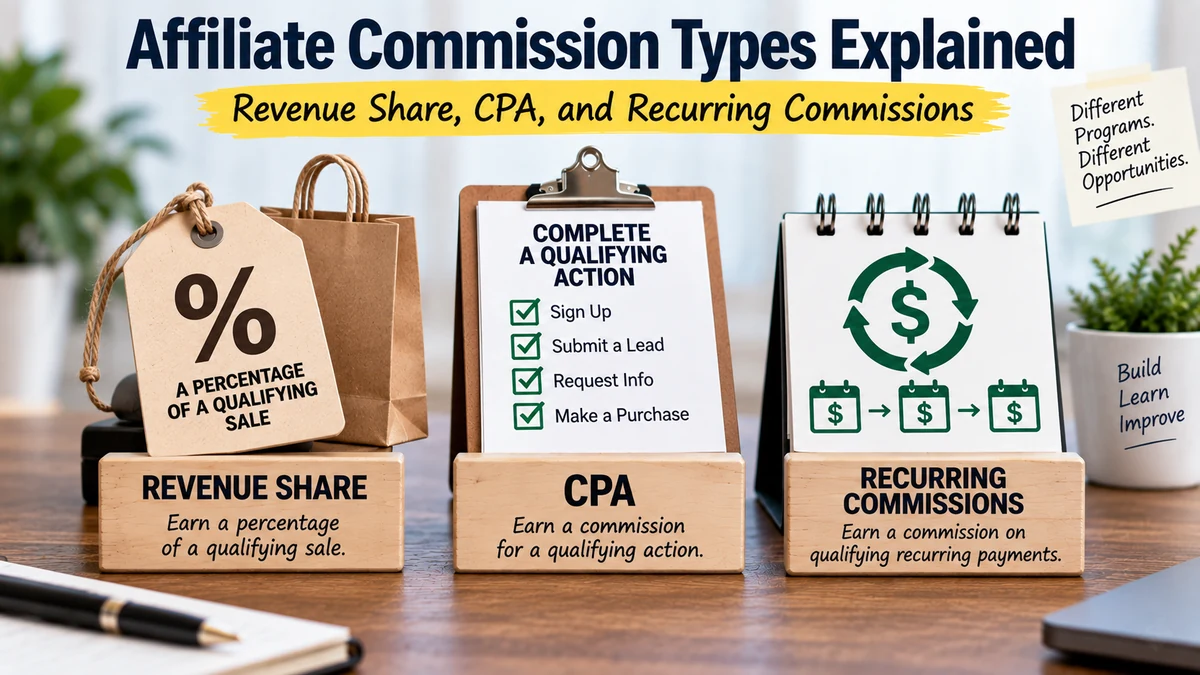
Affiliate offers can pay in different ways. Learn how revenue share, fixed CPA payouts, and recurring commissions work—and why the highest-looking payout is not always the best choice.
Affiliate offers do not all pay affiliates the same way.
Some use a percentage of the sale. Others pay a fixed amount when a qualifying purchase happens. Some products can generate additional commissions when customers continue paying for a subscription.
Understanding the main affiliate commission types makes it easier to compare offers without being distracted by one impressive-looking number.
A high percentage does not automatically mean a high payout. A large fixed commission does not automatically mean the offer is profitable to promote. And recurring commissions are only valuable when customers actually remain subscribed.
The goal is to understand how the commission model works, what event triggers payment, and how that structure fits the audience and offer you plan to promote.
An affiliate commission is the payment an affiliate earns after generating a qualifying action under the rules of an affiliate program.
In many programs, the qualifying action is a completed sale.
The exact amount can be based on:
The important thing is to understand what the program actually pays for.
Do not assume that a percentage, dollar amount, or recurring label tells you the whole story.
Revenue share, often shortened to revshare, means the affiliate receives a percentage of an eligible sale.
For example, if an offer pays a 50% revenue-share commission, the affiliate earns a percentage based on the amount the affiliate program defines as commissionable.
The actual payout may not always equal exactly half of the retail price because individual networks can calculate commissions after certain fees, taxes, refunds, or other adjustments.
Always use the specific network’s documentation when you want to understand the exact calculation.
A large percentage can catch your attention quickly.
But percentage alone does not tell you the actual commission amount.
Consider two hypothetical offers:
Even though Offer A has the larger percentage, Offer B may produce the larger dollar commission per sale.
That does not automatically make Offer B better either.
You still need to consider:
Commission percentage is only one part of the decision.
CPA stands for cost per action.
In affiliate marketing, the exact action depends on the program.
Some programs may define a CPA event as a sale, lead, signup, or another qualifying action.
On ClickBank specifically, CPA commission is a fixed amount paid when the qualifying initial sale occurs.
That means the affiliate knows the fixed payout associated with that qualifying sale rather than receiving a percentage of the transaction.
You can review ClickBank’s explanation in its official CPA commission documentation.
The difference can be simplified like this:
Neither model is automatically superior.
The better fit depends on the offer, payout, customer behavior, refund structure, funnel, traffic cost, and your own campaign economics.
A fixed payout can make campaign math easier to understand.
If the affiliate receives the same qualifying payout each time, it becomes easier to estimate how much a conversion is worth.
That can be useful when evaluating paid traffic.
For example, if a qualifying sale pays a fixed commission, you can compare your average cost to generate that sale with the commission amount.
But you still should not assume a higher CPA automatically produces a better campaign.
A large payout is not useful if the offer rarely converts with the traffic you can realistically reach.
Recurring commissions can occur when a customer continues paying for a subscription or membership and the affiliate program pays additional commission on qualifying rebills.
For example, a product might include:
ClickBank allows sellers of recurring products to set commission rates for the initial sale and the recurring portion separately.
Its official recurring-product documentation explains how those commissions can be structured.

This distinction matters.
A recurring commission does not automatically mean you will be paid forever.
The commission may stop when:
Some programs may also use different rules for renewals, upgrades, upsells, or additional products.
Always look at the actual program terms.
Some subscription products do not pay the same percentage on every payment.
The initial purchase may use one commission rate while later rebills use another.
This means you should not assume that the percentage shown for the first sale automatically applies to all future payments.
When reviewing a recurring offer, try to identify:
Some affiliate funnels include additional products after the initial sale.
These are often called upsells.
Whether an affiliate receives commission on those additional purchases depends on the program’s rules.
Some affiliate structures may pay on upsells.
Others may not.
ClickBank, for example, allows different commission rules within certain upsell structures and commission hierarchies.
You can review the network’s affiliate commission hierarchy if you want to understand how different ClickBank commission settings can take priority.
This is especially important when comparing CPA with revenue share.
Under ClickBank’s CPA structure, the affiliate receives the agreed fixed commission on the qualifying initial sale.
ClickBank states that CPA affiliates do not receive additional commission for upsells or recurring rebills tied to that sale.
That creates an important tradeoff.
A fixed CPA might provide a larger or more predictable initial payout, while a revenue-share structure may give the affiliate access to additional eligible funnel revenue depending on the offer.
That is why comparing only the front-end number can be misleading.
The commission rate tells you the percentage.
The commission value tells you what that percentage actually produces in dollars.
For example:
50% commission on a $50 eligible sale is very different from 50% commission on a $200 eligible sale.
Even then, the higher payout should not be viewed in isolation.
If the more expensive offer has weak audience fit or a poor sales process, the theoretical commission may not matter much.
Some affiliate marketplaces provide average commission or similar historical metrics.
Those figures can sometimes help you understand what affiliates have actually earned per qualifying sale across an offer’s funnel.
But averages require context.
They may reflect:
Our guide to affiliate network metrics explains why marketplace statistics should be interpreted together rather than treating one number as a verdict.
Affiliate commissions do not always remain final after the initial sale.
Depending on the network and commission model, refunds or chargebacks may reduce or reverse commission.
This matters when comparing offers.
A high commission can look attractive, but heavy refund activity can change the real economics.
Do not assume every posted commission becomes permanent earnings immediately.
Different commission models can also use different refund rules.
For example, ClickBank states that its CPA commission is not returned from the affiliate when the underlying sale is later refunded or charged back.
That is a ClickBank-specific rule and should not be assumed to apply to other affiliate programs.
Always verify the program’s own terms.
The way customers buy can affect which commission model is attractive.
Consider two different products.
One is a simple one-time purchase.
The other is a subscription where satisfied customers may remain for months.
A recurring commission structure may be more meaningful for the second product because the customer’s value can continue beyond the initial purchase.
But that only matters if:
A strong commission structure does not fix a weak customer experience.
Before sending traffic, evaluate the page the visitor will actually see.
Look at:
Our guide to evaluating an affiliate sales page before sending traffic explains how to inspect that part of the funnel.
A valuable commission is only useful if the network attributes the sale correctly.
Before promoting an offer, understand what you can about:
Our guide to affiliate cookie duration and attribution explains how those pieces fit together.
A commission number becomes meaningful only when you compare it with what it costs to generate the result.
Suppose a campaign generates:
If each sale earns a $60 commission, the campaign produced $180 in gross affiliate commission against $150 in advertising spend.
That simple example does not account for every business cost, but it shows why payout amount must be connected to acquisition cost.
A $100 commission can still produce an unprofitable campaign if it costs significantly more than $100 on average to generate one sale.
Recurring offers can make early campaign numbers harder to interpret.
The initial commission may represent only part of the eventual customer value.
Later rebills could increase total commission.
But you should not assume those future payments will happen.
Use actual rebill data when it becomes available rather than projecting an ideal subscription lifetime without evidence.
Imagine one offer pays:
$80 CPA per qualifying sale.
Another pays:
50% revenue share plus eligible recurring commissions.
You cannot determine which is better from those descriptions alone.
You would need more information about:
Commission models are inputs into a campaign decision, not conclusions by themselves.
Revenue share can be attractive when:
It can also be easier for beginners to understand because the payout moves with the sale amount.
CPA can be attractive when:
Remember that network-specific CPA rules can differ.
Always verify what qualifies as the action and what additional funnel revenue, if any, is included.
Recurring commission can be attractive when:
The recurring label itself should never be the reason you promote something that does not fit your audience.
Before you promote an offer, find out what event creates your commission.
Possible examples include:
The specific event matters because it determines what you are actually being paid to generate.
Do not assume every product from one seller uses the same commission structure.
Some affiliate programs can set different rates for:
On ClickBank, sellers can use product-level commission settings and other commission rules that can override broader defaults.
This is another reason to verify the specific offer rather than relying only on a general seller listing.
Before choosing an offer, compare:

The highest-looking commission is not automatically the best affiliate opportunity.
A more complete evaluation considers:
A smaller commission from a strong audience-offer match may be more useful than a larger theoretical payout from an offer your visitors do not want.
You cannot know the value of a commission structure from the offer listing alone.
Eventually, the campaign has to be tested with real traffic.
Measure the relationship between:
Traffic Cost → Clicks → Qualified Visitors → Sales → Commission
Then make deliberate changes rather than reacting to one day of data.
Our guide to testing an affiliate campaign without changing everything at once explains how to preserve a useful baseline while evaluating performance.
Affiliate commission types can look complicated at first, but the basic differences are straightforward.
Revenue share pays a percentage of eligible sales.
CPA pays a fixed amount for a defined qualifying action.
Recurring commissions can add additional payments when customers continue paying under the program’s rules.
The harder part is deciding what those structures mean for a real campaign.
Do not stop at the headline percentage or payout.
Look at the offer, audience, sales page, attribution rules, refund treatment, recurring potential, and traffic economics together.
When those pieces are evaluated as a system, commission structure becomes a useful decision factor instead of just another attractive number in an affiliate marketplace.
Subscribe to get the latest posts sent to your email.
If you found this guide helpful, please tap the Like button and share it with someone who could benefit. Every Like and Share helps more people discover Partner to Wealth.