An affiliate bridge page sits between the traffic source and the merchant. Learn when it adds real value, when it becomes unnecessary friction, and what beginners should include.
An affiliate marketer does not always send a visitor directly from a traffic source to a merchant’s sales page.
Sometimes there is an additional page in between.
That page is often called an affiliate bridge page, although marketers may also use terms such as pre-sell page, intermediary page, advertorial, or landing page depending on how the page is built.
A bridge page can be useful when it helps the visitor understand the problem, the offer, or the next step before leaving your site.
But a bridge page can also become unnecessary friction if it adds no real information and exists only to push the visitor toward another website.
The difference is value.
A useful bridge page earns its place in the visitor journey. A thin bridge page simply adds another click.
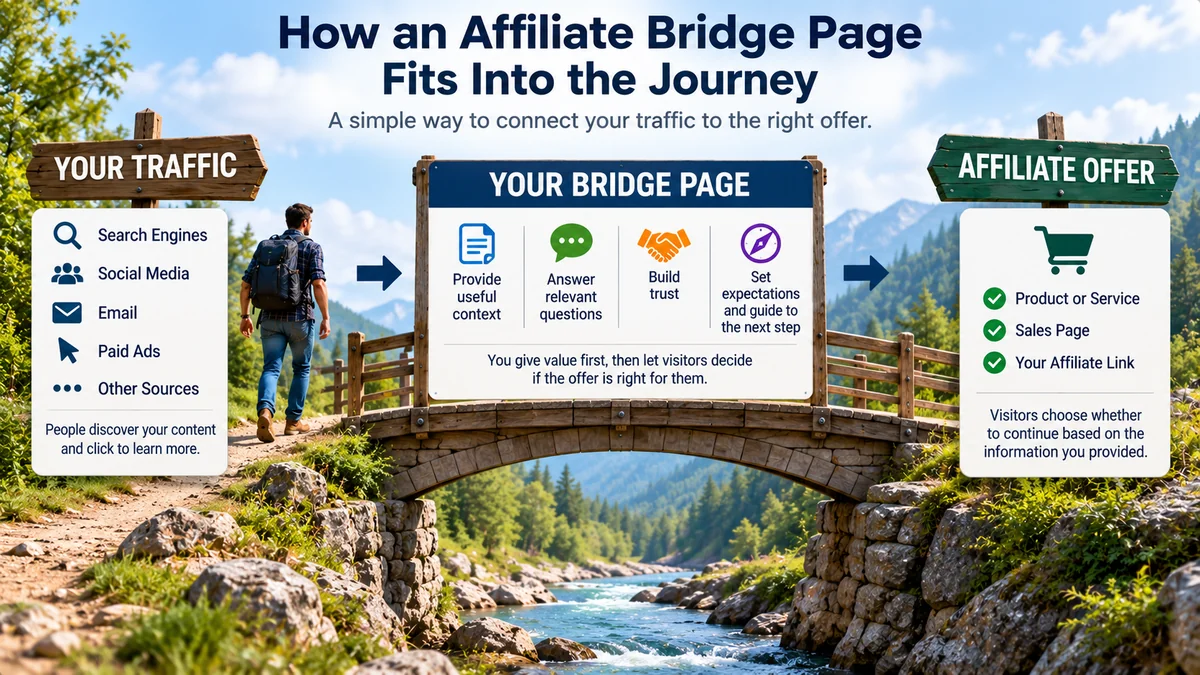
An affiliate bridge page is a page that sits between the original traffic source and the final merchant or offer destination.
A simplified journey might look like this:
Search, Ad, Email, or Social Post → Your Bridge Page → Merchant Sales Page
The bridge page gives the affiliate an opportunity to provide context before asking the visitor to leave for the merchant’s site.
Depending on the campaign, that page might:
The bridge page should not be thought of as a trick for inserting an extra step into a funnel.
Its job is to improve the visitor’s understanding.
The terminology can be confusing because a bridge page is also a type of landing page.
A landing page is simply the page someone reaches after clicking a link, advertisement, email, or other traffic source.
A bridge page is more specific: it is an intermediary landing page designed to connect that visitor to another destination.
For example:
The label matters less than what the page actually does for the visitor.
Affiliates may use bridge pages for several legitimate reasons.
One of the most important is that the affiliate can control the information before the visitor reaches the merchant.
The merchant’s sales page may be designed for a broad audience.
Your traffic may come from a much more specific context.
A bridge page can connect those two experiences.
Message match means the experience after the click makes sense compared with the message before the click.
Suppose someone searches for a beginner explanation of a specific problem.
If the visitor clicks an advertisement and lands immediately on an aggressive sales page, the transition may feel abrupt.
A useful bridge page could first explain:
The merchant page then becomes the next logical step rather than a surprise.
Not every visitor should click through to every offer.
A good bridge page can help someone decide that an offer is not appropriate before they leave your site.
That may sound counterproductive, but it can improve the quality of the traffic you send.
For example, the page can explain:
This creates a more informed click.
Our guide to affiliate traffic quality explains why the right visitors can matter more than raw click volume.
Affiliate marketers often know their audience better than the merchant does.
A merchant may sell to beginners, advanced users, businesses, hobbyists, and several different market segments.
Your site may serve only one of those groups.
A bridge page can translate the offer into the context your particular audience understands.
For example, you might explain:
That is useful original content.
The opposite can also happen.
A bridge page may contain little more than:
If the visitor learns almost nothing before being sent elsewhere, the page may not justify its existence.
This matters from both a user-experience and advertising-policy perspective.
Google Ads’ destination policies state that landing pages should be functional, useful, and easy to navigate. Google also lists destinations whose only purpose is sending users to another site—including bridge pages, doorways, and gateways—as examples of insufficient original content.
You can review Google’s insufficient original content policy for the current wording.
The lesson is not that every affiliate intermediary page is prohibited.
The lesson is that a page should provide meaningful value of its own.
A bridge page should not be used to disguise where the visitor is ultimately going.
The page should make the next step understandable.
Visitors should not have to wonder:
Clarity builds trust.
An intermediary page loses much of its purpose if the visitor cannot actually use it.
Automatically redirecting someone to another domain can also create advertising-policy and destination issues.
Google Ads requires the final URL and display URL domains to be consistent and warns about redirect chains that send users to a different domain unexpectedly.
You can review Google’s destination URL guidance for current requirements.
If you create a bridge page, let the visitor choose whether to continue.
There is no single required layout.
The best structure depends on the traffic source, audience, and offer.
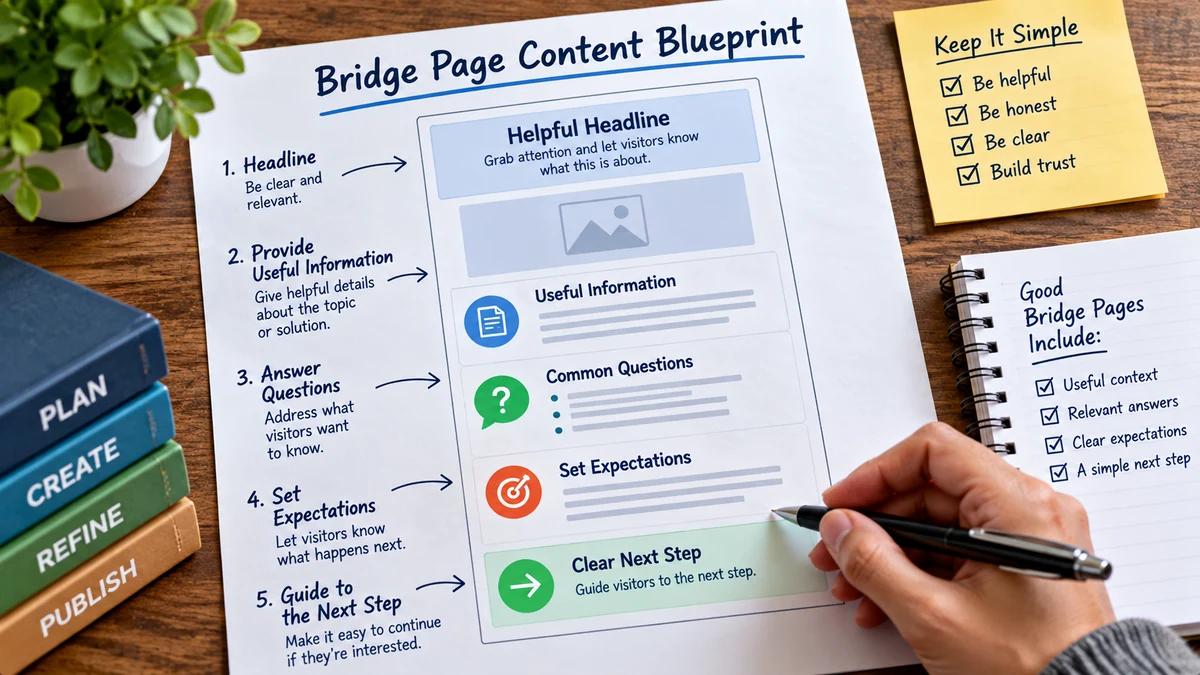
But a useful page often answers several basic questions.
The visitor should understand the subject quickly.
Do not force someone to read half the page before discovering what it is about.
Clarify the audience.
A beginner should be able to tell whether the page is written for beginners.
Explain the decision rather than only promoting the result.
Give the reader enough context to make an informed next step.
A useful page can discuss advantages, limitations, cost considerations, prerequisites, or alternatives where relevant.
The call to action should clearly explain what the visitor will find after clicking.
A common mistake is writing every paragraph with the sole goal of pushing someone toward the call to action.
That can make the page feel repetitive and promotional.
Instead, write the page as if the button did not exist yet.
Ask:
If the answer is yes, the page is more likely to have a legitimate role in the funnel.
A bridge page should not simply rewrite the merchant page paragraph by paragraph.
That creates duplication without adding perspective.
Your value comes from interpretation.
You can help by:
Our guide on how to write affiliate content that helps before it sells explains why useful content should serve the reader first.
A bridge page is still marketing content.
Do not invent results simply because the merchant uses aggressive language.
Be especially careful with claims involving:
Your page should not promise more than you can reasonably support.
If the merchant’s sales page contains questionable claims, consider whether the offer is appropriate to promote at all.
Our guide to evaluating an affiliate sales page before sending traffic explains how to review the destination before building a campaign around it.
If the bridge page contains affiliate links or compensated recommendations, the visitor may need to know about that financial relationship.
The Federal Trade Commission says affiliate relationships should be disclosed clearly and conspicuously so readers can understand that the publisher may earn a commission.
The FTC also says disclosures should be placed close enough to the recommendation or link that readers are likely to notice them.
You can review the FTC’s Endorsement Guides FAQ for current guidance.
Our educational guide to affiliate disclosures explains the issue in more detail.
A vague button such as:
Click Here
does not tell the reader much.
A more descriptive action might explain what happens next.
For example:
The wording should accurately describe the destination.
Do not imply that clicking guarantees a result.
A bridge page should provide value, but that does not mean it needs to become an enormous website inside one page.
Remove material that does not help the visitor understand the decision.
A focused page may include:
Longer is not automatically better.
More useful is better.
If you plan to send paid advertising traffic to an affiliate bridge page, the page has two jobs.
It must help the visitor, and it must comply with the advertising platform’s policies.
For Google Ads, the destination should provide useful original content and a functional experience rather than acting only as a gateway to another site.
Google also advises advertisers to make sure the landing page matches the message and keyword themes that created the click.
You can review Google’s landing-page guidance for additional context.
Do not assume that a page will be approved merely because another affiliate appears to be using something similar.
Advertising platforms evaluate the actual destination and campaign.
A page built for organic search should usually have an even stronger reason to exist independently.
If someone finds the page through search, the page itself should satisfy the searcher’s intent.
Do not create a search-targeted article whose only real purpose is sending people to a merchant.
The visitor should receive a complete, useful answer before deciding whether an external offer is relevant.
This connects directly with the content strategy we have discussed throughout Partner to Wealth.
Your site becomes stronger when pages have their own purpose rather than functioning as disposable traffic funnels.
A bridge page does not necessarily need to look like a traditional landing page.
A useful article can serve as a bridge naturally.
For example, an article might:
The article still stands on its own.
The affiliate link becomes one optional next step rather than the entire purpose of the page.
A comparison page may help readers understand meaningful differences between several options.
For that page to be useful, the comparison should be fair and based on real differences.
Do not manufacture weaknesses for one option simply to make the affiliate offer look better.
A comparison should help the reader decide.
A review is another common intermediary page.
A strong review should go beyond repeating the merchant’s marketing copy.
Useful review content may cover:
If you have not personally used the product, do not imply that you have.
A bridge page should fit the visitor’s level of awareness.
Someone who is just learning about a problem probably needs more explanation.
Someone already comparing specific products may need more detail about features, differences, and costs.
Someone who already knows the offer may need very little intermediary content.
This is why the same bridge-page structure should not be copied across every campaign.
An extra page is not automatically an improvement.
Sometimes the best visitor journey is direct.
For example, if someone intentionally clicks a clearly labeled link to visit an official product page, inserting an unnecessary intermediary page may only create friction.
Before adding a bridge page, ask:
If you cannot explain the page’s purpose, you may not need it.
If you use a bridge page, track enough of the journey to understand what is happening.
Useful measurements may include:
That can help separate problems.
For example:
This kind of diagnosis is more useful than assuming the entire funnel is broken.
A very high outbound click-through rate can look impressive.
But if the page achieves that rate by pushing almost everyone toward the merchant without helping them understand the offer, the number may not indicate a strong visitor experience.
Likewise, a lower click-through rate is not automatically bad if the page is filtering out visitors who are not a good fit.
Look at what happens after the click.
A simple comparison can help.
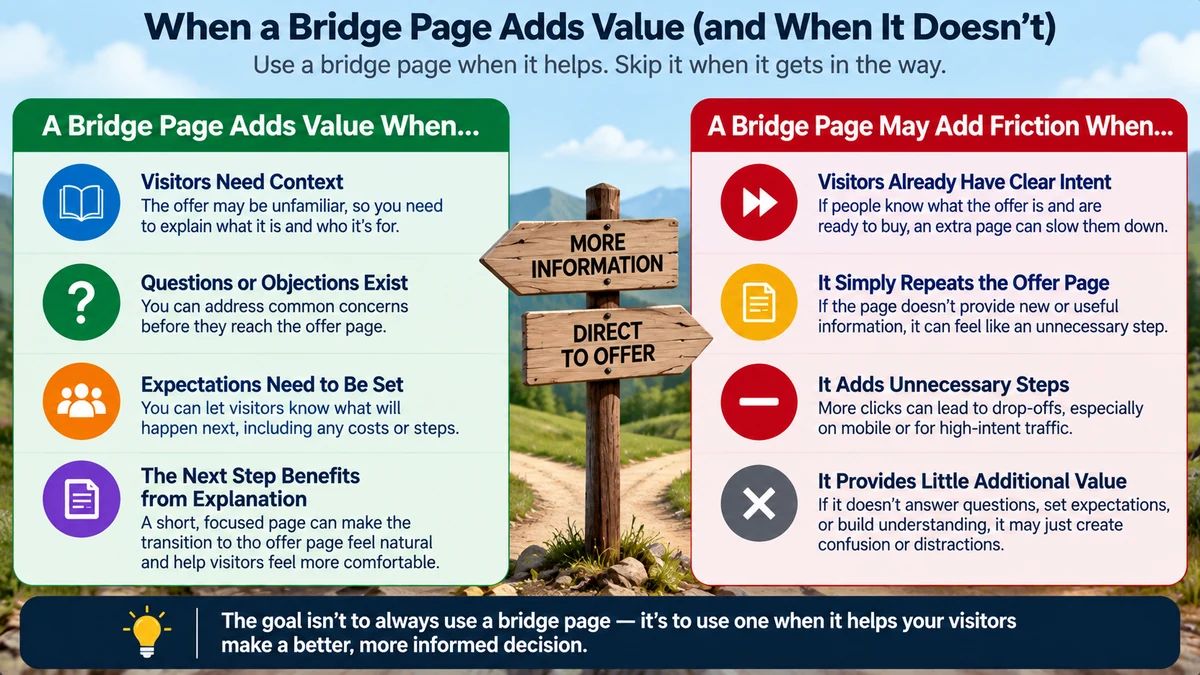
Before using an affiliate bridge page, ask:
An affiliate bridge page can be a useful part of a funnel when it genuinely improves the visitor’s understanding.
It can explain the problem, qualify the audience, set expectations, answer questions, and prepare the visitor for the merchant’s page.
But an intermediary page should not exist simply because someone told you every affiliate funnel needs one.
If the page contains little original value and exists only to send people somewhere else, it adds friction rather than usefulness.
Build the page around the reader’s decision.
Give it a clear purpose.
Make the next step transparent.
Then measure whether the page is actually improving the journey rather than assuming another funnel step must be better.
Subscribe to get the latest posts sent to your email.
If you found this guide helpful, please tap the Like button and share it with someone who could benefit. Every Like and Share helps more people discover Partner to Wealth.