
More traffic is not always better traffic. Learn how to evaluate affiliate visitors by relevance, intent, engagement, source, and the actions they take after arriving.
Affiliate marketers often focus on getting more traffic, but raw visitor numbers do not tell you whether the right people are arriving.
That is why affiliate traffic quality matters.
A campaign can generate many clicks and still perform poorly if those visitors have weak interest, low intent, poor message match, or little reason to continue toward the offer.
On the other hand, a smaller group of highly relevant visitors may be much more useful because they understand the topic, match the audience, and are more likely to take the next meaningful action.
The goal is not to label traffic as simply “good” or “bad.” It is to understand whether a source is bringing the kind of visitors your content and offer are designed to serve.
Traffic quality describes how well visitors match the purpose of your page, content, and offer.
High-quality traffic generally means the visitors are:
That does not mean every quality visitor will become a customer.
It means the traffic has a reasonable fit with what the page is trying to accomplish.
It is easy to look at a large increase in visitors and assume something is working.
But traffic volume by itself does not explain:
Ten thousand visitors who have little connection to the content may be less useful than a few hundred visitors who arrived specifically because the page answered a problem they were trying to solve.
The important question is not simply:
How much traffic did I get?
It is:
What kind of visitors arrived, and what did they do next?
You cannot evaluate traffic quality properly until you know what the page is supposed to accomplish.
Different pages have different jobs.
An educational article may be designed to:
A review or comparison page may have a more commercial purpose.
A bridge page may be intended to move a qualified visitor toward an external offer.
The definition of useful behavior changes with the purpose of the page.
For example, a visitor who reads a beginner guide and then opens a related educational article may be behaving exactly as intended, even if they do not click an affiliate link during that session.
Relevance is one of the strongest foundations of traffic quality.
Ask whether the visitor had a reasonable reason to land on the page.
If someone searches for a beginner affiliate-marketing question and reaches a beginner affiliate-marketing guide, the topic match is strong.
If someone arrives because of an unrelated keyword, misleading ad, vague social post, or accidental click, the match is weaker.
Relevance depends on the connection between:
This is why good keyword research matters for search traffic. The goal is not to attract every possible searcher. It is to attract people whose question actually matches the page.
Our guide to keyword research for affiliate marketing explains how to connect search phrases with the intent behind them.
Two visitors can arrive on similar pages with very different intentions.
One may be researching a topic for the first time.
Another may already understand the problem and be comparing solutions.
Another may simply be looking for a specific website or login page.
That difference matters because the same call to action will not fit every stage equally well.
High-quality traffic is not always high-buying-intent traffic.
A beginner who is genuinely interested in learning can still be a valuable visitor for an educational site.
The important thing is that the visitor’s intent matches the purpose of the page.
Traffic quality can be affected before someone ever reaches your site.
The ad, search result, email subject, social post, or other message that produces the click creates an expectation.
If the pre-click message is accurate, the visitor has a better chance of arriving with the right expectations.
If the message exaggerates, hides important context, or attracts people for reasons unrelated to the actual page, traffic quality can suffer.
Ask:
This is the same basic principle of message match that applies when evaluating an offer or sales page.
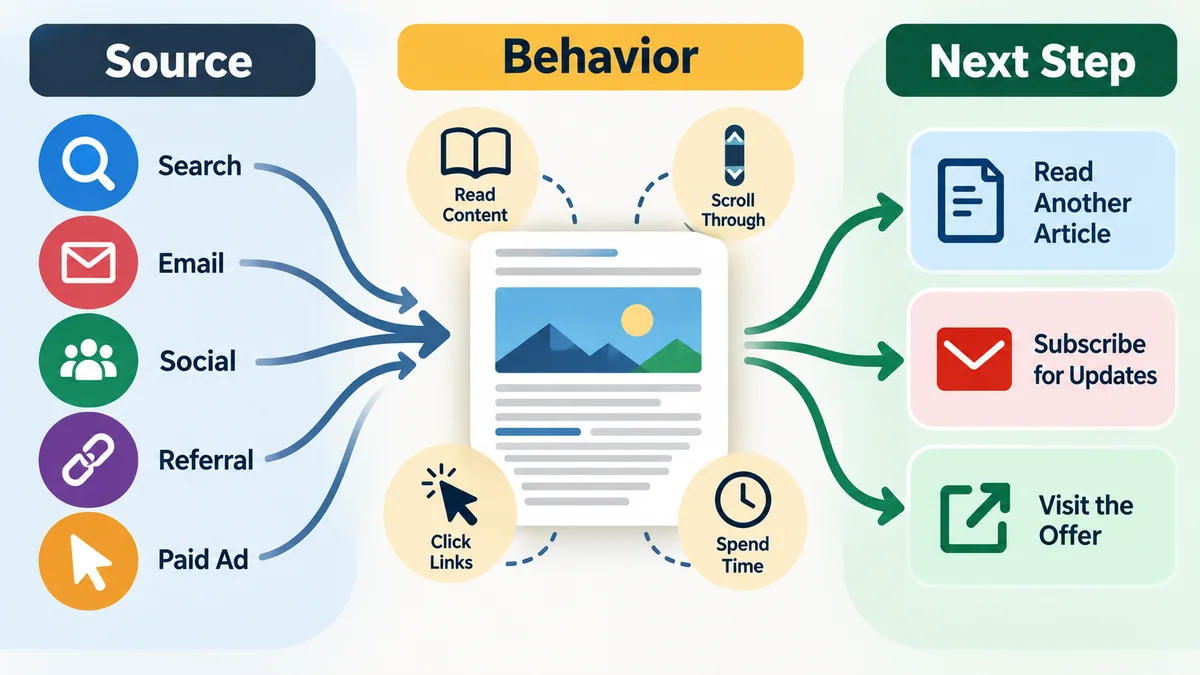
Visitors from different sources may behave differently even when they land on the same page.
For example, traffic might come from:
Each source can carry different levels of intent, context, and familiarity.
A visitor coming from a detailed search query may already have a specific question.
An email subscriber may already know your site.
A social visitor may be encountering the subject for the first time.
That does not make one source automatically better than another.
It means you should evaluate each source according to the role it is supposed to play.
If you are still comparing acquisition approaches, our guide to free vs paid traffic for affiliate marketing explains why the two models should not be judged only by cost or visitor count.
If all visitors are analyzed together, important differences can disappear inside the average.
Google Analytics can separate traffic using dimensions such as source, medium, campaign, and channel.
Its Traffic acquisition report is designed to show where sessions come from and how those visitors behave after arriving.
This lets you compare traffic instead of treating the whole site as one audience.
For example, you may discover that:
Those differences can help you decide what deserves more investigation.
No single metric can tell you whether traffic is valuable.
A high engagement rate does not automatically mean the visitor is commercially valuable.
A short visit does not automatically mean the traffic was poor.
A strong click-through rate does not automatically mean the visitor will like the destination.
Metrics should be interpreted together.
Useful signals may include:
The value of each metric depends on the page and campaign goal.
Google Analytics defines an engaged session as one that meets at least one of several conditions: it lasts longer than 10 seconds, includes a key event, or includes two or more page or screen views.
You can review Google’s explanation of engagement rate and bounce rate for the current definitions.
That can help distinguish sessions where visitors interacted from sessions where almost nothing happened.
But engagement is still a signal, not a final verdict.
A person can spend a long time on a page because the content is excellent.
They can also spend a long time because the page is confusing.
That is why analytics should be combined with the actual visitor journey.
One of the best ways to understand traffic quality is to examine whether visitors take actions that make sense for the page.
Possible actions include:
The action should relate to the visitor journey.
Do not mark everything as important just because your analytics platform lets you track it.
A meaningful event should represent something you actually care about understanding.
This distinction is extremely important.
Suppose visitors:
but very few continue further after reaching the merchant page.
That does not automatically mean the traffic was poor.
The issue could be:
Traffic quality and offer performance overlap, but they are not the same thing.
This is why affiliate marketers should inspect the full journey rather than blaming the first metric that looks weak.
Be careful when comparing sources that play different roles.
An educational organic-search campaign and a high-intent paid-search campaign may have very different expected behavior.
It may not be useful to compare them using one universal benchmark.
Instead, compare:
The closer the comparison, the more useful the conclusion is likely to be.
It is easy to overreact when a campaign has only a handful of visits or clicks.
A small number of visitors can produce dramatic-looking percentages.
For example, one action among five visitors can look very different from the same action rate across several hundred visitors.
That does not mean you should ignore early data.
It means you should treat it as early evidence rather than a final conclusion.
Avoid rebuilding a campaign after every small fluctuation.
Traffic quality becomes easier to evaluate when patterns appear across multiple signals.
For example:
Pattern 1:
This may indicate poor targeting, weak message match, accidental clicks, or low-interest traffic.
Pattern 2:
This may indicate that the audience and content are reasonably aligned.
Pattern 3:
This may suggest investigating the offer or destination rather than assuming the traffic itself is the problem.
If one source repeatedly brings poorly matched visitors, ask why.
The problem may involve:
The solution is not automatically to stop the source.
First identify the mismatch.
Sometimes the traffic is relevant, but the page itself does not serve the visitor well.
Signs may include:
Possible improvements may involve:
This is another reason content quality and traffic quality should not be treated as separate worlds.
A click tells you that someone arrived.
The more useful question is what happened afterward.
A simple visitor journey might look like:
Traffic Source → Landing Page → Content Interaction → Next Step → Offer Click → Downstream Action
You do not need perfect tracking for every possible action before you begin.
But the more clearly you can distinguish the important stages, the easier it becomes to diagnose where a campaign may be losing momentum.
A vanity metric is a number that looks impressive without necessarily telling you whether the campaign is accomplishing anything useful.
Examples can include:
Those numbers are not useless.
They simply need context.
The problem begins when a large number becomes the goal instead of a signal.
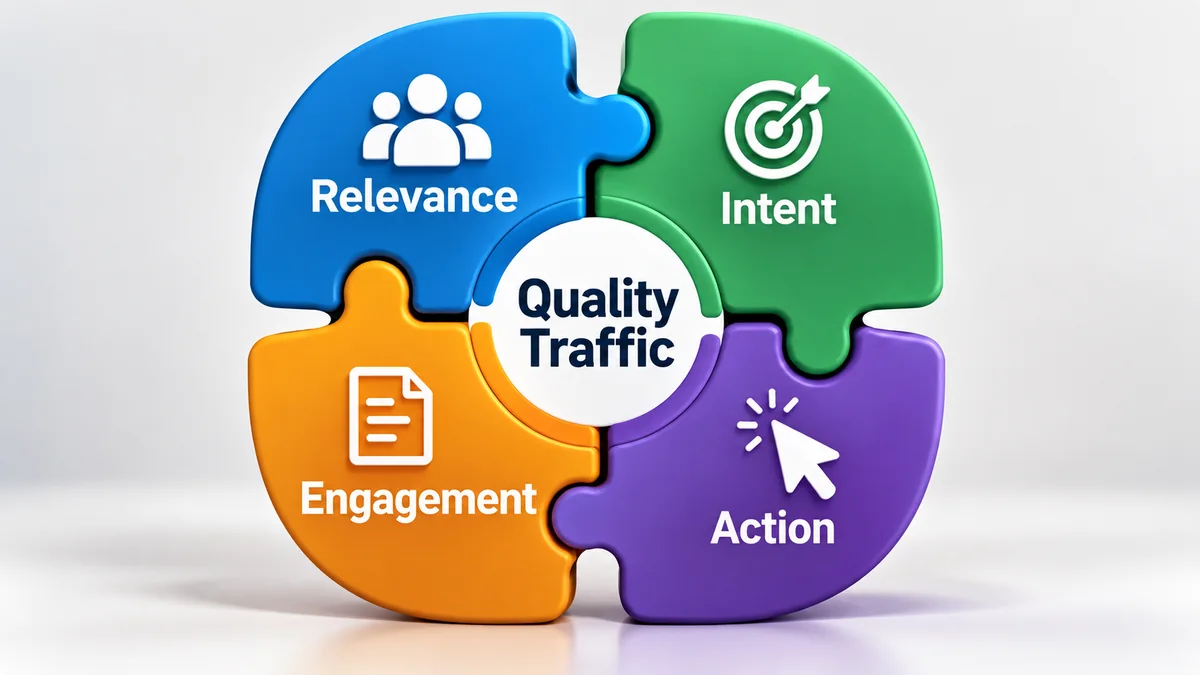
You can evaluate a traffic source using four broad areas.
Does the source bring people who actually match the topic and audience?
Why did they click, and does that intention fit the purpose of the page?
Do visitors interact with the content in a way that suggests they are genuinely using it?
Do relevant visitors take sensible next steps?
Those four areas give you a much more useful picture than visitor count alone.
If you identify a traffic-quality problem, avoid changing targeting, ad copy, landing-page content, offer, and tracking all at the same time.
When too many variables change together, it becomes much harder to understand what actually improved or worsened the result.
Instead, identify the most likely problem and make a deliberate adjustment.
Our guide on how to test an affiliate campaign without changing everything at once explains how controlled changes can make campaign results easier to interpret.
When reviewing a traffic source, ask:
Affiliate traffic quality is not about finding one perfect metric.
It is about understanding the relationship between the visitor, the source, the message, the content, and the next action.
Start with relevance. Consider intent. Look at engagement. Then examine what visitors actually do.
Use traffic-source data to separate audiences instead of relying on site-wide averages, and avoid assuming that every weak result is caused by the traffic itself.
Sometimes the source is the problem. Sometimes the content is the problem. Sometimes the offer is the problem.
The more clearly you can see the journey, the easier it becomes to decide what deserves improvement.
That is a much stronger foundation for affiliate marketing than simply chasing more clicks and hoping the numbers work themselves out.
Subscribe to get the latest posts sent to your email.
If you found this guide helpful, please tap the Like button and share it with someone who could benefit. Every Like and Share helps more people discover Partner to Wealth.