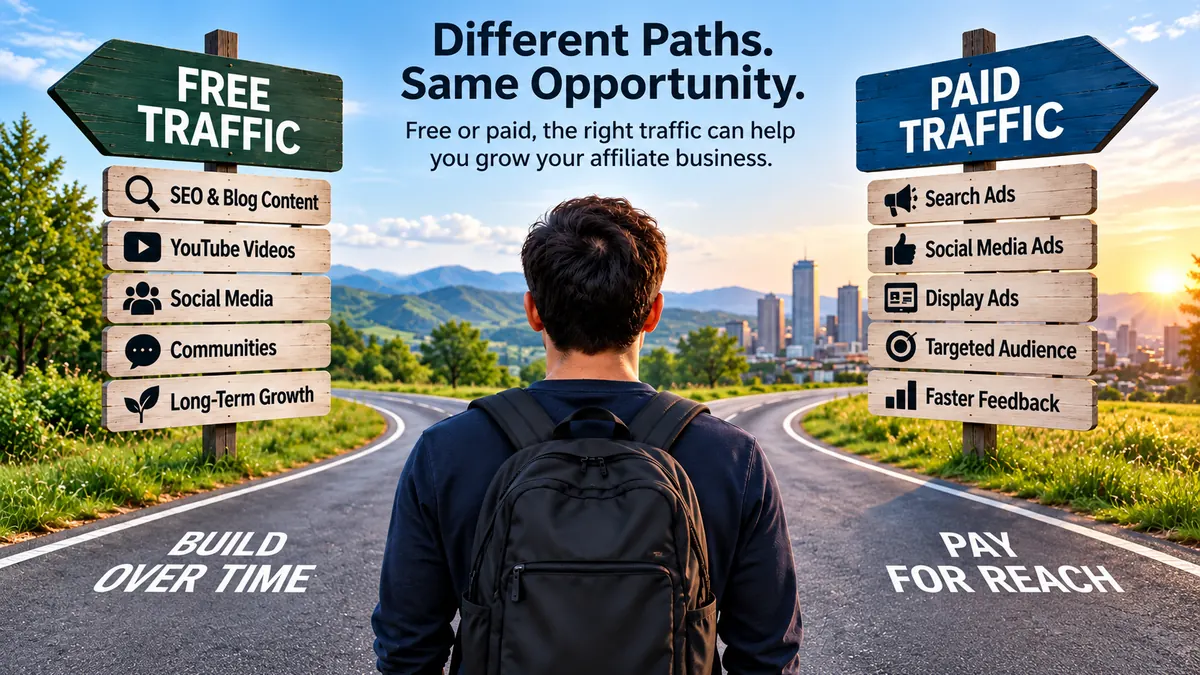
Free and paid traffic can both support an affiliate business, but they require different amounts of time, money, control, and testing. Learn the key differences and how beginners can choose a practical starting point.
If you are new to affiliate marketing, one of the first traffic decisions you will face is whether to focus on free traffic, paid traffic, or a combination of both.
At first, the difference may seem simple. Free traffic does not require you to pay for each visitor, while paid traffic usually involves spending money to place advertisements in front of a targeted audience.
But the real comparison goes much deeper than cost.
Free vs paid traffic for affiliate marketing involves tradeoffs in speed, control, learning curve, risk, scalability, and the amount of ongoing work required.
Understanding those differences can help you choose a traffic method that fits your current skills, budget, and stage of business instead of jumping from one strategy to another.
Free traffic generally refers to visitors you attract without paying directly for every click, impression, or visitor.
Common examples include:
The word free can be slightly misleading, however.
You may not be buying clicks, but you are still investing something valuable: your time.
Creating useful articles, optimizing pages, publishing videos, participating in communities, and building an audience all require consistent effort.
For example, search engine optimization can help people discover your website through search results, but organic visibility usually develops over time rather than appearing immediately. Google’s SEO Starter Guide explains the fundamentals of helping search engines understand your content while creating pages that are useful to readers.
Paid traffic means using advertising platforms or other paid placements to send visitors to your content, landing pages, or funnels.
Examples can include:
With paid traffic, you are exchanging money for access to an audience.
The main advantage is control. Depending on the platform, you can often choose targeting, keywords, locations, budgets, advertisements, and landing pages.
For example, Google explains that its Search campaigns can place ads in front of people actively searching for relevant products or services.
Paid traffic can therefore help you begin collecting campaign data without waiting for organic content to gain visibility.
However, that speed comes with financial risk. Every test has a cost, and traffic alone does not guarantee leads, sales, or commissions.
There is no single traffic method that is automatically right for every affiliate marketer.
Instead, think about the practical differences between the two approaches.
Free traffic: Usually requires little or no direct advertising spend, but it can require substantial time to create content and build an audience.
Paid traffic: Requires an advertising budget from the beginning. You may spend money before discovering whether your targeting, offer, page, and message work well together.
Free traffic: Organic traffic can take time to develop. A new article or website may not immediately receive meaningful search traffic.
Paid traffic: Advertising can begin generating impressions and clicks once a campaign is active and eligible to serve.
Free traffic: You have less control over exactly when someone discovers your content. Search engines, social algorithms, audience behavior, and competition can all influence visibility.
Paid traffic: Advertising platforms generally provide more direct controls over targeting, budget, campaign settings, and where visitors are sent.
Free traffic: The biggest risk is often time. You can spend weeks creating content that attracts little traffic.
Paid traffic: The risk is both time and money. Poor targeting, weak ads, or an ineffective landing page can consume a budget without producing profitable results.
Free traffic: It may take longer to collect enough visitors to understand how well a page converts.
Paid traffic: Because you can deliberately send visitors to a page, paid campaigns may generate useful testing data more quickly.
That data is only valuable if you actually measure what happens after the click. Our guide on tracking affiliate marketing without overcomplicating it explains a simple way to focus on the numbers that matter.

The biggest advantage of free traffic is that useful content can continue working after you create it.
A helpful article may be discovered through search. A useful video can continue receiving views. A social post can introduce new people to your website or email list.
This makes content an asset rather than simply a temporary advertising placement.
Free traffic also encourages beginners to learn an important affiliate marketing skill: understanding what people actually need help with.
When you regularly create content around real questions, problems, and purchase decisions, you begin learning how different types of visitors think.
That connects directly with matching affiliate content to buyer intent. Not everyone arriving at your website is ready to buy. Some people are researching, comparing options, or trying to understand a problem first.
Helpful content allows you to serve those different stages.
The main drawback is that organic growth can be slow and unpredictable.
You can create good content without receiving immediate traffic.
Search rankings can change. Social reach can fluctuate. New websites often need time to build a meaningful library of useful content.
This is why constantly changing strategies can become a problem.
If you publish three articles, switch to social media for a week, then abandon that for video before any method has had time to develop, you may never gather enough information to judge any of them fairly.
Beginners can often benefit from choosing one primary traffic source long enough to understand how it works.
Paid traffic gives you the ability to deliberately place an offer or piece of content in front of a selected audience.
That can make testing faster.
Instead of waiting to see whether people eventually discover your page, you can run a controlled campaign and begin observing:
Advertising platforms also allow you to set budgets. Google Ads, for example, allows advertisers to establish campaign budgets and bidding settings rather than simply spending without limits. Its official bid and budget documentation explains how those controls work.
Paid traffic can expose weaknesses very quickly—and those lessons cost money.
If your page is confusing, the offer is poorly matched to the visitor, your tracking is incomplete, or your message does not connect with the audience, buying more clicks will not automatically fix the problem.
It may simply send more people into an ineffective process.
That is why beginners should avoid thinking of advertising as a shortcut around the fundamentals.
Before spending heavily, you should understand where the visitor is going and what you want that visitor to do next.
A simple affiliate marketing funnel can help organize that journey instead of sending every visitor directly toward an offer with no supporting context.
No particular advertising budget is appropriate for every beginner.
Campaign costs depend on factors such as the platform, market, targeting, competition, geographic area, and advertising model.
The more useful question is:
How much can you afford to spend on learning without putting yourself under financial pressure?
A beginner testing paid traffic should treat early spending as a controlled experiment, not as guaranteed profit.
Before increasing a budget, you should be able to explain what you are measuring and what result would justify continuing.
If you cannot yet identify the important numbers in your campaign, adding more money usually makes the situation harder to understand rather than easier.
Free traffic can be a sensible starting point for someone who has more time than advertising capital.
It gives you an opportunity to practice:
The downside is that feedback can arrive slowly.
If very few people see a page, it can be difficult to know whether the page itself is weak or whether it simply has not received enough traffic yet.
Paid traffic may be appropriate when a beginner has a controlled testing budget, understands the basic advertising platform, and has working tracking in place.
It becomes much more dangerous when someone starts advertising without knowing:
Paid traffic is not automatically an advanced strategy, but it does require discipline.
You need to be willing to look at the numbers, make measured changes, and avoid reacting emotionally to every click or day of results.

The decision does not always have to be free or paid forever.
A mature affiliate business may use both.
For example, you might create useful articles that attract organic visitors while using carefully controlled paid campaigns to test selected landing pages or offers.
You might also use content to educate visitors before inviting them onto an email list, allowing you to continue the relationship after the first visit.
That is one reason building an email list from day one can be useful. Traffic sources can change, but an email list gives you a direct way to communicate with people who have chosen to hear from you.
One of the easiest ways to create confusion is to change your traffic source, landing page, offer, headline, targeting, and funnel at the same time.
If the results improve, you will not know which change helped.
If the results get worse, you will not know what caused the decline.
A simpler approach is to establish a basic system, measure it, and make deliberate changes.
This matters whether your traffic is free or paid.
Traffic should be treated as part of a larger process rather than an isolated trick. Your content, audience, offer, page, tracking, follow-up, and traffic source all need to work together.
If you are still unsure which direction to take, ask yourself four questions.
Those questions are more useful than asking which traffic source is universally “best.”
The biggest mistake is not choosing free traffic when you should have chosen paid traffic—or the other way around.
The bigger mistake is scaling something you do not understand.
With free traffic, scaling might mean producing large amounts of content without knowing what your audience finds useful.
With paid traffic, scaling might mean increasing advertising spend before you know whether the campaign economics make sense.
Start small enough that you can observe what is happening.
Track the important numbers. Learn how visitors behave. Improve the weakest part of the process. Then decide whether increasing traffic makes sense.
Free vs paid traffic for affiliate marketing is not really a choice between a good method and a bad method.
They are different tools.
Free traffic can help you build long-term content assets and develop audience understanding without paying for every visitor, but it often requires patience and consistent work.
Paid traffic can provide faster feedback and greater campaign control, but every test has a financial cost and poor decisions can become expensive quickly.
Beginners do not need to master every traffic source at once.
Choose a method you can manage responsibly, connect it to a clear funnel, track what happens, and give yourself enough time to learn from real results.
Once you understand one traffic source well, you will be in a much stronger position to decide when another one belongs in your affiliate marketing system.
Subscribe to get the latest posts sent to your email.
If you found this guide helpful, please tap the Like button and share it with someone who could benefit. Every Like and Share helps more people discover Partner to Wealth.