
Affiliate tracking involves more than a click. Learn how cookie duration, attribution rules, browser behavior, and tracking methods can affect whether an affiliate receives credit.
Affiliate tracking can sound simple: someone clicks your link, buys later, and you receive credit.
In reality, the process can involve several different tracking rules and technologies.
One of the most important terms to understand is affiliate cookie duration.
The cookie duration describes how long a referral may remain eligible for attribution after a visitor clicks an affiliate link, subject to the rules of the specific program or network.
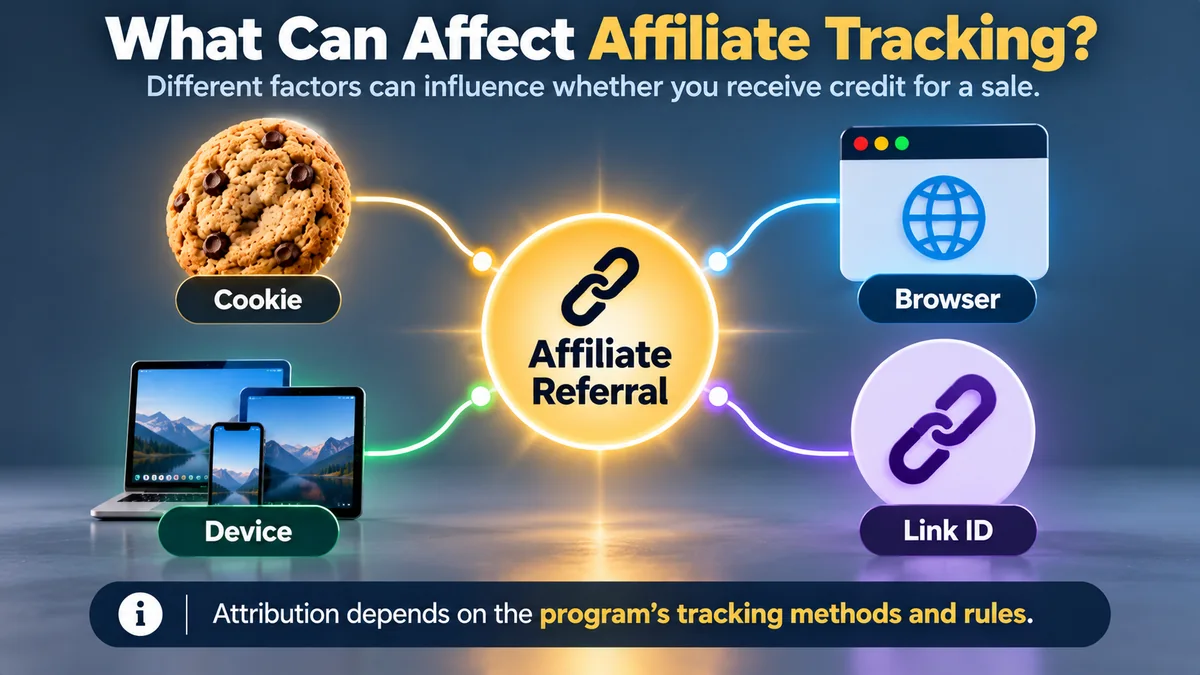
But cookies are only one part of modern affiliate attribution.
Programs can also use link identifiers, account information, email-based attribution, device signals, or other methods to determine which affiliate should receive credit.
Understanding the basics can help you evaluate programs more intelligently and avoid assuming that every click will be tracked forever.
Affiliate cookie duration is the length of time an affiliate tracking cookie remains eligible to help connect a referral with a later purchase.
Imagine someone clicks your affiliate link today but does not buy immediately.
If the program has a qualifying attribution window and the visitor returns later within that period, the original referral may still receive credit depending on the program’s attribution rules.
The important word is may.
A cookie duration does not guarantee that you will receive credit simply because the customer eventually purchases.
Other factors can affect attribution, including:
That is why cookie duration should be understood as one part of the attribution system rather than the entire system.
Many people do not purchase immediately after seeing an offer.
A visitor may:
A tracking window gives the affiliate program a defined period in which that earlier referral can potentially remain connected to a purchase.
Different programs can use different durations.
Some may use short windows. Others may use longer periods.
There is no universal affiliate cookie duration that applies across the entire industry.
A long attribution window sounds attractive because it creates more time for a purchase to occur.
But cookie duration should not be evaluated in isolation.
An offer with a long tracking window can still be a poor fit if:
Likewise, an offer with a shorter window may still perform well if customers typically make decisions quickly.
Cookie duration is one factor in offer evaluation, not a substitute for evaluating the complete opportunity.
Attribution is the process of deciding which affiliate receives credit for a conversion.
That matters when more than one marketing interaction occurs before the purchase.
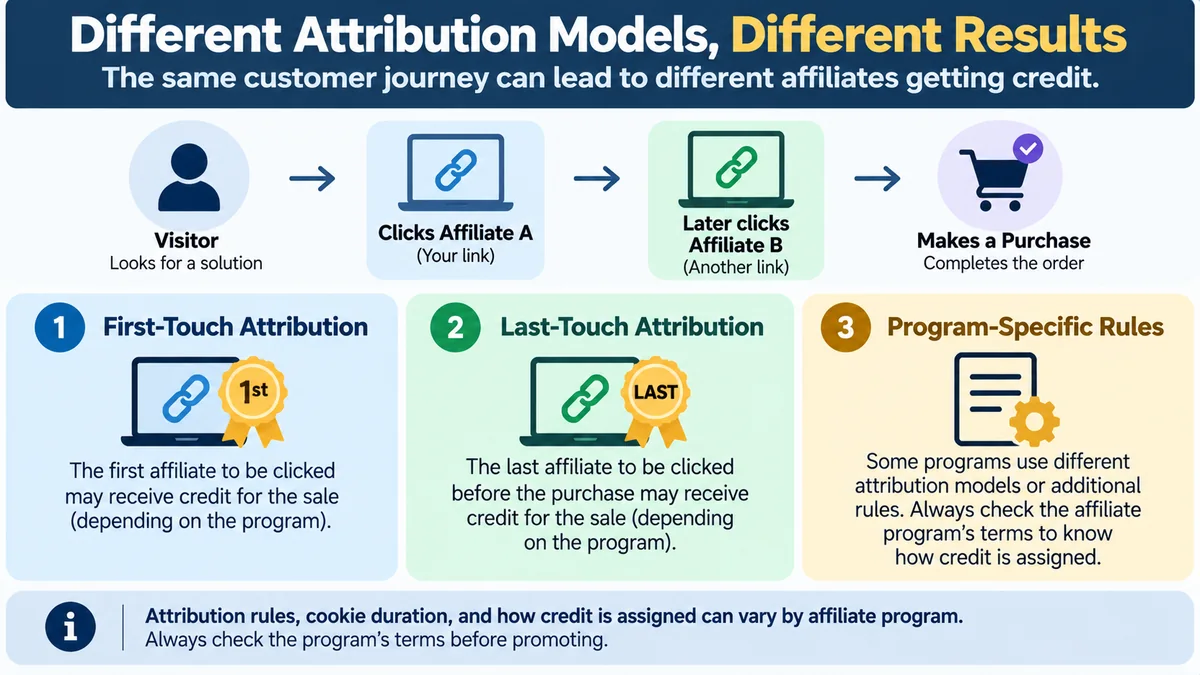
For example, imagine this sequence:
Who receives the commission?
The answer depends on the program’s attribution rules.
Different platforms can use different models.
Under a last-touch model, the most recent qualifying affiliate referral before the purchase generally receives credit.
Using the earlier example, Affiliate B may receive the commission because that was the latest qualifying referral.
ClickBank states that it uses last-touch attribution for its standard affiliate system.
That means a later qualifying ClickBank referral can affect which affiliate ultimately receives credit.
This is an important reminder that a long cookie window does not necessarily mean the first affiliate owns the customer for the entire period.
In a first-touch model, the first qualifying affiliate who referred the visitor may retain credit even if other interactions happen later.
Not every affiliate program uses this approach.
The important point is that attribution models determine how competing referrals are handled.
When reviewing an affiliate program, look for documentation explaining:
ClickBank provides a useful real-world example.
According to the official ClickBank HopLinks Guide, a HopLink is an affiliate tracking URL that tells ClickBank which affiliate referred the visitor.
ClickBank states that if the customer purchases within 60 days of clicking the HopLink, the referring affiliate can receive credit, subject to ClickBank’s attribution rules.
This is commonly described as ClickBank’s 60-day affiliate cookie window.
But the system involves more than a simple browser cookie.
Browser privacy changes have made affiliate tracking more complex.
Cookies may be deleted, blocked, or restricted.
Visitors may also switch browsers or devices.
Because of those limitations, some affiliate platforms use additional attribution methods.
ClickBank, for example, documents several methods that can contribute to attribution, including:
The exact methods vary by platform.
This is why it is increasingly inaccurate to think of all affiliate tracking as nothing more than “dropping a cookie.”
Affiliate links usually contain information that identifies the affiliate or the referral.
When someone clicks the link, the tracking system can use that information to record the visit.
The identifier may be associated with:
The tracking platform then attempts to connect the later purchase with the appropriate referral.
Some systems can pass identifying information through the URL itself, which can provide another attribution signal beyond the browser cookie.
ClickBank introduced an additional Attribution Tracking Script for sellers.
According to ClickBank’s Attribution Tracking Script documentation, the system can pass a unique Hop ID through the URL from the seller’s landing page to the order form.
This provides an additional attribution signal alongside cookies and device fingerprinting.
The purpose is to reduce attribution loss in situations where browser-based tracking alone may be less reliable.
This is mostly something sellers implement, but affiliates benefit when the tracking path preserves their referral more reliably.
A tracking cookie can disappear or become unavailable for several reasons.
For example:
These situations help explain why modern attribution systems may use multiple signals.
No tracking system should be assumed to capture every possible customer journey perfectly.
Imagine a visitor clicks an affiliate link inside one browser.
Later, the visitor opens a different browser and purchases directly.
A cookie stored in the original browser may not automatically be available in the second browser.
The same issue can occur when someone clicks on a phone and later purchases on a computer.
Whether the affiliate still receives credit depends on what additional attribution methods the program uses.
Some systems can connect an affiliate referral to a customer’s email address.
ClickBank supports an optional email-based attribution method for participating sellers.
When properly implemented, a customer email can be associated with an affiliate so that a later purchase using that email may still be attributed even if the customer does not return through the original HopLink.
Not every ClickBank seller uses this feature.
That distinction is important: just because a network supports an attribution method does not mean every individual offer uses it.
It can help to think of attribution as a chain rather than one event.
A simplified affiliate journey may look like this:
Affiliate Link → Click Recorded → Visitor Reaches Seller → Visitor Returns Later → Purchase → Attribution Decision → Commission
Problems can occur at different points in that chain.
For example:
Thinking about the complete chain makes tracking easier to understand.
One of the simplest things an affiliate can do is verify that the tracking link works before sending traffic.
Check that:
A tracking window is irrelevant if the referral link was broken from the beginning.
Some affiliate platforms allow you to add a campaign identifier to your affiliate link.
ClickBank, for example, supports Tracking IDs, often called TIDs, that affiliates can add to HopLinks.
These identifiers can help distinguish traffic coming from different campaigns or placements.
You might use different tracking IDs for:
This does not change the basic commission rate.
It gives you more information about which promotion generated the activity.
Your website analytics and your affiliate network reporting serve different purposes.
Website analytics may tell you:
The affiliate network may tell you:
Those systems do not necessarily use identical data.
Small differences between reports should not automatically be treated as proof that something is broken.
The importance of a tracking window can depend partly on how long customers typically need to make a decision.
A simple, inexpensive purchase may involve a relatively short decision process.
A more expensive or complicated offer may require more consideration.
That means a longer attribution window can be more meaningful for offers where customers commonly research, compare, leave, and return later.
Again, this should be evaluated alongside the entire offer rather than treated as a standalone ranking factor.
When the information is available, try to understand:
You may not always find every answer publicly.
But knowing what to look for makes affiliate-program documentation much easier to understand.
It is easy to compare two offers and assume the longer cookie is automatically superior.
A better evaluation includes:
If you are comparing network data, our guide to affiliate network metrics explains why individual numbers should be interpreted together rather than in isolation.
Under a last-touch model, a later qualifying affiliate referral may receive credit instead of the earlier affiliate.
This can happen even if the original affiliate introduced the customer to the product.
That may feel surprising at first, but it is simply the rule used by that attribution system.
This is another reason the cookie duration and attribution model need to be understood together.
A 60-day window does not necessarily mean the original affiliate is protected from all later referrals for 60 days.
If the applicable attribution window expires and no other supported attribution method preserves the referral, a later purchase may no longer qualify for commission from the original click.
The exact result depends on the program.
Some programs may have additional rules for:
Always use the specific program’s documentation when evaluating those situations.
Affiliate marketing depends heavily on measurement, but no tracking environment should be assumed to be flawless.
Technical changes, browsers, redirects, privacy settings, implementation mistakes, and customer behavior can all affect attribution.
The goal is not to eliminate every possible tracking limitation.
The goal is to:
If you suspect a tracking problem, avoid immediately rebuilding the entire campaign.
First identify what you can verify.
Check:
Changing multiple elements at the same time can make diagnosis more difficult.
Our guide to testing an affiliate campaign without changing everything at once explains why controlled changes are easier to evaluate.
For a beginner, the entire subject can be reduced to four questions:
If you understand those four questions, terms such as cookie duration, attribution window, tracking ID, and last-touch attribution become much less intimidating.
Affiliate cookie duration is important, but it is only one part of affiliate attribution.
A tracking window defines how long a referral may remain eligible, while the attribution model determines how competing referrals and later interactions are handled.
Modern networks can also use additional tracking methods beyond traditional cookies.
Before promoting an offer, learn what you can about the program’s tracking rules, verify your affiliate link, and use campaign identifiers when they provide useful information.
Most importantly, do not judge an affiliate opportunity from one attractive number.
Cookie duration, commission rate, sales-page quality, audience fit, network metrics, and tracking reliability all work together.
Understanding that complete picture will help you make better decisions than simply asking, “How long does the cookie last?”
Subscribe to get the latest posts sent to your email.
If you found this guide helpful, please tap the Like button and share it with someone who could benefit. Every Like and Share helps more people discover Partner to Wealth.