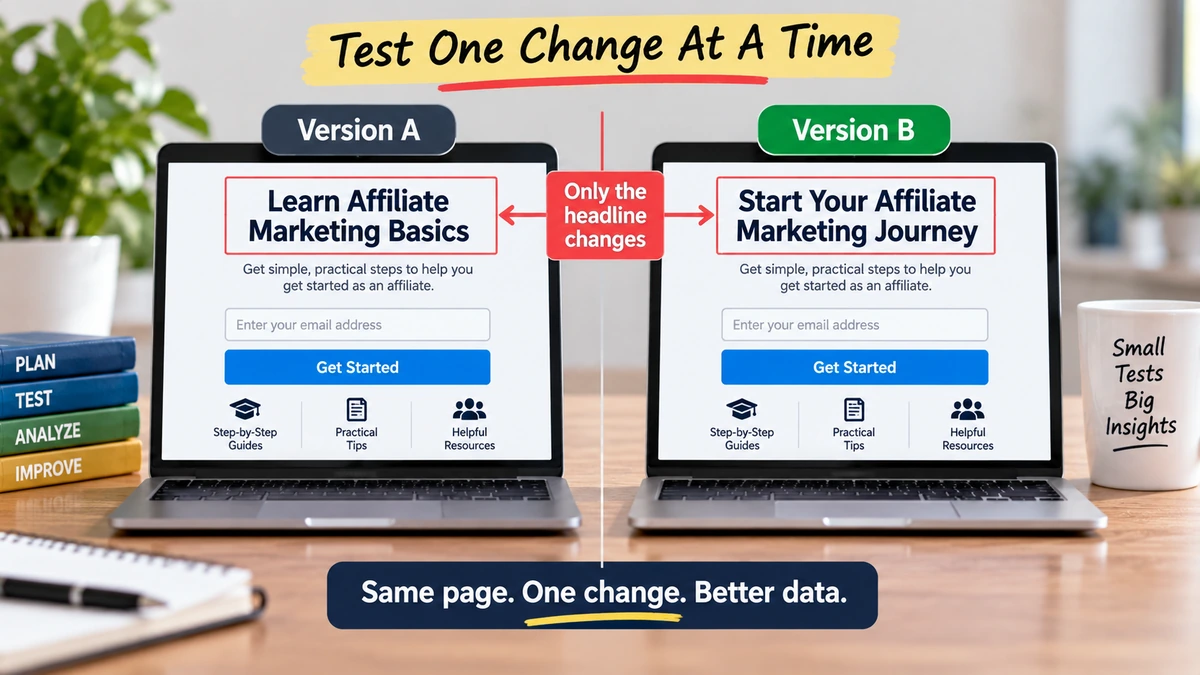
Changing your ad, page, offer, targeting, and budget at the same time makes results difficult to understand. Learn a simpler way to test affiliate campaigns one variable at a time.
Testing is one of the most useful skills an affiliate marketer can develop.
It is also one of the easiest things to make unnecessarily confusing.
A campaign gets a few clicks but no sale, so the headline changes.
Then the landing page changes.
Then the offer changes.
Then the targeting changes.
Then the budget changes.
A few days later, the numbers look different—but you have no idea which change actually caused the difference.
Learning how to test an affiliate campaign does not mean changing everything until something works.
It means creating controlled tests that help you learn what is affecting the result.
Imagine that you change your advertisement, landing-page headline, call to action, offer, and targeting on the same day.
Conversions improve.
What caused the improvement?
You cannot know.
Maybe the new ad attracted better visitors.
Maybe the landing-page headline explained the offer more clearly.
Maybe the new targeting reached people with stronger buyer intent.
Or perhaps the new offer simply matched the audience better.
The same problem occurs when results decline.
If five variables changed at once, you do not know which change hurt performance.
That is why controlled testing is so useful.
Google Ads’ official experiment guidance recommends testing one variable at a time so you can identify which element contributed to the outcome.
Before testing something new, you need something to compare it with.
That is your baseline.
A baseline does not have to be a highly profitable campaign.
It simply needs to represent the current version of the campaign.
For example, your baseline might include the current advertisement, targeting, landing page, offer, call to action, and follow-up process.
Record the important numbers before you begin changing things.
Without a baseline, improvement becomes difficult to measure because you do not know what the new version is improving upon.
If you are still deciding which numbers deserve attention, our guide on tracking affiliate marketing without overcomplicating it explains how to focus on useful metrics instead of watching every number available.
A good test begins with a question.
Not:
Can I make this campaign better?
That is too broad.
Instead, ask something specific.
For example:
Will a benefit-focused headline generate more opt-ins than the current headline?
Or:
Will a more specific search keyword bring visitors who are more likely to reach the offer page?
Or:
Will moving the call to action higher on the page increase clicks to the next step?
A specific question gives the test a purpose.
You know what you are changing, why you are changing it, and what result you will examine.
The simplest testing rule is also one of the most important:
Change one meaningful thing at a time whenever practical.
That variable could be the ad headline.
It could be the landing-page headline.
It could be the call-to-action wording.
It could be the traffic targeting.
It could be the offer.
It could be the page layout.
But if the purpose of your test is to understand whether a new headline improves the result, leave the rest of the campaign as stable as possible.
This gives you a much better chance of connecting the change to the outcome.
Do not wait until the test ends and then search through the numbers for something that improved.
Decide in advance which metric matters most.
The appropriate metric depends on the part of the campaign you are testing.
If you are testing an advertisement, click-through behavior might matter.
If you are testing an opt-in page, the opt-in rate may matter more.
If you are testing a bridge page, the percentage of visitors who continue to the offer may be more useful.
If you have reliable sales tracking, the ultimate conversion or revenue result may matter most.
Google Ads’ conversion measurement guidance similarly recommends identifying the valuable action you want to measure, such as a purchase or sign-up, so campaign decisions can be based on meaningful activity.

Not every test should be judged by the same number.
Suppose you change a landing-page headline.
If the headline’s job is to persuade visitors to enter an email address, then the opt-in rate is directly connected to that change.
Now suppose you change your traffic targeting.
The click-through rate might change, but you should also watch what those visitors do after they arrive.
Cheap clicks are not automatically useful clicks.
This is why it helps to understand the entire affiliate marketing funnel instead of treating each campaign number as an isolated score.
A change near the top of the funnel can affect what happens farther down.
One conversion does not necessarily prove that one version is better.
Neither does one unusually good day.
Small samples can move dramatically.
A campaign can receive several clicks without a conversion and then produce one shortly afterward.
That does not mean you should ignore early results.
It means you should avoid making large conclusions from very little data.
The amount of data needed depends on traffic volume, conversion frequency, the size of the difference between versions, and the type of decision you are making.
There is no single universal number that makes every affiliate test conclusive.
The practical lesson is patience.
Give the test enough opportunity to produce useful information before constantly changing it.
A test becomes harder to interpret when you keep modifying it.
Imagine that you begin testing a new landing-page headline.
Two days later, you also change the button.
Then you change an image.
Then you add another section to the page.
You no longer have the original headline test.
You have created several overlapping changes.
Google’s experiment guidance warns about the same problem: changing the underlying campaign during an experiment can make it difficult to understand which change influenced the result.
Once a meaningful test begins, resist the urge to keep adjusting it unless there is an obvious technical problem.
Not every poor result is a marketing problem.
Sometimes something is simply broken.
A button may not work.
A tracking link may point to the wrong destination.
A conversion event may not be firing.
A page may load incorrectly on mobile.
An affiliate link may have been replaced or expired.
Those issues should be fixed immediately because they prevent the test from operating correctly.
That is different from changing a headline because the campaign has not converted after a handful of clicks.
Before interpreting performance, make sure the campaign is technically functioning.
You do not need to test every part of the campaign simultaneously.
Look for the part that appears to be restricting the next step.
If your advertisement receives impressions but almost no clicks, the ad or targeting may deserve attention.
If visitors click the ad but immediately leave the landing page, the page-message match may deserve attention.
If people opt in but almost nobody continues through the funnel, investigate the transition after the opt-in.
If people reach the offer but purchases remain weak, the offer fit may deserve closer examination.
This approach helps you focus testing where it can teach you something useful.
A campaign that generates more clicks is not automatically better.
Suppose Version A generates 100 visitors and Version B generates 60.
If Version B brings more qualified visitors who join your list, continue through the funnel, or purchase, the lower traffic volume may still be more valuable.
This connects with buyer intent.
Visitors at different stages of the buying process behave differently.
When testing traffic, look beyond the number of clicks and ask whether the traffic is helping the campaign accomplish its actual goal.
Lower costs can be useful.
But reducing cost is not always the same as improving the campaign.
A cheaper click that never moves forward can be less valuable than a more expensive click from someone with stronger intent.
The same applies to leads.
A low-cost lead is not automatically a good lead if those subscribers never engage or continue through your funnel.
Evaluate cost together with quality.
If you are testing the landing page, try not to swap the affiliate offer during the same test.
The offer itself can have a major effect on conversion behavior.
If both the page and offer change, you will not know whether a stronger result came from better presentation or better offer fit.
Choosing the right offer deserves its own decision process.
Our guide on how to choose an affiliate offer explains how to evaluate fit before traffic reaches the campaign.
The reverse is also true.
If the purpose of your experiment is to compare two page versions, changing the traffic source at the same time can distort the comparison.
Visitors from organic search may behave differently from visitors clicking paid search ads.
A social-media visitor may behave differently from someone actively searching for a solution.
Our guide comparing free and paid traffic for affiliate marketing explains why different sources can produce different visitor behavior.
Keep the traffic conditions as consistent as reasonably possible when the page itself is the variable you want to understand.
You do not need complicated software to remember what you tested.
A simple document or spreadsheet can record the test name, date, original version, changed variable, reason for the change, primary metric, result, and decision.
This becomes increasingly valuable as you run more campaigns.
Without a record, it is surprisingly easy to repeat old tests or forget why something was changed.
A testing log turns individual experiments into accumulated business knowledge.
Not every experiment should improve performance.
If every test appears to win, you may not be testing rigorously enough.
A new headline might perform worse.
A new audience might be less responsive.
A new landing-page layout might reduce conversions.
That information still has value.
You learned what not to replace.
Testing is not about proving that every new idea is better.
It is about learning whether it is better.
Increasing traffic or budget magnifies whatever is already happening.
If the campaign is working well, additional traffic may provide more opportunity.
If the campaign has a serious weakness, additional traffic may simply expose more people to the same weakness.
This is why testing should usually come before aggressive scaling.
First understand the campaign.
Then improve the weak points.
Then consider whether the evidence supports increasing traffic or budget.
Testing is deliberate.
Tinkering is reactive.
A deliberate test has a reason, one primary change, a metric, and a period for observation.
Constant tinkering usually happens because the marketer becomes uncomfortable with uncertainty.
A few clicks arrive without a sale, so something changes.
A day looks expensive, so something changes again.
Then the campaign becomes impossible to interpret.
Patience is part of testing.

A practical campaign-testing process can be summarized as follows:
You do not need to make testing more complicated than that when you are starting.
Sometimes the correct conclusion is simply:
We do not know yet.
The difference between two versions may be too small.
There may not be enough traffic.
Conversions may happen too infrequently.
The campaign may have been interrupted.
Do not force a winner merely because you want the test to produce an answer.
An inconclusive result is more useful than a confident conclusion unsupported by the data.
Learning how to test an affiliate campaign is less about sophisticated tools and more about disciplined decision-making.
Start with a baseline.
Decide what you want to learn.
Change one meaningful variable.
Choose the metric before the test starts.
Keep the rest of the campaign as stable as practical.
Then give the test enough opportunity to produce useful information.
The goal is not to change things constantly.
The goal is to learn what each change actually does.
When you test that way, even disappointing results can teach you something—and each test can make the next campaign decision a little more informed.
Subscribe to get the latest posts sent to your email.
If you found this guide helpful, please tap the Like button and share it with someone who could benefit. Every Like and Share helps more people discover Partner to Wealth.