Affiliate marketing becomes easier to manage when you stop treating every task as urgent. Learn how to organize content, traffic, tracking, testing, and improvement into a simple weekly workflow.
Affiliate marketing can feel complicated when every task seems important at the same time.
You need content.
You need traffic.
You need offers.
You need tracking.
You need email follow-up.
You need to review results and decide what to improve next.
Without a system, those responsibilities can turn into constant switching between unfinished tasks.
A simple affiliate marketing workflow helps organize the work into a repeatable weekly rhythm.
The goal is not to create a rigid schedule that every affiliate must follow.
The goal is to make sure the important parts of the business receive regular attention without trying to work on everything every day.
A workflow gives each task a place.
Instead of asking yourself every morning, What should I work on today?, you already know which part of the business deserves attention.
That can reduce unnecessary strategy switching.
It can also help you recognize whether you are actually moving the business forward or simply staying busy.
A useful weekly system usually covers five areas:
You may also include email, offer management, technical maintenance, or other tasks depending on how your business operates.
The exact days matter less than making sure the essential work happens consistently.
Before creating anything, decide what the week is mainly supposed to accomplish.
Do not begin with a list of twenty unrelated tasks.
Choose one primary objective.
For example:
This does not mean you can only complete one task all week.
It means one objective receives priority when competing tasks appear.
A clear priority makes it easier to distinguish important work from distractions.
Your weekly planning should begin with a quick look backward.
What did you publish?
What traffic arrived?
What did visitors click?
Did anyone join your email list?
Did a campaign test produce useful information?
Was anything technically broken?
You do not need to spend hours analyzing every number.
The goal is simply to understand what changed since the previous review.
Google Search Console’s Performance report, for example, can show search clicks, impressions, click-through rate, average position, queries, and pages.
Google also notes that weekly and monthly views can help smooth daily fluctuations when you are looking for broader trends.
That is one reason a weekly review can be more useful than reacting emotionally to every individual day.
Tracking is useful when it leads to a decision.
It becomes less useful when you repeatedly open dashboards without knowing what you are looking for.
A beginner may only need a few questions:
If the numbers do not lead to a decision, close the report and return to productive work.
Our guide on tracking affiliate marketing without overcomplicating it explains how to focus on useful information instead of watching every available metric.
Once you understand the current situation, decide what content deserves attention.
That could mean creating something new.
It could also mean improving an existing page.
Useful content tasks include:
The purpose should be helping the audience, not publishing simply because another post is due.
Google’s official guidance on helpful, reliable, people-first content encourages creators to focus on whether readers leave feeling they learned enough to help achieve their goal.
That is a useful standard for affiliate content too.
A new article should not become an isolated page.
Look for natural connections with what you have already published.
If you write about traffic, link to relevant articles about buyer intent, funnels, tracking, or email follow-up when those topics genuinely help the reader.
If an older article would benefit from linking to the new one, update that article too.
This creates a connected learning path rather than a collection of unrelated posts.
It also helps readers continue exploring the site when they need more information.
When the content includes a recommendation, the recommendation should fit the reader’s problem.
Do not begin the weekly content process by asking which product you can promote.
Begin by asking what the reader needs help understanding.
Then decide whether an offer belongs in that conversation.
Our guide on writing affiliate content that helps before it sells explains this approach in more detail.
If a product does not improve the article or help the reader take the next reasonable step, it may not belong there.
Publishing content and generating traffic are related, but they are not identical tasks.
You can create useful content that nobody has discovered yet.
This is why your weekly workflow should include time to support distribution.
Depending on your strategy, that might involve:
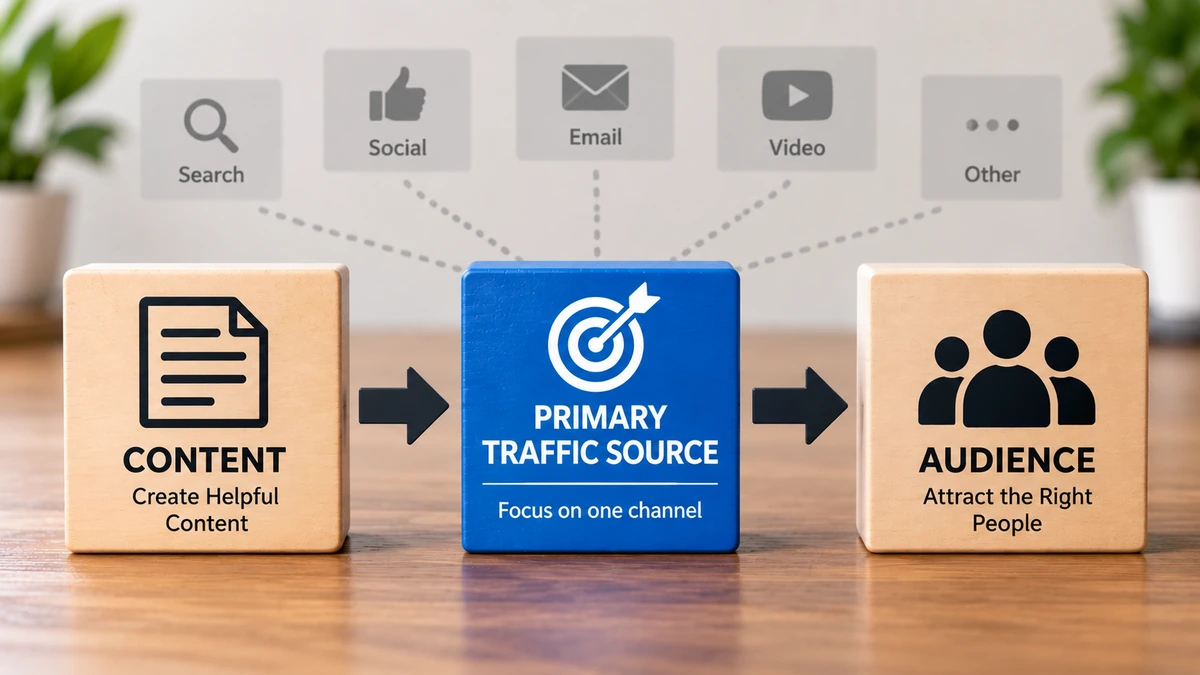
You do not need to use every traffic source.
In fact, constantly switching between traffic methods can make progress harder to measure.
Our guide on focusing on one traffic source explains why learning one channel well can be more useful than spreading attention across many methods.
Trying to write an article while checking traffic reports, advertising accounts, email statistics, and social platforms can make both tasks harder.
Consider giving creation and promotion separate work periods.
During content time, focus on the reader and the page.
During traffic time, focus on helping the right people discover that content.
This reduces task switching and makes it easier to finish meaningful work.
At least once during the week, follow your own visitor path.
Start where a visitor would start.
Click the links.
Open the landing page.
Test the form.
Check the redirect.
Confirm the next page loads.
Make sure affiliate links still point where they should.
Check the experience on mobile when relevant.
This does not need to become a full technical audit every week.
It is simply a quick way to catch obvious problems before more visitors encounter them.
If the visitor journey itself still feels unclear, review our guide to building a simple affiliate marketing funnel.
An offer should not be changed merely because one week was quiet.
But it should not be ignored forever either.
Periodically ask:
If the offer still fits, leave it alone long enough to gather meaningful information.
If it no longer fits the audience, then replacing it can be a deliberate business decision rather than a reaction to short-term results.
Our guide on choosing an affiliate offer explains how audience fit should influence that decision.
Testing deserves its own place in the workflow because it requires discipline.
If you casually change things throughout the week, you may lose track of what caused the result.
A better approach is to decide:
Then leave the test alone long enough to collect useful information.
Our guide on how to test an affiliate campaign explains why changing one meaningful variable at a time makes results easier to interpret.
A weekly workflow does not mean every activity must happen every seven days.
Some tests need more time.
Some campaigns do not receive enough traffic in a week to support a useful conclusion.
Sometimes the correct weekly action is simply to leave the test running.
The workflow is there to make sure you review the test deliberately, not to force constant change.
If you are building an email list, give email a regular place in the weekly routine.
That might include:
Email is valuable because it gives you a direct way to communicate with people who chose to hear from you.
It should therefore be maintained like any other part of the business.
Our article on building an email list from day one explains why that owned connection can complement your traffic strategy.
Not every productive task creates something new.
A healthy website and funnel also require maintenance.
Your weekly or periodic maintenance list may include:
You do not have to inspect the entire site every week.
Rotate through the areas that matter most.
A short scorecard can make progress visible without turning your business into a spreadsheet project.
You might record:
The scorecard should help you remember what happened.
It should not create another large workload.
You control some things directly.
You control whether you publish useful content.
You control whether you check your links.
You control whether you run a disciplined test.
You do not fully control how many people search for a topic, when someone decides to buy, or how quickly a new article gains visibility.
This is why it helps to separate activity from outcomes.
A week can still be productive even if no sale occurs.
If you created a useful page, fixed a broken funnel step, collected better data, or learned that a test did not work, the business gained information or an asset.
A workflow should create calm structure.
It should not create another reason to constantly check numbers.
If your plan says campaign results are reviewed Friday, you do not necessarily need to check the campaign every hour on Tuesday.
If an article was published yesterday, you do not need to panic because it has not received search traffic today.
Give your work time to operate.
Use the schedule to reduce unnecessary reaction.
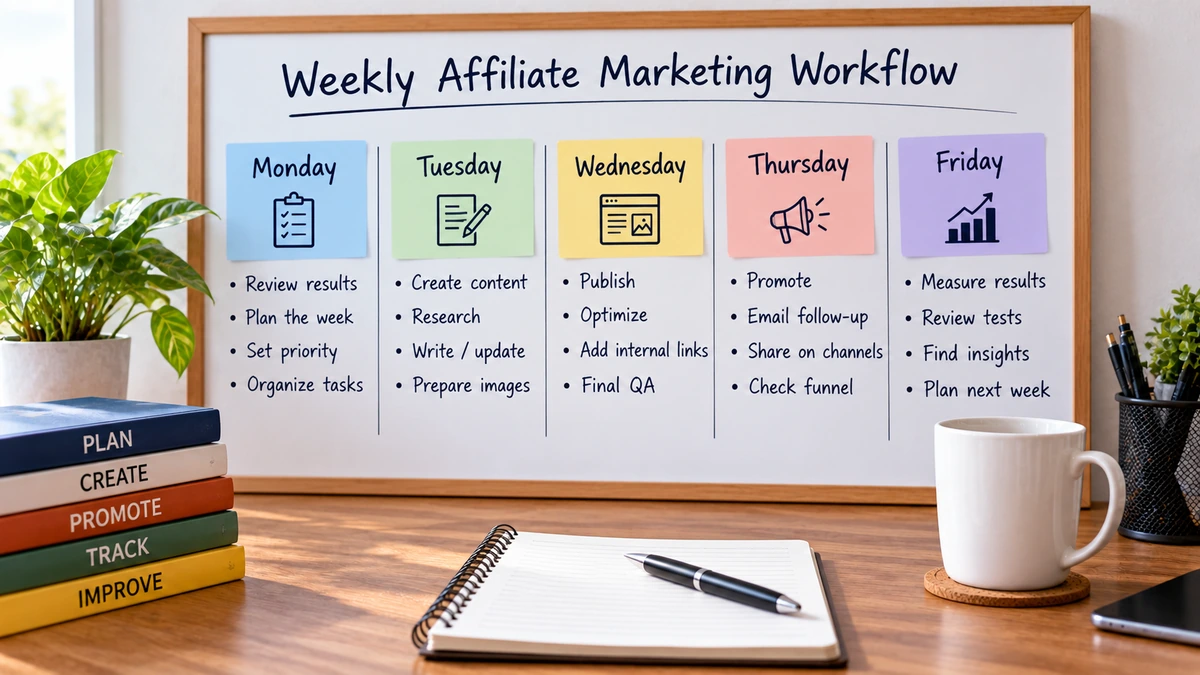
Here is one example of how a beginner might organize the week.
Review the previous week.
Check important metrics.
Confirm the main priority.
Choose the content or campaign task that deserves attention.
Work on the main content asset.
Research the reader’s question.
Write, edit, improve examples, add useful links, and prepare images.
Complete final QA.
Publish or update the page.
Add relevant internal links from older content.
Make sure the page connects naturally to the rest of the site.
Work on the primary traffic method.
Review email follow-up if relevant.
Check the visitor journey and confirm important links or forms work.
Review the week’s meaningful numbers.
Check any active tests.
Record what you learned.
Choose one possible improvement for the next cycle.
This is only an example.
You could complete the same activities on different days or combine them into fewer work sessions.
The sequence is more important than the calendar.

Simplify the workflow rather than abandoning it.
You might divide limited time into three blocks:
You do not need a full-time schedule to operate systematically.
A smaller workflow completed consistently can be more manageable than a large plan you rarely finish.
More available time does not mean you need more strategies.
Use additional time to improve quality.
You can:
Depth can be more useful than constantly adding another traffic platform or tool.
Every recurring task should have a reason.
Do not add activities simply because another marketer says they perform them daily.
Ask:
What business function does this task support?
If you cannot answer that question, reconsider whether the task belongs in your routine.
Your workflow should reflect your audience, traffic source, content strategy, funnel, and available resources.
Your first weekly system will not be perfect.
That is fine.
After several weeks, you may discover that certain tasks need more time.
You may find that another task can be automated or performed less frequently.
You may realize that your traffic source requires a different cadence.
Adjust the workflow based on evidence.
Do not rebuild the entire system every time one week feels different.
The best sign that your system is working is not that every box is checked.
It is that you understand what to do next.
Your content work teaches you what readers need.
Your traffic work brings people to the content.
Your tracking shows how they respond.
Your testing helps identify possible improvements.
Your weekly review turns those observations into the next priority.
That creates a cycle:
Plan → Create → Publish → Promote → Measure → Improve.
Then the cycle begins again with better information than you had before.
A practical affiliate marketing workflow does not need dozens of tools, complicated dashboards, or an exhausting daily schedule.
It needs a repeatable way to make sure the important work gets done.
Plan deliberately.
Create content that helps the audience.
Support one manageable traffic strategy.
Check that the funnel works.
Track the numbers that support decisions.
Test improvements carefully.
Then review what you learned and use that information to choose the next priority.
The individual tasks may change as your business develops.
But the underlying process remains useful: do the work, measure what happened, learn from it, and make the next decision with better information.
Subscribe to get the latest posts sent to your email.
If you found this guide helpful, please tap the Like button and share it with someone who could benefit. Every Like and Share helps more people discover Partner to Wealth.