
Before promoting an affiliate offer, review the program rules that govern how you can advertise it. Learn what to check for commissions, traffic sources, trademarks, disclosures, tracking, and restricted promotional methods.
A strong affiliate offer can still become a poor choice if the program rules conflict with the way you plan to promote it.
That is why reviewing the affiliate program terms should happen before you build a campaign, publish promotional content, or spend money on traffic.
The commission rate is only one part of the relationship.
Affiliate programs can also establish rules about:
Understanding those rules before promotion begins can prevent wasted work and help you choose offers that actually fit your marketing strategy.
Joining an affiliate program creates a business relationship.
The program provides tracking and a potential commission. In return, the affiliate agrees to follow the rules that govern promotion.
Those rules can be broader than many beginners expect.
They may apply to:
If your planned marketing method conflicts with the rules, discovering that after the campaign is built can be expensive and frustrating.
Affiliate programs can differ significantly.
One program may allow paid search advertising.
Another may allow paid search but prohibit bidding on its brand name.
Another may prohibit paid search completely.
The same differences can exist with:
Never assume that a promotional method is permitted simply because another affiliate program allowed it.
The primary affiliate agreement is the best place to begin.
Look for sections explaining:
Some networks place important requirements in separate policy documents rather than one single agreement.
ClickBank, for example, maintains a Client Contract along with several incorporated policies covering areas such as prohibited activities, promotional practices, trademark use, network abuse, and other platform rules.
You can review the current ClickBank Client Contract and its related policies directly.
Affiliate agreements are not necessarily permanent documents.
Programs may update:
Look for language explaining how changes are communicated and when revised terms take effect.
For an offer you promote actively, periodically reviewing the current rules is a reasonable part of campaign maintenance.
The terms should explain what actually generates your commission.
Depending on the program, payment might be based on:
Look beyond the headline commission rate.
Try to determine:
Our guide to affiliate commission types explains the differences between revenue share, CPA, and recurring structures.
A sale appearing in an affiliate report does not always mean the commission is permanent.
Programs can apply different rules when a customer receives a refund or initiates a chargeback.
Look for information about:
This matters when evaluating the real economics of an offer.
The program terms or documentation may explain how credit is assigned when multiple marketing interactions occur.
Questions to investigate include:
Our guide to affiliate cookie duration and attribution explains why the cookie window and attribution model should be considered together.
This is one of the most important sections for anyone planning paid traffic.
Programs may place restrictions on specific channels.
Examples can include:
A campaign method that works technically may still violate the affiliate agreement.
ClickBank, for example, maintains specific prohibited-activity rules and says certain promotional channels can require additional restrictions or approval.

If you plan to use Google Ads, Microsoft Advertising, or another search platform, look specifically for rules involving:
Do not assume that because a keyword is available in an advertising platform you are allowed to bid on it under the affiliate agreement.
Network rules, seller rules, trademark law, and advertising-platform policies can all apply independently.
Brand bidding generally means bidding on search terms containing a company’s brand, product name, trademark, or closely related variation.
Some affiliate programs permit it.
Others prohibit it completely.
Others may allow certain terms but not others.
ClickBank’s prohibited-activity guidelines include restrictions on unauthorized use of third-party trademarks and trademarked search terms.
If the rules are unclear, do not guess.
Seek clarification from the program before spending money on the campaign.
Affiliate promotion often involves brand names, product names, logos, images, and promotional assets.
Those materials may be protected intellectual property.
Look for rules describing whether affiliates can use:
Permission to promote a product does not automatically mean you have unlimited permission to use every piece of the brand’s intellectual property.
Some programs provide approved promotional materials.
These can include:
Using official assets can reduce uncertainty about whether a particular image or statement was authorized.
However, you should still understand the rules that govern how those assets may be used.
A seller may provide promotional copy, but affiliates are still responsible for the content they publish.
Be careful with claims involving:
ClickBank’s Promotional Guidelines prohibit false or misleading claims and place restrictions on tactics involving fear, exaggerated ease of results, unsupported brand references, misleading scarcity, and other promotional practices.
Do not assume that an aggressive claim becomes safe merely because another marketer used it.
Testimonials can create additional responsibilities.
If you describe your own experience with a product, that description should be truthful.
If you have not used the product, do not imply that you have.
The FTC’s Endorsement Guides state that endorsements should reflect honest opinions and experiences, and marketers should not make claims that would require proof they do not have.
When you recommend a product and may earn a commission if someone purchases through your link, that financial relationship can be important information for the reader.
The FTC says affiliate relationships should be disclosed clearly and conspicuously so people can evaluate the recommendation with that relationship in mind.
The disclosure should not be hidden where readers are unlikely to notice it.
Our guide to affiliate disclosures explains the issue in more detail.
The FTC has specifically noted that the words “affiliate link” by themselves may not clearly communicate that the publisher can earn money from a purchase.
The disclosure should explain the financial relationship in language an ordinary reader is likely to understand.
If you plan to promote through email, confirm that the affiliate program permits it and whether special rules apply.
Look for requirements involving:
ClickBank’s Promotional Guidelines remind affiliates that commercial email is subject to applicable email laws and specifically reference the CAN-SPAM requirements against deceptive subject lines and false or misleading header information.
Do not assume that buying a list gives you permission to promote affiliate products to those contacts.
ClickBank’s Network Abuse Policy states that clients may not send email to purchased lists or lists obtained through harvesting and says email recipients should have joined mailing lists directly.
Other affiliate networks and email providers can have their own rules as well.
Some programs allow broad social promotion.
Others limit:
ClickBank, for example, states that Telegram promotion of ClickBank offers requires approval from its Compliance Team.
This is a good example of why broad assumptions about “social media traffic” can be risky.
Direct linking means sending traffic from the advertising source directly to the merchant page using your affiliate tracking link.
Some programs allow it.
Some advertising platforms restrict certain implementations.
Some sellers may require affiliates to use their own intermediary page.
Before building the campaign, understand both:
If you use an intermediary page, our guide to affiliate bridge pages explains why that page should provide meaningful original value rather than acting as a thin redirect.
Some offers provide multiple destination pages.
Others may require affiliates to send traffic through a specific approved path.
Do not bypass the seller’s required funnel unless the program explicitly allows it.
ClickBank’s prohibited-activity guidelines specifically identify attempts to bypass seller pitch pages among restricted activities.
Affiliate tracking exists to credit legitimate referrals.
Programs generally prohibit attempts to manufacture or steal attribution.
Examples can include:
ClickBank explicitly prohibits cookie stuffing and other attempts to manipulate traffic or commission tracking.
An offer may not be available everywhere.
Check whether:
Sending traffic from locations that cannot purchase can waste campaign budget and create a poor visitor experience.
Some offers work differently across devices or platforms.
For example, a software product may require a specific operating system.
A service may only be available through certain devices.
If those restrictions matter to the buying decision, they should be considered before promotion begins.
Affiliate programs may also establish rules for when commissions are actually paid.
Look for:
A commission shown in a report is not necessarily the same thing as money immediately available for withdrawal.
Review the circumstances under which the network can suspend or terminate an affiliate account.
Common areas can include:
ClickBank states that violation of its prohibited-activity rules can result in listing cancellation, suspension, termination, or other remedies.
The order matters.
A better workflow is:
This reduces the chance of creating assets around a promotional method you were never allowed to use.
Do not read the terms only as an abstract legal document.
Compare them directly with what you intend to do.
For example:
If your plan is paid search:
If your plan is email:
If your plan is content marketing:
This practical comparison makes the rules much easier to evaluate.
If you promote multiple affiliate offers, it can become difficult to remember every program’s rules.
A simple record can help.
You might track:
This makes future campaign reviews much easier.
Affiliate policies change.
An old forum answer, video, screenshot, or blog post may describe rules that no longer apply.
When a restriction affects your campaign, go back to the current official program documentation.
If the policy remains unclear, contact the network or program directly rather than relying on an assumption.
A program can have clear, reasonable rules and still offer a product that does not fit your audience.
You should also evaluate:
Our guide to evaluating an affiliate sales page explains how to inspect the visitor experience after the click.
A large payout can make an offer look attractive.
But imagine the offer prohibits the exact traffic source you intended to use.
The headline commission is irrelevant to that campaign.
Likewise, an offer might have:
but restrictive advertising rules that make it unsuitable for your strategy.
This is why offers should be evaluated as complete systems.
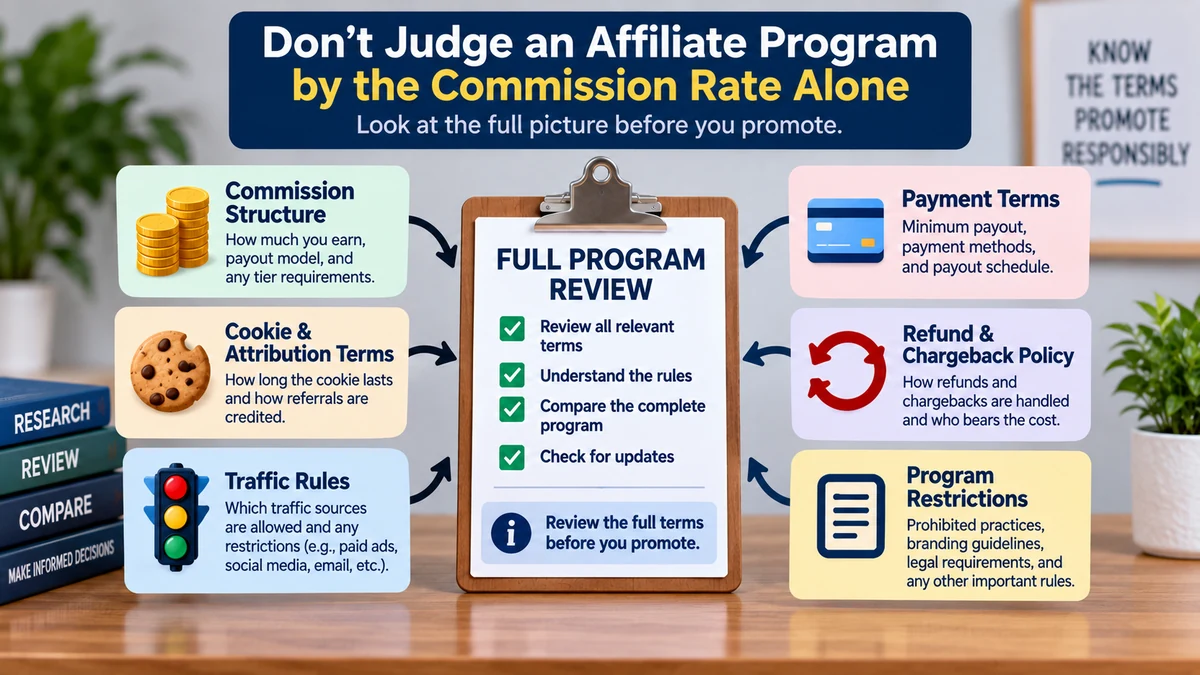
Before promoting an offer, check:
Reviewing affiliate program terms is not the most exciting part of affiliate marketing, but it can prevent expensive mistakes.
Do not stop at the commission number.
Understand how the program handles traffic, claims, trademarks, email, tracking, refunds, attribution, and payment.
Then compare those rules with the campaign you actually intend to run.
An attractive offer is only useful if you can promote it in a way that fits both your audience and the program’s requirements.
Checking the rules first gives you a much stronger foundation than building a campaign and discovering the restrictions afterward.
Subscribe to get the latest posts sent to your email.
If you found this guide helpful, please tap the Like button and share it with someone who could benefit. Every Like and Share helps more people discover Partner to Wealth.