Not every affiliate visitor is ready to buy. Learn how to match content to buyer intent so beginners, researchers, comparison shoppers, and ready-to-buy visitors get the information they actually need.
Two people can search for information about the same product and want completely different things.
One person may be trying to understand what the product does.
Another may already understand the product and want to compare it with alternatives.
A third may simply be looking for the best place to buy.
If you give all three visitors the same page, the content may technically be related to the topic while still failing to answer what each person actually needs.
That is why understanding buyer intent in affiliate marketing matters.
Buyer intent is not about pretending you can read someone’s mind. It is about using the clues available in a search, traffic source, page topic, and visitor behavior to make a reasonable judgment about what stage of the decision process the person is probably in.
Then you create the next piece of content around that need.
If you first need the larger business framework, start with How Affiliate Marketing Actually Works for Beginners.
Buyer intent describes how close someone appears to be to making a decision and what information that person needs before taking the next step.
Not every visitor should be treated as though a purchase is imminent.
Someone searching:
“What is affiliate tracking?”
is probably in a different stage from someone searching:
“Tool A vs Tool B for affiliate tracking”
And both are different from someone searching:
“Tool A pricing”
The topic overlaps, but the visitor’s likely purpose changes.
Your content should change with it.
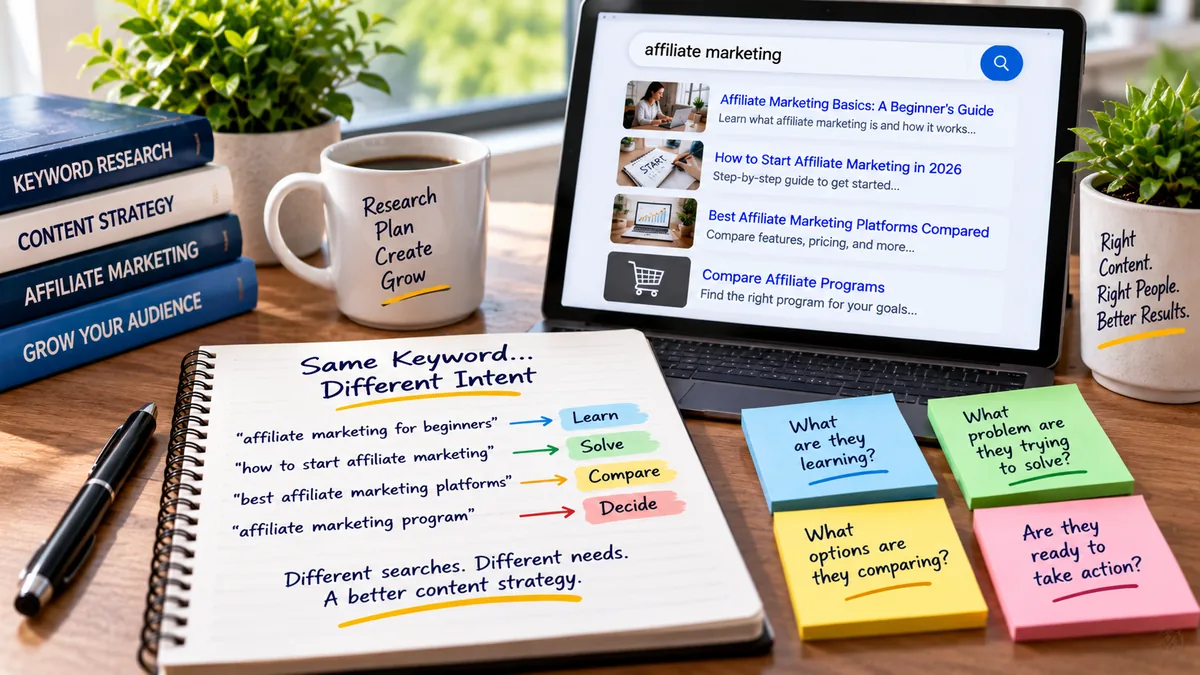
Keywords are useful, but the exact words alone do not tell the entire story.
A better approach is to think about the stage behind the search.
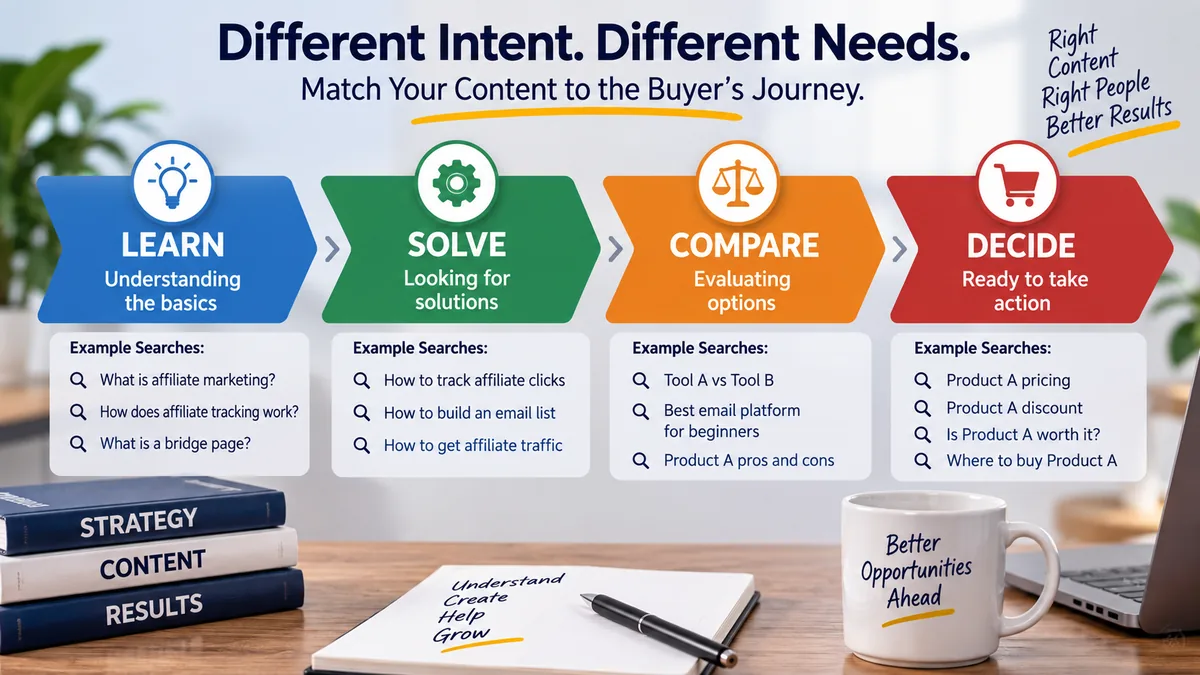
For beginner affiliate content, you can often organize intent into four broad stages:
These stages are not rigid boxes.
A real visitor can move between them quickly, and the same search phrase can sometimes mean different things depending on context.
The purpose of the framework is simply to help you ask a better question:
What would be most useful to this person right now?
Learning-intent visitors are usually trying to understand a topic before making any meaningful decision.
Typical searches might include:
These visitors usually need explanation more than promotion.
Useful content formats include:
Your goal is to help the reader understand the subject well enough to take the next sensible step.
For example, someone asking what a bridge page is should first understand the purpose of that page. That is exactly the job of What Is a Bridge Page and Why Use One?.
Dropping a hard product pitch into the first paragraph would ignore the visitor’s likely reason for arriving.
At the next stage, the visitor often understands the basic problem but has not decided how to solve it.
The search becomes more practical.
Examples might include:
These visitors need actionable guidance.
They may also be more receptive to tools or resources, but the recommendation should emerge from the solution rather than replace the solution.
For example, a visitor trying to understand tracking would benefit from learning what should actually be measured before being told to purchase another tracking platform.
That is the approach we used in How to Track Affiliate Marketing Without Overcomplicating It.
The content solves the immediate problem first.
A product recommendation can come later if a particular tool genuinely helps with the next stage.
Comparison visitors are much closer to making a choice.
They may already know which category of solution they need and are deciding between specific options.
Typical searches might look like:
This is where shallow affiliate content often becomes a problem.
If the visitor is comparing options, repeating the vendor’s sales page does not help much.
Comparison content should answer practical questions such as:
The objective is not to declare every affiliate product “the best.”
The objective is to help the reader decide whether the offer fits.
That same principle is central to How to Choose an Affiliate Offer Without Chasing High Commissions.
Decision-intent visitors appear closer to taking action.
Their searches may include:
These visitors usually do not need a 3,000-word introduction explaining the entire category from the beginning.
They need the information that removes the final uncertainty.
That might include:
Decision-stage content can be more direct because the visitor’s likely intent is more direct.
But direct does not mean exaggerated.
The page should still help the person make an informed decision rather than manufacture urgency that does not exist.
Buyer intent should influence more than the article itself.
It should also influence the call-to-action.
A learning-stage visitor may respond better to:
“Read the beginner guide.”
or:
“Download the checklist.”
A comparison-stage visitor may be ready for:
“See how the two options compare.”
A decision-stage visitor may be ready for:
“Visit the official offer page.”
Sending every visitor to the same affiliate button ignores the different stages that brought them to your site.
This is one of the reasons a simple affiliate marketing funnel can be useful. It gives visitors different ways to continue instead of forcing every visit into an immediate purchase decision.
You do not have to invent buyer intent entirely from theory.
Real search terms can give you useful clues.
If you are running search advertising, for example, the actual searches that trigger your ads can reveal what people were looking for before they reached your page.
Google explains that its Search Terms Report shows the searches that triggered ads and can help advertisers develop landing-page and creative ideas that better align with what customers are looking for.
You can review Google’s official Search Terms Report documentation.
Google also explains that keyword matching goes beyond identical wording and can consider the meaning or intent represented by a search.
That is another reason not to treat every keyword as an isolated string of text.
You can review Google’s official keyword matching guidance.
The page itself also gives you context.
Suppose someone arrives on an article titled:
“What Is Email Marketing?”
That visitor likely expects something different from the visitor who lands on:
“AWeber vs GetResponse for Affiliate Marketing.”
Do not make the first page behave like the second.
Your title, introduction, supporting sections, links, and CTA should all feel consistent with the promise that earned the click.
If the page promises education, educate.
If it promises comparison, compare.
If it promises a review, review.
The closer the page matches the visitor’s expectation, the less work the reader has to do to figure out whether the page is relevant.
A search can sound highly commercial and still be poor traffic for your particular offer.
For example, someone searching for a product may be:
That means a commercial-looking keyword is not automatically valuable.
You still need to evaluate the actual search, the visitor’s behavior, and whether the traffic matches the offer.
This is particularly important with paid search, where a misleading assumption about intent can cost money quickly.
It is also another reason beginners benefit from learning one traffic source at a time. When you understand the traffic source, the intent signals become easier to interpret.
Not every visitor needs to reach an affiliate offer from the first article.
Internal links can help readers move from one intent stage to another.
A beginner may start with:
How does affiliate marketing work?
Then continue to:
How do I choose an affiliate offer?
Then:
How do I build a funnel?
Then:
How do I track the results?
That progression creates a useful learning path while also strengthening the connections between related content on your site.
You do not need to force every article to perform the entire journey by itself.
Sometimes the correct next step is not another article and not an affiliate offer.
It is an email relationship.
A visitor who finds your content useful but is not ready to make a decision may still want a checklist, guide, or future lessons.
That is why building an email list from day one can complement an intent-based content strategy.
You are giving interested visitors another way to continue rather than assuming every useful session must end in a sale.
Matching intent does not mean manufacturing dozens of thin pages for slightly different keyword variations.
The content still needs to be genuinely useful.
Google Search Central says its ranking systems are designed to prioritize helpful, reliable information created primarily to benefit people rather than content produced mainly to manipulate search rankings.
Google’s people-first guidance also encourages publishers to consider whether an intended audience would find the content useful and whether readers leave feeling they learned enough to help achieve their goal.
You can review the official Google Search Central guidance on helpful, reliable, people-first content.
That is a useful standard for affiliate content too.
Do not ask only:
“Can this keyword rank?”
Also ask:
“Will this page satisfy the reason someone searched for it?”

Imagine your topic is affiliate tracking software.
You could build several useful pieces of content around different intent stages.
What Is Affiliate Tracking and Why Does It Matter?
This explains the concept for someone new to the subject.
How to Track Affiliate Campaigns Without Overcomplicating It
This helps someone who understands the need and wants a practical process.
Tool A vs Tool B: Which Tracking Platform Fits Beginners?
This serves someone who has narrowed the problem to specific solutions.
Tool A Review: Pricing, Features, Limitations, and Who It Fits
This gives a nearly decided visitor the details needed to evaluate that particular option.
All four articles cover the same broad subject.
But each has a different job.
Once the content is published, measure behavior that makes sense for that stage.
A learning article may be successful if readers continue to related content or join your email list.
A comparison article may be judged partly by whether visitors move toward the relevant offer pages.
A decision-stage article may reasonably be expected to produce a higher percentage of affiliate clicks.
Do not expect every article to generate the same type of conversion.
The measurement should match the page’s purpose.
If you need help interpreting the downstream numbers, use How to Read Affiliate Network Metrics Without Getting Lost.
The most useful way to think about buyer intent in affiliate marketing is not as a trick for getting more clicks.
It is a way to make the content more relevant.
Ask what the visitor is trying to accomplish.
If the person is learning, teach.
If the person is solving a problem, provide a process.
If the person is comparing, explain meaningful differences.
If the person is deciding, remove the remaining uncertainty.
Then make the next step fit that stage.
When the content, visitor intent, call-to-action, and offer all make sense together, the affiliate experience becomes clearer for the reader and easier for you to evaluate.
You are no longer trying to make every page sell.
You are giving each page one useful job.
Subscribe to get the latest posts sent to your email.
If you found this guide helpful, please tap the Like button and share it with someone who could benefit. Every Like and Share helps more people discover Partner to Wealth.