A bridge page connects your traffic source with the final offer while giving visitors useful context along the way. Learn what bridge pages do, when they make sense, and what a good one should contain.
If you are learning affiliate marketing, you will eventually hear someone mention a bridge page.
The name makes it sound more technical than it really is.
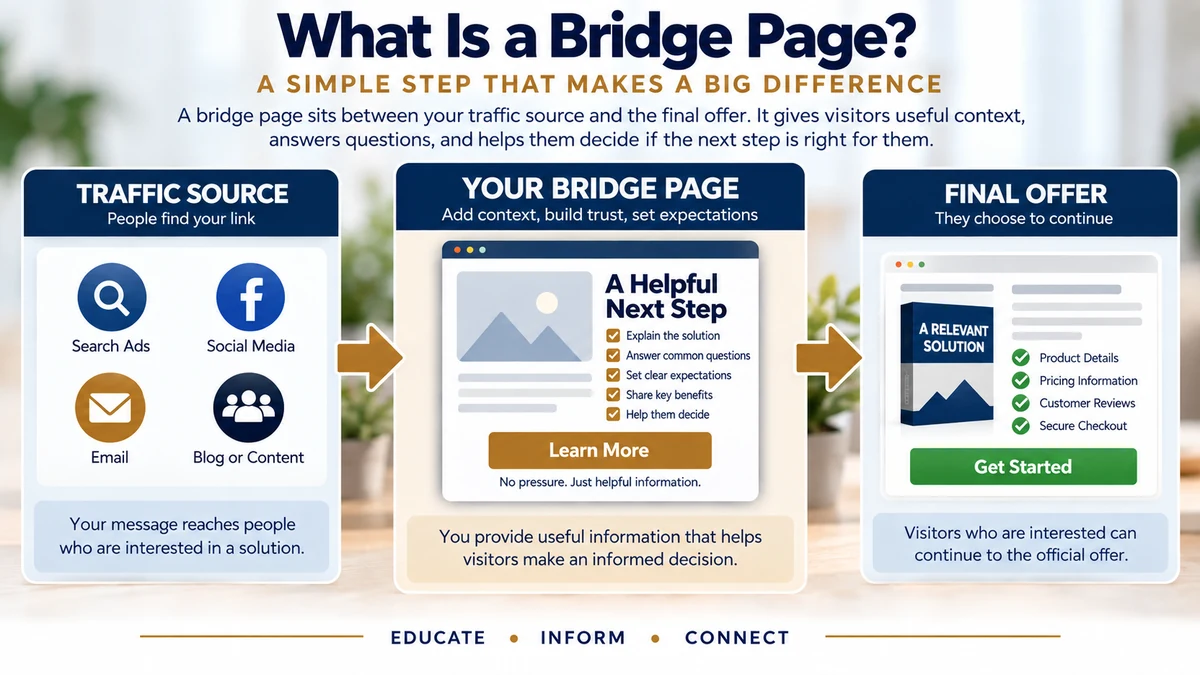
A bridge page is simply a page that sits between your traffic source and the final destination you want the visitor to reach.
Instead of sending someone directly from an advertisement, social post, email, or other traffic source to a merchant’s sales page, you first send them to a page you control.
That page can explain the offer, answer a question, set expectations, provide useful context, collect an email address when appropriate, or help the visitor decide whether continuing makes sense.
Then, if the visitor wants to continue, they click through to the next step.
In affiliate marketing, a bridge page is an intermediate page you control that connects a visitor with a merchant, product, service, webinar, registration page, or another destination.
The basic flow looks like this:
Traffic source → Your bridge page → Merchant or final destination
The bridge page is not normally the place where the final transaction happens.
Its job is to make the transition between the visitor’s original intent and the next page more useful and understandable.
That distinction matters.
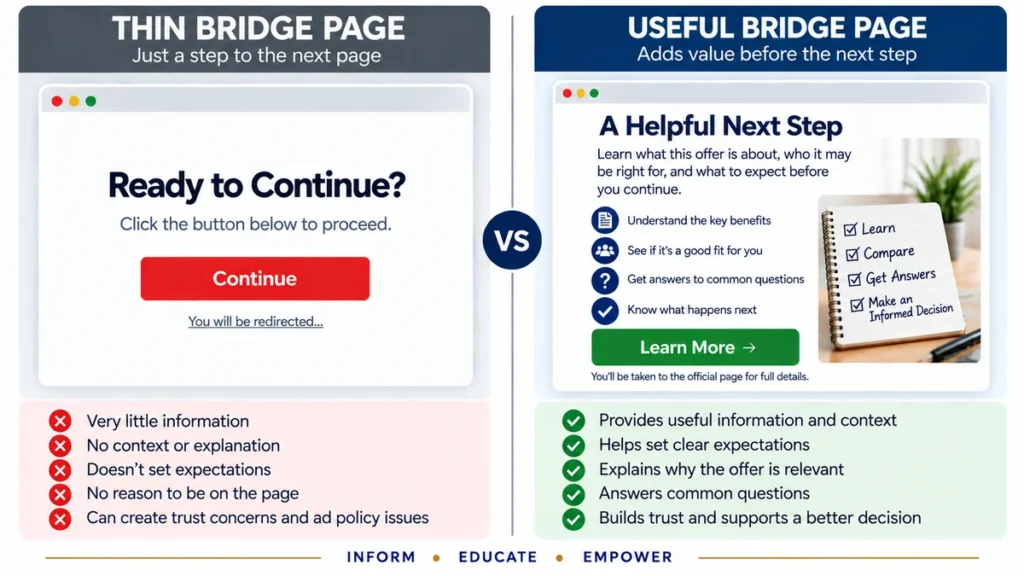
A useful bridge page does more than display a button that says “Continue.”
It should give the visitor something they did not have before arriving: clearer information, useful context, an explanation, a comparison, a qualification step, or another legitimate reason for the page to exist.
Direct linking can be appropriate in some situations, depending on the affiliate program, traffic source, merchant rules, and platform policies.
But direct linking also means you give up much of the experience between the initial click and the merchant’s page.
You cannot explain why you are recommending the offer.
You cannot easily prepare the visitor for what they are about to see.
You may have limited ability to measure what visitors do before they reach the merchant.
And if the merchant changes its page, messaging, or funnel, the visitor can experience a sudden disconnect between what attracted their attention and what they see next.
A bridge page can give you more control over that transition.
Imagine someone clicks an ad after searching for a solution to a specific problem.
If they immediately land on a long merchant sales page, they may not understand why that particular offer is relevant to what they were looking for.
A bridge page can close that gap.
It can briefly explain the problem, introduce the type of solution being discussed, and tell the visitor what they can expect if they continue.
That is a much more useful role than simply pushing someone toward another link.
Different visitors can arrive with very different levels of knowledge.
A person searching for “what is affiliate marketing?” is in a different stage from someone searching for a specific affiliate marketing tool, training program, or service.
Your bridge page gives you an opportunity to match the message more closely to the reason the visitor arrived.
This is closely related to the process described in How Affiliate Marketing Actually Works for Beginners: attracting the right person is only one part of the system. The information they encounter after the click also needs to make sense.
An affiliate recommendation is more useful when the visitor understands the reasoning behind it.
A bridge page might explain:
This is more credible than presenting every offer as though it is perfect for everyone.
A visitor should not have to guess what happens when they click your button.
A good bridge page makes the next step obvious.
For example, the page might explain that the visitor is about to:
Clear expectations reduce unnecessary confusion.
This is one of the most important points for beginners.
Owning the page does not automatically make it useful.
A page with a headline, one sentence, and a giant button that immediately sends visitors somewhere else may technically sit between the traffic source and merchant, but it provides very little reason for the visitor to be there.
That can also create problems with advertising platforms.
For example, Google Ads states that destinations must offer unique value and specifically identifies intermediate pages whose only purpose is sending users to another site as a potential insufficient-original-content problem.
AUTHORITY LINK: Add Google’s official “Insufficient original content” policy link to the phrase Google Ads destination policy here.
The practical lesson is simple: if you build a bridge page, build a page worth visiting.
It should contain useful original information rather than exist merely as an extra click between the visitor and the merchant.
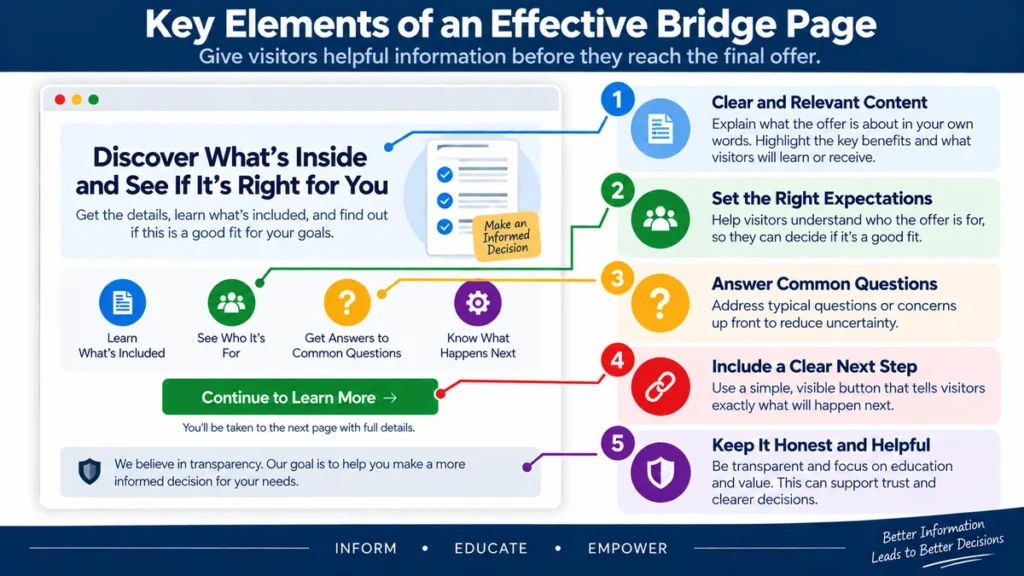
There is no single bridge-page template that fits every campaign.
But several elements are commonly useful.
The headline should connect with the reason the visitor arrived.
It does not need exaggerated promises. It simply needs to make the subject of the page clear.
This is the substance of the page.
Depending on the campaign, that might include an explanation, short guide, product overview, comparison, frequently asked questions, demonstration, or another form of useful content.
The product or next destination should not appear randomly.
The visitor should be able to understand how the recommendation connects to the problem or topic discussed on the page.
Your call to action should accurately describe the next step.
Simple phrases such as “Learn More,” “See the Full Details,” or “Visit the Official Page” can often communicate more clearly than exaggerated urgency.
If the page contains an affiliate recommendation and you may earn compensation when someone follows the link and completes a qualifying action, that relationship should be disclosed clearly.
A disclosure should not be hidden simply because the page is short.
A bridge page should also work properly on the devices your visitors actually use.
That means readable text, buttons that are easy to tap, sensible spacing, fast-loading assets, and no critical information that becomes difficult to access on a smaller screen.
Yes, in some funnels the bridge step can also include an opt-in.
For example:
Traffic → Opt-in / bridge page → useful resource or next page → relevant offer
This can be useful because it gives the visitor an opportunity to join an audience you control instead of making the entire relationship depend on one click.
But that does not mean every bridge page needs an email form.
If asking for an email does not serve a clear purpose in the visitor’s journey, adding one can create unnecessary friction.
If you want a deeper explanation of where email fits into the overall business model, see Do I Need a List Already to Make Affiliate Marketing Work?.
The terms are often used loosely, which can cause confusion.
A landing page is simply a page a visitor lands on after clicking a link, ad, email, or another traffic source.
A bridge page describes the page’s role in the journey: it connects the visitor from one stage to another.
So a bridge page can also be a landing page.
You may also hear terms such as presell page, pre-lander, or intermediate page. These terms can overlap, although marketers sometimes use them to describe slightly different page styles.
Rather than getting stuck on terminology, focus on the function of the page.
What information does it give the visitor, and why is that information useful before the next step?
A bridge page is a tool, not a cure for a weak campaign.
It cannot make poor traffic suddenly become qualified traffic.
It cannot turn an irrelevant product into the right offer.
It cannot replace honest tracking and analysis.
And it cannot guarantee that someone will buy.
If a campaign is not working, the bridge page is only one part of the system to examine.
You still need to look at traffic quality, message match, offer relevance, tracking, visitor behavior, and the merchant’s own sales process.
That systems mindset is why I prefer treating affiliate marketing as a connected process rather than a collection of isolated tricks. I explain that idea further in Courses vs Systems: Why Systems Win.
A bridge page can make sense when you have a genuine reason to add something useful between the visitor and the final destination.
For example, you may want to:
The key phrase is genuine reason.
If the page exists only because somebody told you every affiliate funnel needs another page, that is not a strong reason to build one.
So, what is a bridge page?
It is a page you control that connects the visitor’s original click with the next destination while adding useful context along the way.
A good bridge page should make the visitor’s journey clearer.
It should explain rather than confuse, inform rather than exaggerate, and create a logical transition rather than simply insert another click into the funnel.
When the page genuinely helps the visitor understand the next step, it has a reason to exist.
When it does nothing except forward traffic somewhere else, it is worth asking whether you need the page at all.
If you are building your affiliate marketing foundation and want to see how the different pieces fit together, visit the Start Here page.
Subscribe to get the latest posts sent to your email.
If you found this guide helpful, please tap the Like button and share it with someone who could benefit. Every Like and Share helps more people discover Partner to Wealth.