An affiliate marketing funnel does not need dozens of pages or complicated automation. Learn how beginners can connect traffic, useful content, email follow-up, and relevant offers with a simple structure.
An affiliate funnel can sound complicated when you first hear the term.
You may picture dozens of landing pages, advanced automation, multiple email sequences, tracking software, upsells, downsells, and complicated integrations.
None of that is necessary to begin.
A simple affiliate marketing funnel is simply a path that helps the right visitor move from discovering you to understanding a problem, receiving useful information, and eventually considering a relevant offer.
For a beginner, that path can be surprisingly small.
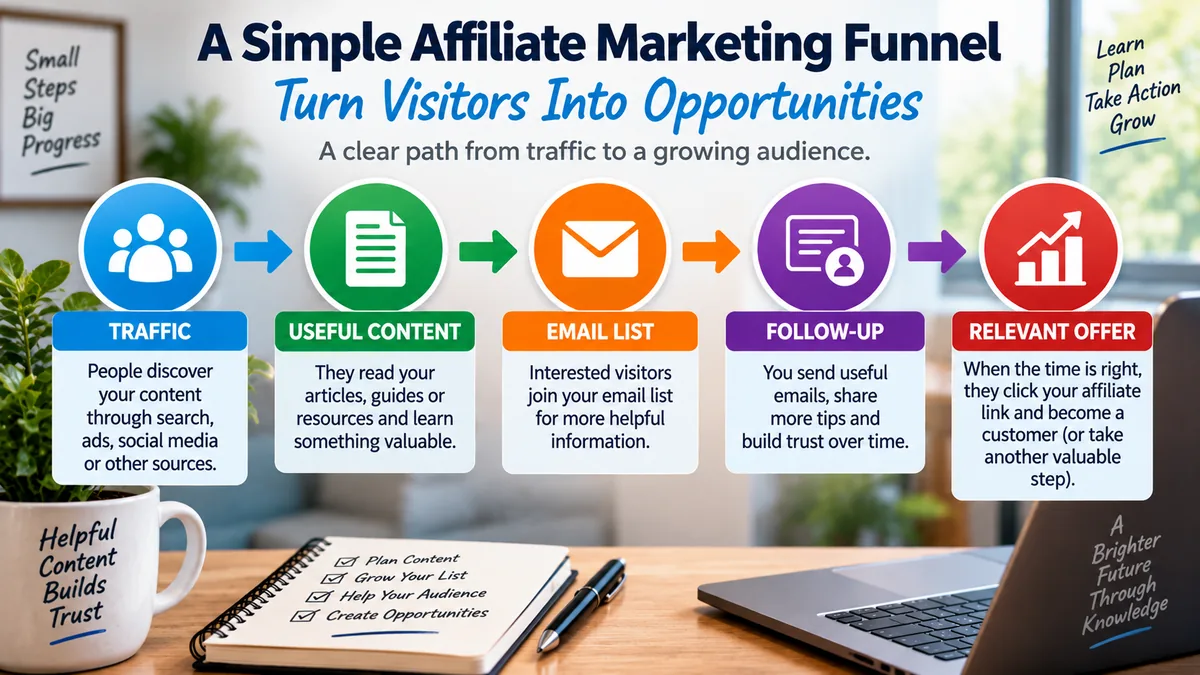
Traffic → useful content → email relationship → relevant offer
The purpose of the funnel is not to pressure every visitor into buying immediately. It is to make the next useful step clear.
If you first want to understand the overall business model behind that journey, read How Affiliate Marketing Actually Works for Beginners.
An affiliate marketing funnel is the sequence of steps a potential customer moves through before reaching an affiliate offer.
The funnel may begin with a search result, advertisement, social post, email, video, or another source of traffic.
Instead of sending every visitor directly to a seller’s page, you can give the visitor useful information first.
That might be an article, a guide, a comparison, a bridge page, a checklist, or another resource that helps the person understand the subject.
Some visitors may then join your email list.
Others may be ready to continue directly to a relevant offer.
The important idea is that each step has a purpose.
You are not adding pages simply because funnels are supposed to look complicated.
Every additional page, tool, automation, and decision creates another place where something can break.
It also creates another thing you need to understand and maintain.
That is why a beginner usually benefits from building the smallest funnel that can accomplish the goal.
A basic system lets you learn important questions first:
Those questions matter more than whether your funnel has five automations or fifty.
This is similar to the principle behind The Simple Affiliate Marketing Tech Stack You Actually Need. Start with what solves an actual problem and add complexity only when the business gives you a reason to add it.
Before building pages, decide who the funnel is for.
A funnel built for someone who has never heard of affiliate marketing should look different from one designed for an experienced affiliate comparing advanced tracking tools.
You do not need an elaborate customer avatar.
You simply need enough clarity to answer:
Then choose one primary goal for the funnel.
For example, your goal might be to turn interested visitors into email subscribers before introducing them to a relevant affiliate offer.
Trying to make one page perform six unrelated jobs usually weakens all six.
Your funnel needs visitors, but you do not need traffic from everywhere at once.
You might begin with search traffic, Microsoft Ads, Pinterest, YouTube, email, or another channel that fits your audience.
The important thing is to understand where those visitors came from and why they clicked.
A search visitor who asked a specific question may need a different introduction from someone who clicked an advertisement promising a free guide.
That is another reason beginners benefit from focusing on one traffic source at a time.
When the traffic source is clear, it becomes easier to judge whether the next page matches the visitor’s expectations.
Your first owned page should help the visitor make progress.
That could be a blog article, landing page, review, tutorial, resource page, or bridge page.
The page should not exist merely to hide an affiliate link behind another click.
It should add useful context.
For example, a beginner searching for help choosing affiliate tools might benefit from an article that explains which tools are actually necessary before being introduced to a specific product.
A visitor considering an unfamiliar program might benefit from a page explaining who the program is for, what problem it addresses, and what questions to consider before buying.
This is the basic role discussed in What Is a Bridge Page and Why Use One?.
A useful page gives you an opportunity to educate rather than simply redirect.
Not every visitor is ready to buy during the first visit.
An email opt-in gives an interested person another way to continue.
The offer could be simple:
The best opt-in usually extends the subject the visitor is already interested in.
If someone is reading an article about building an affiliate funnel, a beginner funnel checklist makes sense.
A completely unrelated download does not.
You also do not need twenty lead magnets when you are starting.
One useful resource that matches the audience is enough to begin.
This is one of the reasons affiliate marketers should build an email list from day one. A visitor who is not ready for the offer today can still become part of an audience you can help later.
Once someone subscribes, the next message should not feel disconnected from the reason they joined.
If you promised a checklist, deliver it.
If you promised a guide, provide the guide.
Then continue the conversation with useful information.
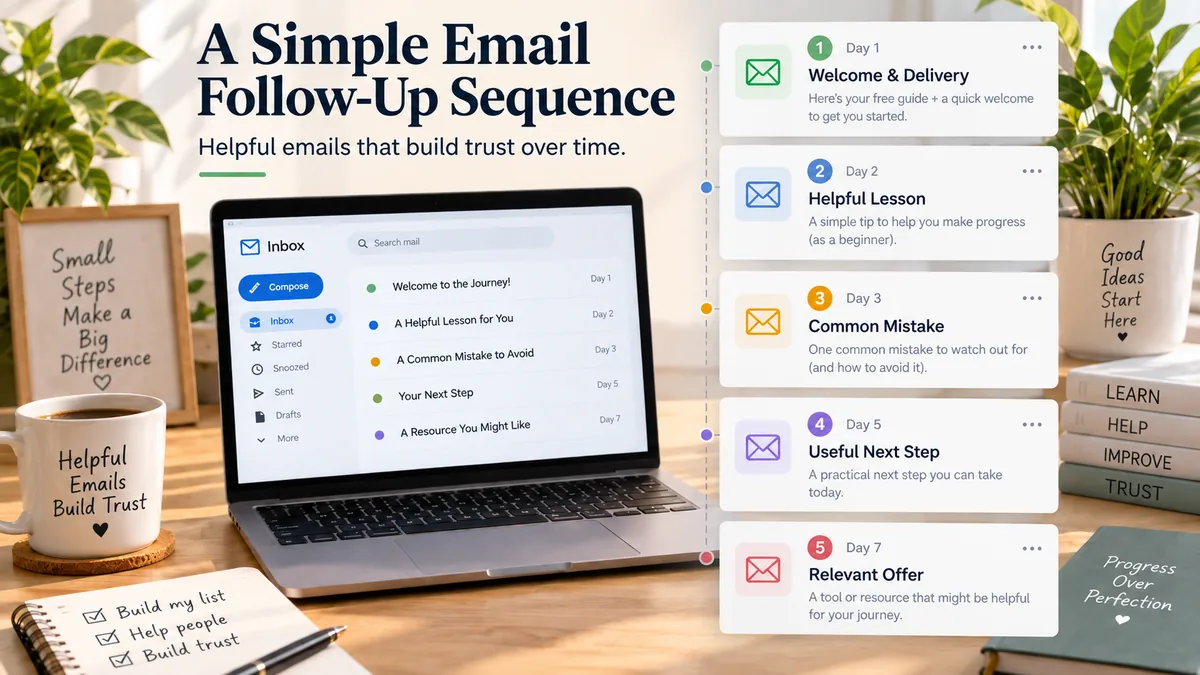
A beginner follow-up sequence does not need thirty emails.
You might begin with a small sequence such as:
You can refine the sequence later based on what subscribers actually respond to.
The goal is not to create the longest automation.
The goal is to make each message useful enough that the subscriber has a reason to keep opening the next one.
The offer should feel like a logical continuation of the problem you have been helping the visitor solve.
If the traffic, content, opt-in, emails, and offer all address completely different needs, the funnel will feel disconnected.
A simple structure might look like this:
Beginner affiliate traffic article → affiliate starter checklist → beginner email lessons → beginner-friendly affiliate resource
The offer does not need to have the highest commission in the marketplace.
Audience fit matters more.
That is why the process in How to Choose an Affiliate Offer Without Chasing High Commissions starts with the audience rather than the payout.
If you use ClickBank, the network uses affiliate tracking URLs called HopLinks to connect referred traffic with the affiliate responsible for the referral.
ClickBank explains how these links work in its official HopLink documentation.
Whichever affiliate network you use, make sure you understand how its tracking links work before sending traffic through the funnel.
When your funnel includes an affiliate recommendation or affiliate link, visitors should understand that you may receive compensation from qualifying purchases.
The Federal Trade Commission says material relationships between an endorser and a company should be disclosed clearly and conspicuously.
For affiliate marketing specifically, the FTC explains that the disclosure should make the commission relationship understandable and should be placed close enough to the recommendation or link that readers can connect the two.
You can review the FTC’s official guidance in FTC’s Endorsement Guides: What People Are Asking.
A disclosure should not be treated as something to hide in a distant legal page while the recommendation appears somewhere else.
Clarity builds a better funnel than concealment.
You should know enough about the funnel to identify where visitors are moving forward and where they are dropping off.
For a beginner funnel, start with a few practical measurements:
You can add more advanced tracking later.
The goal is to answer useful questions rather than collect every statistic available.
If you need a simple framework for that process, use How to Track Affiliate Marketing Without Overcomplicating It.
Beginners often delay launching because they believe a funnel is incomplete without advanced technology.
You probably do not need all of these on day one:
None of those tools or techniques is automatically bad.
They simply need to earn their place.
If your simple funnel begins producing enough activity that you can identify a specific limitation, then solve that limitation.
Do not build an enterprise marketing system for a funnel that has not received its first hundred visitors.
Imagine you publish an article helping beginners understand the essential tools needed to start affiliate marketing.
A visitor discovers that article through search.
The article contains a call-to-action offering a simple affiliate marketing starter checklist.
The visitor subscribes and receives the checklist by email.
Over the next several messages, you provide additional help:
When a particular tool, service, or program genuinely supports one of those lessons, you introduce it with a clear affiliate disclosure.
That is a funnel.
It does not require fifteen pages.
It creates a logical path from discovery to education to relationship to recommendation.

The strongest beginner funnel is not necessarily the one with the most technology.
It is the one where each step makes sense to the person moving through it.
Start with one audience.
Choose one traffic source.
Send visitors to useful content you control.
Give interested people a relevant reason to join your email list.
Follow up with information that helps them move forward.
Then introduce affiliate offers where they naturally solve a problem the audience already understands.
Your affiliate marketing funnel can become more sophisticated later.
For now, build the simplest version that lets you attract, help, follow up with, and learn from real visitors.
A working simple funnel will teach you far more than an elaborate funnel that never gets launched.
Subscribe to get the latest posts sent to your email.
If you found this guide helpful, please tap the Like button and share it with someone who could benefit. Every Like and Share helps more people discover Partner to Wealth.