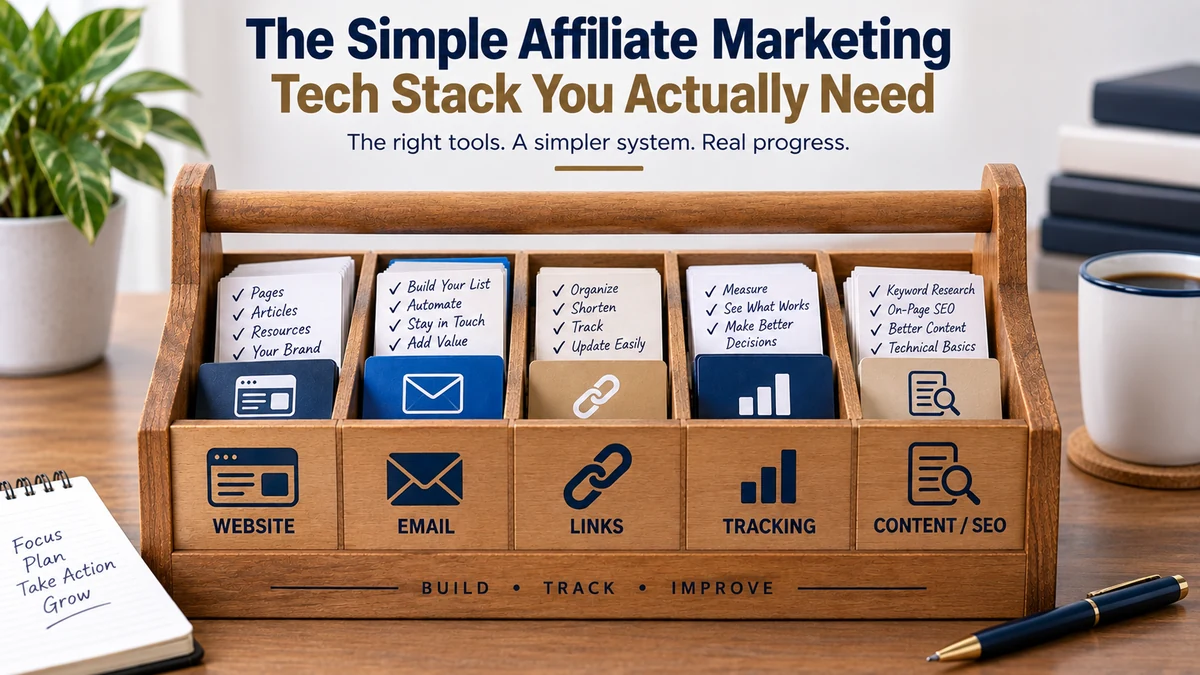
ou do not need dozens of tools to start affiliate marketing. Learn the core technology needed for your website, email, links, SEO, tracking, and a simpler working system.
Affiliate marketing can become surprisingly complicated when you start collecting tools before you have a clear reason to use them.
You hear about page builders, autoresponders, tracking platforms, link managers, SEO plugins, analytics tools, funnel software, chatbot software, automation platforms, heatmaps, split-testing systems, and dozens of other products.
Before long, you can end up paying for a large collection of software while still trying to answer a much simpler question:
What technology do I actually need to run a basic affiliate marketing business?
The answer is usually less than beginners expect.
A useful affiliate marketing tech stack should help you publish useful information, capture and communicate with interested visitors when appropriate, send people to relevant offers, and measure what happens.
Everything beyond that should earn its place.

Your tech stack is simply the collection of technology you use to operate your business.
For an affiliate marketer, that may include the software used to:
The mistake is assuming you need a separate paid platform for every possible function from day one.
You do not.
A beginner usually benefits more from a small stack they understand than a complicated stack full of overlapping tools.
That is the same principle behind building an affiliate marketing system instead of continually collecting more tactics.
The first core component is somewhere you control where useful content and important pages can live.
For many affiliate marketers, that means a website.
Your site can eventually contain:
The important part is not owning the fanciest website platform.
It is having a reliable place where you can publish, organize, and improve your content without rebuilding the business every time a social platform or advertising account changes.
Partner to Wealth currently uses WordPress as that core publishing layer. That does not mean every affiliate marketer must use WordPress, but it illustrates the role this part of the stack serves.
Your publishing platform also needs a practical way to create readable pages.
That might be the built-in editor, a theme, or a page-building tool.
You do not need three separate page builders doing the same job.
You need a reliable way to build the types of pages your business actually uses.
For example, an affiliate site might need:
If you are not familiar with the role of an intermediate presell page, see What Is a Bridge Page and Why Use One?.
The tool should support the page you need to build. The page should not exist simply because you bought another tool.
Email becomes another important part of the stack when you want visitors to voluntarily join an audience you can communicate with again.
An email platform typically gives you the ability to:
You do not need a massive email list before affiliate marketing can work.
But when list building becomes part of your strategy, using a proper email platform is much more practical than trying to manage subscribers manually.
I discuss that distinction in Do I Need a List Already to Make Affiliate Marketing Work?.
Partner to Wealth currently uses AWeber for email. Again, the point is not that every beginner must choose the same provider. The important part is understanding the job this tool performs inside the system.
Affiliate businesses can accumulate a surprising number of long, unattractive, and difficult-to-manage URLs.
A link-management system can make those easier to organize.
Instead of scattering raw destination URLs throughout your website, you can maintain cleaner branded links and update destinations from a central location when appropriate.
That can be useful when:
Partner to Wealth currently uses Pretty Links for this role.
Link management is helpful, but it should not be confused with full conversion tracking. A clean redirect can organize a link; it does not automatically tell you everything that happens after the visitor leaves your site.
This is one area where beginners should avoid operating completely blind.
You do not need an enterprise analytics department.
But you should eventually be able to answer basic questions such as:
Google’s official Google Analytics setup documentation explains how a website owner can create a GA4 property, add a web data stream, and install the Google tag so data can begin flowing into Analytics.
You may eventually add more specialized tracking depending on your campaigns, affiliate networks, advertising platforms, or conversion requirements.
But the principle is simple: tracking should answer a business question.
Installing another tracking platform just because somebody recommends one is not the same thing as knowing what you actually need to measure.
This is also why focusing on one acquisition channel at first can help. If you have not read it yet, see Why Beginners Should Focus on One Traffic Source at a Time.
If organic search is part of your content strategy, an SEO tool can help you handle some of the technical and on-page details.
Depending on the tool, that can include:
Partner to Wealth currently uses Rank Math for this role.
An SEO score is not the business objective, however.
A plugin can identify technical or structural opportunities, but it does not replace useful content, sensible site organization, or a genuine reason for somebody to visit the page.
The less exciting parts of the stack still matter.
If your website is the center of your content and funnels, it needs to remain available, reasonably fast, maintained, and recoverable if something goes wrong.
That means paying attention to:
WordPress recommends keeping plugins updated because updates can include security, performance, code-quality, and feature improvements. Its official plugin-management documentation also recommends having a current backup before updating plugins.
You do not need to become a server administrator.
You do need a reasonable maintenance process so the infrastructure supporting the business is not ignored.
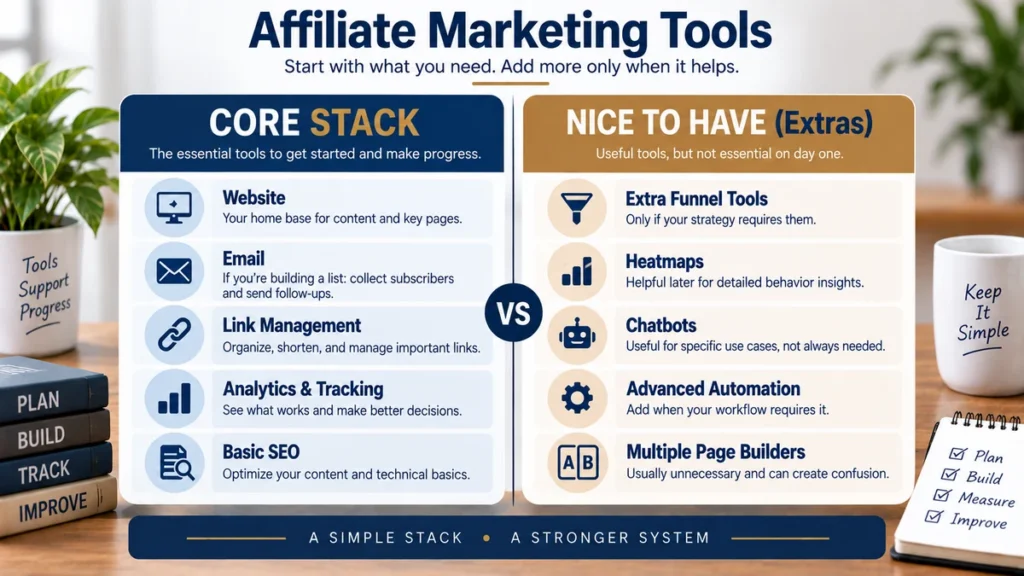
Many useful tools exist that are not essential to a beginner’s first working system.
Depending on your strategy, you may not initially need:
Some of these tools may eventually become useful.
But “useful someday” is not the same thing as “needed now.”
Software overlap creates more than a financial cost.
It can also create:
That is why simplifying a tech stack can sometimes be more useful than adding another feature.
If two tools perform almost the same job, ask whether both are actually necessary.
For many beginners, a practical starting stack can be reduced to a handful of functions:
That is already enough technology to build a substantial amount of affiliate marketing infrastructure.
You can add specialized tools later when an actual business requirement appears.
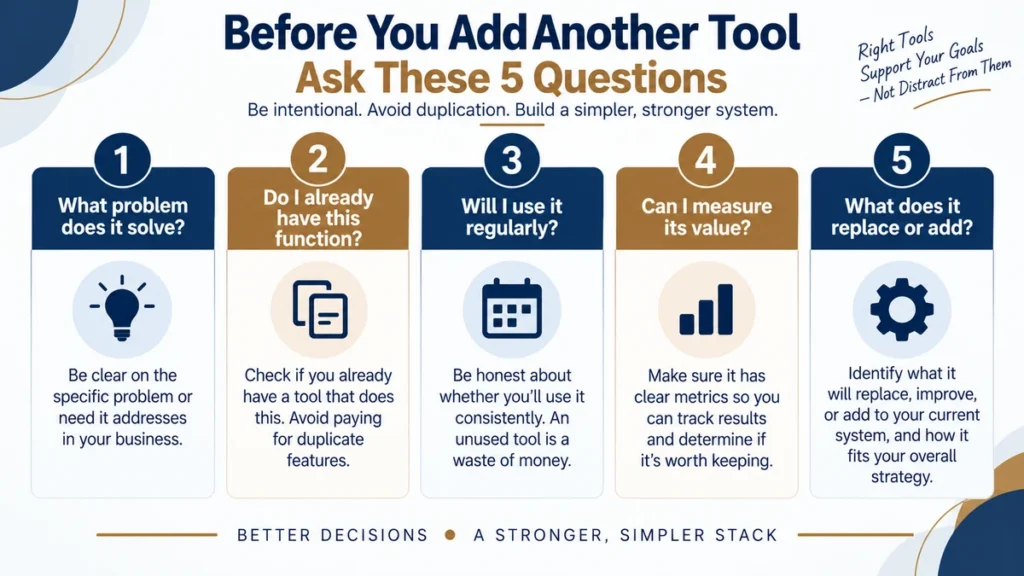
Before adding software to your stack, ask:
If you cannot clearly answer those questions, you may not need the tool yet.
Your technology should support the way you have decided to operate.
It should not determine the strategy simply because a new piece of software looks impressive.
If your current priority is publishing useful search content, your stack should make publishing, SEO, internal linking, and measurement easier.
If you later begin running paid traffic, you may need additional conversion tracking or specialized landing pages.
If your email list becomes more sophisticated, you may need additional segmentation or automation.
Add those capabilities when the workflow requires them.
That approach keeps technology serving the business rather than turning software management into the business.
To make this less theoretical, the current Partner to Wealth setup includes tools serving several of the roles described above:
This is not presented as the only correct combination of tools.
It is simply an example of assigning one clear job to each part of the stack and trying to avoid unnecessary overlap.
If you want to see the resources and tools currently being organized around the site, you can also visit the Partner to Wealth Resources page.
The best affiliate marketing tech stack is not the one with the most software.
It is the one that gives you the capabilities you actually need without creating unnecessary cost and complexity.
Start with the core functions:
Publish → Communicate → Link → Measure → Improve.
Then add technology when a real limitation appears.
If you are still building the foundation of your affiliate business, visit the Start Here page to continue through the core concepts in order.
Subscribe to get the latest posts sent to your email.
If you found this guide helpful, please tap the Like button and share it with someone who could benefit. Every Like and Share helps more people discover Partner to Wealth.