Learn a practical beginner-friendly approach to affiliate keyword research so you can choose topics based on search intent, relevance, and real reader needs instead of chasing search volume.
Keyword research can sound much more complicated than it needs to be.
For an affiliate marketer, the goal is not to collect the biggest possible list of keywords. It is to understand what people are searching for, why they are searching for it, and whether you can create a genuinely useful piece of content that answers that need.
Good keyword research for affiliate marketing helps you decide what to write before you spend hours creating an article that nobody was looking for—or that attracts visitors who have no interest in the subject you are trying to help them with.
This guide walks through a simple process you can use to find and evaluate keyword ideas without turning keyword research into a full-time job.
Keyword research is the process of identifying the words and phrases people use when they search online and deciding which of those searches make sense for your website.
For affiliate marketers, there is an extra consideration: a keyword should fit the audience and the role your content plays in their decision-making process.
Someone searching for “what is affiliate marketing” is at a very different stage from someone searching for “how to choose an affiliate offer.” Both searches may be valuable, but they require different content.
That is why keyword research should not begin with search volume alone. It should begin with the person behind the search.
One of the easiest ways to make keyword research confusing is to open a keyword tool before deciding what your site actually needs to cover.
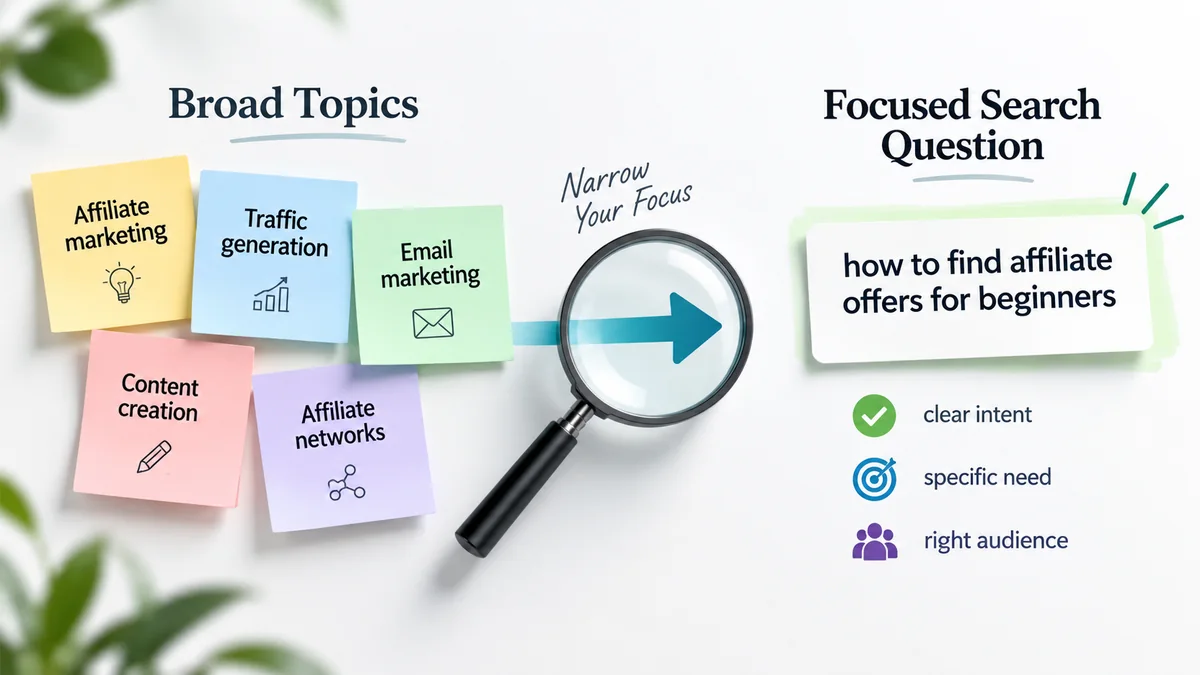
Start with broad topics that belong naturally on your website.
For an affiliate marketing site, those might include:
These are not necessarily your final target keywords. Think of them as topic buckets.
Once you have a clear topic, you can look for the questions and searches that exist inside it.
This also helps prevent a common mistake: publishing articles simply because a keyword tool says they receive searches, even though they have little connection to the main purpose of the site.
Search intent is the reason behind a search.
Two keywords can contain similar words but represent completely different needs.
For example:
If you misunderstand the intent, even a well-written article can disappoint the visitor.
Before choosing a keyword, ask:
If you want to go deeper into this part of the process, understanding buyer intent is especially useful because it helps you recognize how a reader’s needs change as they move from learning to evaluating possible solutions.
You do not need to invent complicated phrases just because they sound like SEO keywords.
Google’s SEO Starter Guide recommends thinking about the words people might use to find your content. It also explains that experienced users and beginners may search differently.
That matters in affiliate marketing because beginners frequently describe a problem differently from someone who already understands the terminology.
For example, a new affiliate might search:
A more experienced marketer might search:
Both audiences can be valuable. The important thing is knowing which reader you are writing for.
You do not need dozens of tools to find useful ideas.
Several simple sources can reveal what people want to know.
Start typing a relevant topic into Google and observe the suggestions that appear.
These can expose different ways people express a question or narrow a broader topic.
Do not automatically turn every suggestion into an article. Use the suggestions as research clues and evaluate the intent behind them.
Search results may reveal related questions and topics that help you understand the broader subject.
These are particularly useful for discovering supporting questions that can strengthen an existing article instead of requiring a separate page for every tiny keyword variation.
Once your site has begun receiving search impressions, your own data becomes especially valuable.
Google Search Console can show queries that already trigger impressions for your pages.
You may discover that an existing article is being found through searches you did not originally target. That can reveal opportunities to improve a section, answer an additional question, or create a closely related article when the topic truly deserves its own page.
Dedicated SEO and keyword tools can provide additional information such as estimated search volume, related phrases, trends, and competition estimates.
Those numbers can help you compare ideas, but they should not make the decision for you.
Keyword-tool metrics are estimates. Treat them as supporting information rather than absolute truth.

A large search-volume number can be tempting, but more searches do not automatically make a keyword better.
Consider two hypothetical topics:
The second topic may be much more useful to your content strategy.
A smaller, focused audience can be more meaningful than a large audience arriving for the wrong reason.
Instead of asking only, “How many people search for this?” also ask:
One of the most useful keyword-research steps costs nothing: search the phrase yourself.
Study the results that currently appear.
You are not looking for content to copy. You are trying to understand what kind of result the search engine believes satisfies the query.
Look for patterns such as:
If nearly every result is a product page and you plan to publish a general educational essay, you may be fighting the searcher’s intent.
If most results are beginner guides, that tells you the search probably calls for an educational answer.
Finding a keyword is not enough.
You still need a reason for your page to exist.
Google says its ranking systems are designed to prioritize helpful, reliable, people-first information rather than content produced mainly to manipulate rankings. Its guidance also encourages publishers to provide substantial value rather than simply rewriting what other pages already say.
You can review Google’s guidance on creating helpful, reliable, people-first content for the broader principles.
Before writing, ask yourself:
If the only plan is to rewrite the existing search results with slightly different wording, the keyword probably is not enough of a reason to create another article.
Broad keywords tend to cover large topics.
A more specific search often tells you more about what the reader needs.
Compare:
The third phrase communicates a much clearer question.
That does not mean every article needs to target an extremely long keyword. It means specificity can help you match the content more closely to the reader’s problem.
Partner to Wealth’s guide to free vs paid traffic for affiliate marketing is an example of taking a broad traffic topic and narrowing it into a specific question a beginner can understand.
A common SEO mistake is finding several nearly identical phrases and assuming each one needs its own page.
For example, these searches might represent essentially the same need:
If one thorough article can satisfy all three searches naturally, creating three nearly identical pages could leave you with thin, repetitive content.
Google’s systems can understand how a page relates to many queries even when every exact variation does not appear on the page.
Build the page around the topic and intent, not around repeating every possible version of the keyword.
Once you have collected ideas, narrow them down.
You can use a basic worksheet or spreadsheet with columns such as:
You do not need an elaborate scoring formula.
The purpose of the shortlist is to slow down the decision just enough that you do not publish whatever keyword happens to look exciting that day.
Before creating a new article, check whether you already have a page that answers the same question.
Sometimes the better move is to improve an existing article instead of publishing another one.
This is especially important as your site grows.
A content library becomes stronger when articles have clear jobs and support one another rather than competing with several pages covering essentially the same subject.
That same principle applies when planning your publishing schedule. A simple weekly affiliate marketing workflow can help you separate research, writing, publishing, and review instead of making every content decision at the last minute.
After choosing a keyword, do not jump directly into writing.
Create a short content brief first.
It can be as simple as answering five questions:
This helps keep the article focused on the reader instead of on how many times you can insert a keyword.
It also makes internal linking easier because you can connect the reader to the next genuinely useful topic.
Your primary keyword can help search engines and readers understand the subject of the page, but it should fit naturally.
Useful places may include:
That does not mean the phrase belongs in every heading or every paragraph.
Google’s Search Essentials recommends using words people would search for in prominent locations while its spam policies specifically warn against repeating keywords so often that the writing becomes unnatural.
Write for comprehension first.
Keyword research does not end when the article is published.
Over time, look at how your content actually performs.
You may learn that:
Those observations make the next round of keyword research better.
This is also why it helps to avoid changing everything at once. If you make a meaningful content or campaign adjustment, knowing what changed makes the result easier to interpret. The same controlled approach is covered in our guide on how to test an affiliate campaign without changing everything at once.
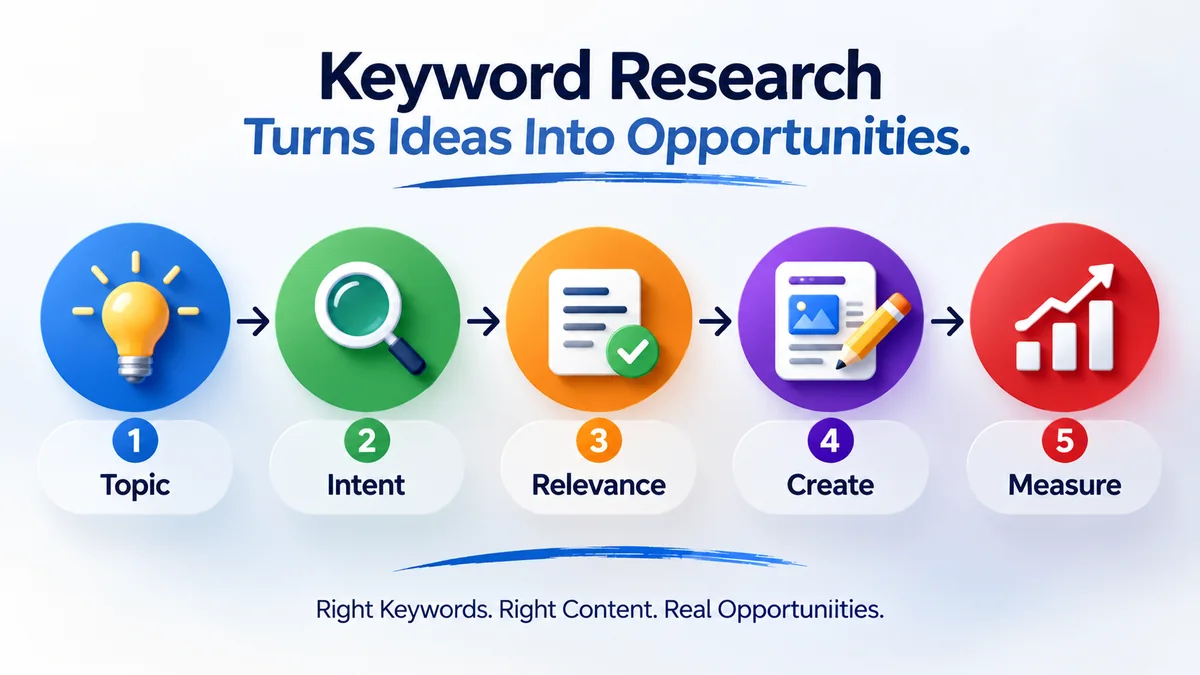
You can reduce the entire process to these steps:
Keyword research for affiliate marketing does not need to become an endless hunt for high-volume phrases.
The most useful approach is simpler: understand what your audience is trying to find, choose topics that belong on your site, study the intent behind the search, and create something that genuinely helps the reader move forward.
Search data can guide the decision, but it should not replace judgment.
When keyword research is connected to a clear content strategy, each article can serve a specific purpose instead of becoming another page published simply because a keyword existed.
That is how a collection of individual posts can gradually become a useful, connected resource for the audience you are trying to reach.
Subscribe to get the latest posts sent to your email.
If you found this guide helpful, please tap the Like button and share it with someone who could benefit. Every Like and Share helps more people discover Partner to Wealth.