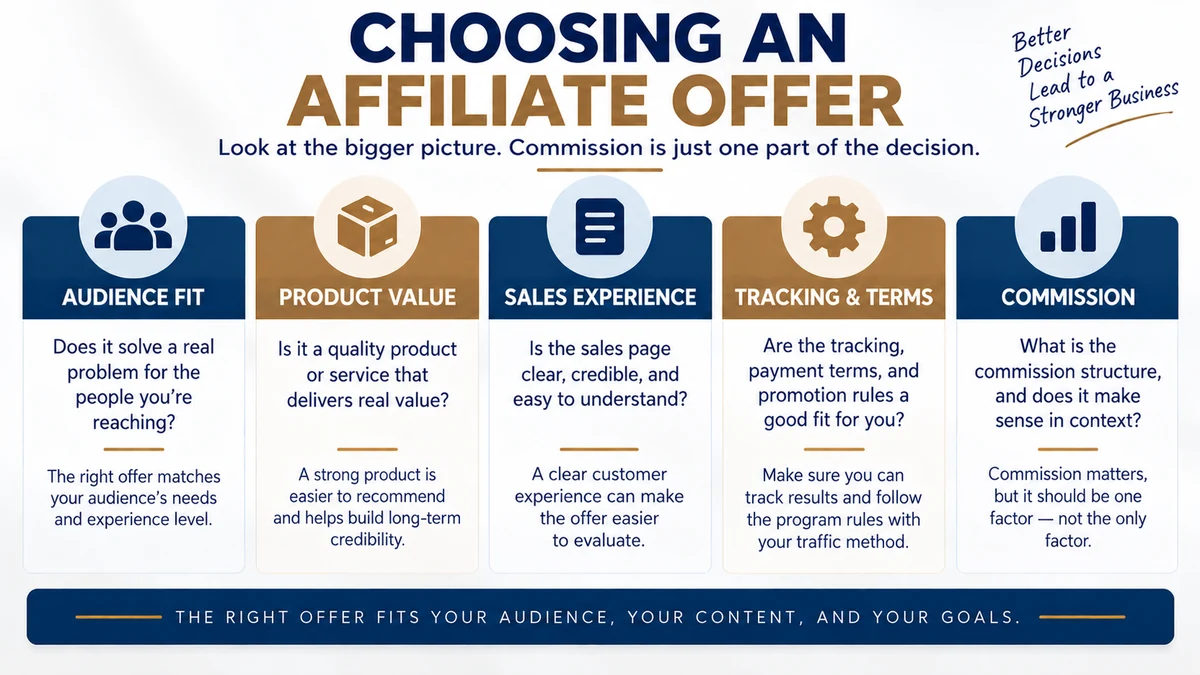
A high commission does not automatically make an affiliate offer worth promoting. Learn how to evaluate audience fit, product quality, tracking, sales experience, program rules, and commissions before deciding.
One of the easiest mistakes to make in affiliate marketing is choosing an offer because the commission number looks impressive.
A product pays $100 per sale instead of $30, so it must be the better opportunity.
Not necessarily.
A high commission cannot compensate for the wrong audience, a weak product, poor message match, confusing sales material, unreliable tracking, or an offer that people simply do not want.
If you want to choose an affiliate offer intelligently, the commission rate should be only one part of the decision.
The better question is:
Is this an offer I can responsibly put in front of the audience I am trying to help?
That question leads to much better decisions than simply sorting offers from highest commission to lowest.
The first question should be whether the offer makes sense for the people you are reaching.
A product can have excellent commission terms and still be a poor fit for your audience.
For example, imagine you attract beginners who are still learning the fundamentals of affiliate marketing.
An expensive advanced platform designed for experienced media buyers may be a strong product in its own right, but that does not automatically make it the right recommendation for a beginner audience.
You need to understand:
This is one reason traffic quality matters so much. If you are attracting the wrong people, even a good offer can look bad in your data.
That connects directly with Why Beginners Should Focus on One Traffic Source at a Time. The better you understand where your visitors come from and what they want, the easier it becomes to evaluate whether an offer actually belongs in front of them.
Before looking at commission statistics, make sure you can clearly explain what problem the product or service addresses.
If you cannot explain the product’s purpose in plain language, you are going to have a difficult time creating useful content around it.
Ask yourself:
A strong affiliate offer usually becomes easier to market when the value proposition is understandable without exaggerated claims.
Affiliate recruitment material is designed to persuade affiliates to promote an offer.
That is not the same thing as evaluating the customer experience.
Whenever practical, look beyond the affiliate statistics and examine what the customer is actually being asked to buy.
Consider:
You are attaching your recommendation to the offer.
That makes the experience after the click relevant to you, even when you do not control the merchant’s website.
One of the most useful things an affiliate can do is stop looking at a sales page like a marketer for a moment and look at it like a potential customer.
Ask:
The affiliate does not control the final sales page, but the sales page can still affect what happens to the traffic you send.
A good bridge or presell page can provide useful context before the visitor reaches the merchant, but it cannot repair every weakness in the merchant’s offer.
If you want a deeper explanation of that part of the funnel, see What Is a Bridge Page and Why Use One?.

Affiliate networks and marketplaces may provide performance statistics that help you compare offers.
Those statistics can be useful, but they need context.
For example, ClickBank’s official Marketplace stats guide explains metrics including average dollars per conversion, conversion rate, earnings per click, and Gravity.
These metrics answer different questions.
None of those statistics can tell you by itself whether the offer is right for your audience.
A high Gravity score may tell you that affiliates are successfully promoting the offer, but it can also mean you are entering a more competitive promotion environment.
A lower figure does not automatically mean the product is bad either. It may simply have less affiliate activity or serve a narrower market.
Use metrics to investigate an offer, not to outsource the entire decision.
This is where beginners can get distracted.
An offer may advertise a large commission per sale, but that figure tells you very little without the rest of the picture.
You still need to consider:
A smaller commission attached to a strong audience match can be more useful than a larger commission attached to an offer your visitors have little reason to consider.
Commission size matters. It just does not deserve to make the decision by itself.
Before investing time or money into promoting an offer, understand the basic affiliate rules.
Depending on the program, you may need to check:
A great offer is not useful to you if your intended promotion method violates the program’s rules.
Affiliate marketing becomes difficult to improve when you cannot tell what happened after you sent the visitor away.
At a minimum, you should understand what the program records and what information you can see.
Depending on the platform and your campaign, that may include:
You may also use your own analytics or link-management tools to understand what happens before a visitor reaches the merchant.
If you are still deciding what technology is actually necessary, see The Simple Affiliate Marketing Tech Stack You Actually Need.
A product becomes much easier to promote responsibly when there are useful questions you can answer around it.
Ask whether the offer gives you legitimate opportunities to create content such as:
If the only promotional idea you can think of is repeatedly telling people to buy the product, the offer may not fit the authority-style content strategy you are trying to build.
Useful affiliate content should help the visitor understand the problem and their options before asking them to consider a commercial solution.
Credibility improves when you are willing to acknowledge that a product may not be appropriate for everyone.
That might mean explaining:
You do not need to attack a product to be balanced.
You simply need to avoid treating every commercial relationship as though it automatically makes the product perfect.
If you can earn money from a recommendation, the visitor should be able to understand that relationship.
The Federal Trade Commission’s official Endorsement Guides guidance specifically addresses affiliate marketing and says affiliate relationships should be disclosed clearly and conspicuously so readers can evaluate the recommendation with that knowledge.
Transparency is not a weakness in the recommendation.
It is part of making the recommendation honestly.
Another beginner mistake is treating an offer selection as a permanent commitment.
You can evaluate an offer carefully and still discover that your particular traffic does not respond to it.
That is why testing matters.
When appropriate, start small enough that you can learn before committing a large amount of time, content, or advertising spend.
Look for evidence such as:
Do not judge an offer from one click.
But do not keep pouring resources into an offer simply because the advertised commission is attractive either.

Before deciding to promote an offer, work through a simple checklist:
If an offer looks weak in several of those areas, a bigger commission probably does not fix the underlying problem.
Affiliate offers do not operate in isolation.
The offer needs to fit:
That is why I prefer thinking in systems rather than looking for one magical product that supposedly solves everything.
The offer is one component of the system, not the entire system.
If you are still building the fundamentals of that process, How Affiliate Marketing Actually Works for Beginners explains how traffic, useful content, affiliate links, tracking, merchants, and commissions fit together.
When you choose an affiliate offer, do not let the commission amount make the entire decision for you.
Start with the audience.
Understand the problem.
Evaluate the product and the sales experience.
Read the program terms.
Use marketplace statistics as evidence rather than guarantees.
Make sure you can track enough information to learn from the promotion.
Then look at the commission within that larger picture.
A good affiliate offer is not simply the one that promises to pay the most.
It is one that makes sense for the audience, fits the system you are building, and is something you can recommend without needing to exaggerate what it does.
If you are still building your affiliate-marketing foundation, visit the Start Here page to continue through the core concepts in order.
Subscribe to get the latest posts sent to your email.
If you found this guide helpful, please tap the Like button and share it with someone who could benefit. Every Like and Share helps more people discover Partner to Wealth.