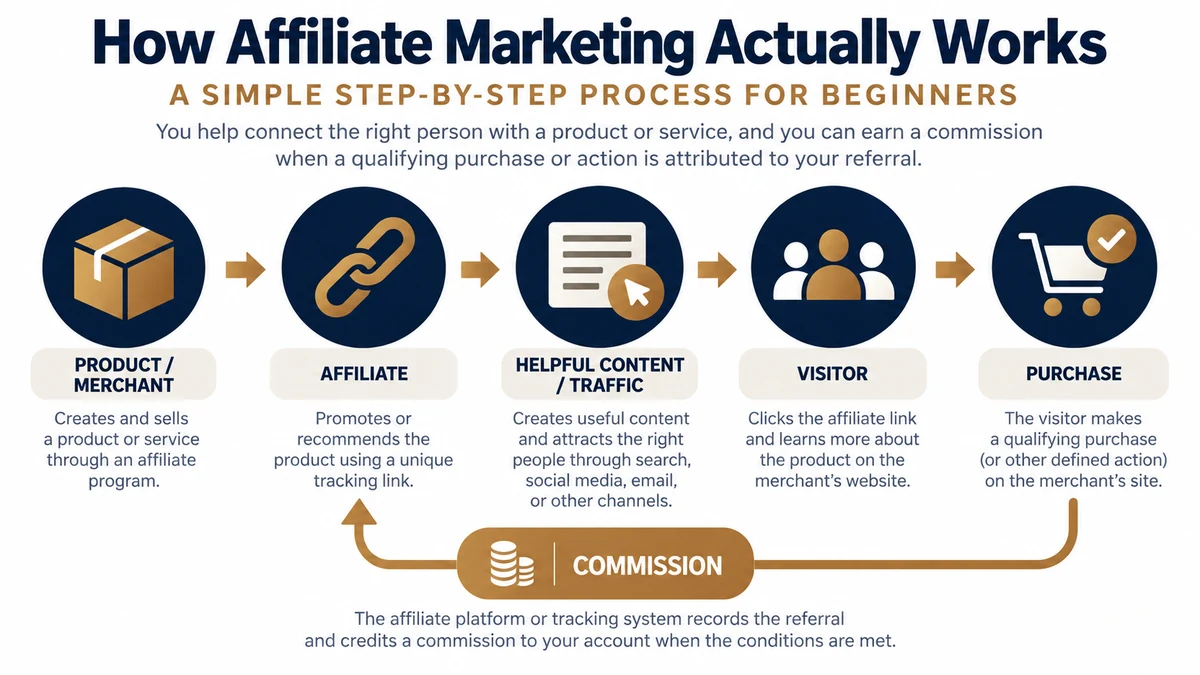
Affiliate marketing is simpler than it first appears. Learn how affiliate links, traffic, tracking, conversions, and commissions work together in a practical beginner-friendly system.
Affiliate marketing can sound more complicated than it really is.
When you are new, you will hear people talking about affiliate links, traffic, funnels, tracking, email lists, conversion rates, networks, commissions, and dozens of different tools. It can make the business model seem as though you need to understand everything before you can even begin.
You don’t.
At its core, affiliate marketing is a simple referral model: you help connect the right person with a product or service that may solve a problem they already have, and you can earn a commission when a qualifying purchase or action is properly attributed to your referral.
The difficult part is not understanding the basic mechanism. The difficult part is building a reliable process around it.
This guide explains how affiliate marketing works from beginning to end, including what happens after someone clicks your link and what a beginner actually needs to focus on.
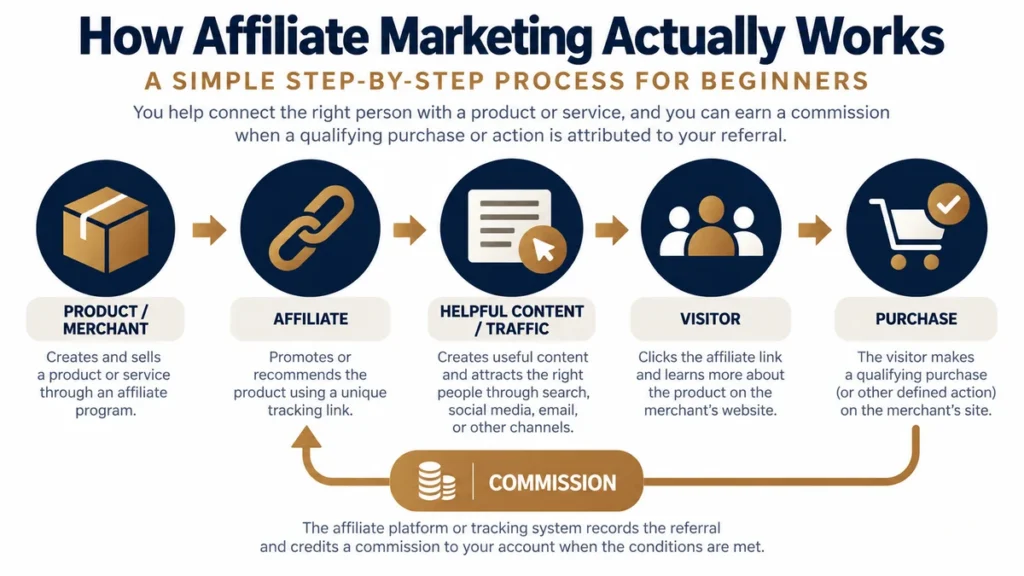
There are usually four main parts involved in an affiliate transaction:
That is the foundation of the entire business model.
You do not normally manufacture the product, process the customer’s payment, ship anything, or provide the core product itself. Your primary job is marketing: attracting appropriate prospects, helping them understand their options, and directing interested people toward an offer.
The process begins when you join a company’s affiliate program or an affiliate network that represents multiple companies.
Some programs approve affiliates automatically. Others review applications before granting access. Requirements vary considerably depending on the merchant, industry, traffic source, and type of product being promoted.
Once approved, you generally receive access to one or more unique tracking links.
An affiliate link contains information that allows the merchant or affiliate platform to associate referred visitors with your affiliate account.
For example, two affiliates might promote exactly the same product, but each affiliate receives a different tracking identifier. That allows the system to determine which affiliate referred a qualifying customer.
Tracking systems differ. Some rely on browser cookies, tracking parameters, account information, or combinations of technologies. Attribution rules can also vary by program, so you should never assume every click will automatically remain credited to you indefinitely.
This is where most of the actual work begins.
Having an affiliate link does not create traffic. You need a way to reach people who may have a legitimate interest in the problem the product addresses.
Traffic can come from many places, including:
A beginner does not need all of these at once. In fact, trying to master several traffic channels simultaneously can make it harder to tell what is actually working.
That is one reason I prefer the idea of building a repeatable process rather than constantly chasing another tactic. I discussed that in more detail in Courses vs Systems: Why Systems Win.
Good affiliate marketing is not simply placing links everywhere and hoping someone clicks.
The useful work happens between attracting a visitor and asking that visitor to consider an offer.
That may involve answering a question, comparing alternatives, explaining how something works, demonstrating a product, discussing advantages and disadvantages, or helping the visitor understand whether an offer is even appropriate for them.
In other words, the affiliate can serve as a bridge between information and the commercial solution.
This is also why a real website can become valuable over time. Instead of depending entirely on sending people directly from an advertisement or social post to somebody else’s sales page, you can create useful content that gives visitors a reason to trust your recommendations and continue exploring your site.
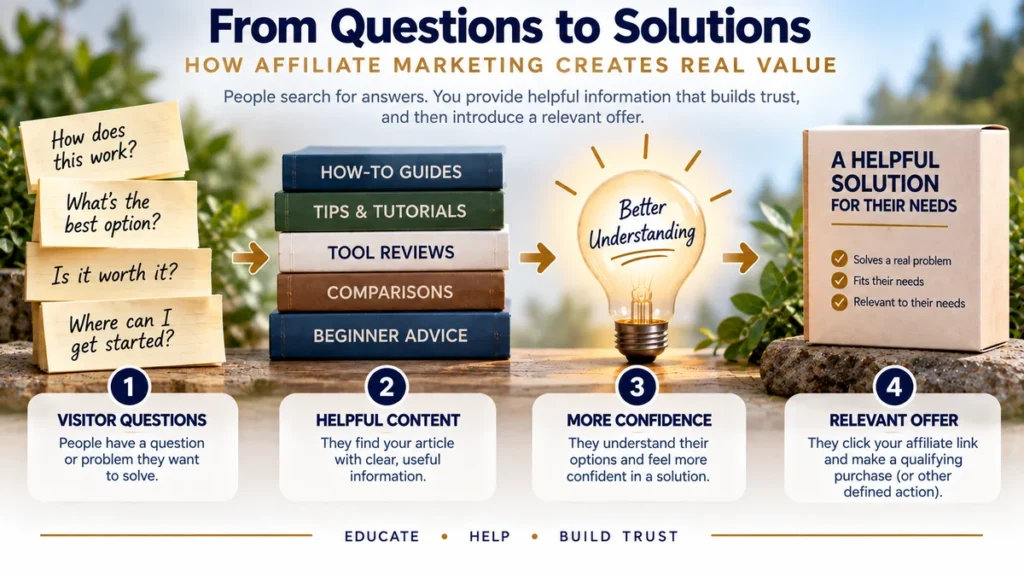
If your content makes the visitor interested in learning more, they may click your affiliate link and continue to the merchant’s website, sales page, registration page, or funnel.
The click itself is usually not a sale.
It is simply the point at which the visitor leaves your property and enters the merchant’s sales process while carrying your tracking information.
This distinction matters because affiliate marketers often focus heavily on getting clicks while overlooking what those clicks represent. A smaller number of well-matched visitors can be more useful than large amounts of poorly targeted traffic.
After the visitor reaches the merchant, much of the sales process is outside the affiliate’s direct control.
The merchant may use a sales page, demonstration, webinar, email sequence, free trial, checkout process, or another conversion mechanism.
This is why choosing an affiliate offer involves more than looking at the commission amount. The quality of the product, credibility of the sales process, fit with your audience, pricing, refund policies, and customer experience can all matter.
A high commission does not automatically make an offer good.
If the visitor completes whatever action the affiliate program pays for, the tracking system can record a conversion.
For many programs, that action is a purchase. Other affiliate arrangements may pay for qualified leads, registrations, subscriptions, or other defined events.
The program’s attribution rules determine whether that conversion is assigned to your affiliate account.
This is an important reason to learn the rules of any program you promote instead of assuming every affiliate program operates the same way.
When an eligible conversion is successfully attributed to you, a commission can be credited to your affiliate account.
That does not always mean the money becomes immediately available.
Programs may have minimum payout thresholds, payment schedules, refund periods, fraud reviews, or other conditions before commissions become payable.
The exact details are program-specific, so beginners should read the terms rather than building financial expectations around a number displayed on a sales dashboard.
An email list is not required for the basic affiliate transaction to work.
You can technically send a visitor from a piece of content directly through an affiliate link to a merchant.
But an email list gives you something important that a single affiliate click does not: the ability to continue communicating with people who have voluntarily asked to hear from you.
That can reduce your dependence on constantly finding a brand-new visitor for every recommendation you make.
I cover this distinction in Do I Need a List Already to Make Affiliate Marketing Work?. The short version is that you do not need a large list before starting, but building an owned audience can become a valuable part of the system.
Understanding how affiliate marketing works also means understanding what it doesn’t do.
A tracked link is only a tracking mechanism. It does not make somebody want the product.
You still need to attract an appropriate audience and give people a legitimate reason to investigate the offer.
A visitor can click and leave without buying. They can dislike the offer. They can decide the price is too high. They can purchase something else, return later under different attribution conditions, or simply change their mind.
Clicks are useful data, but they are not commissions.
Beginners sometimes respond to poor results by joining more programs and collecting more affiliate links.
That can make the real problem harder to diagnose.
If you do not yet understand your traffic, messaging, click behavior, or conversion path, adding another ten offers does not fix the underlying system.
This is closely related to several of the problems covered in 7 Reasons Most ClickBank Affiliates Never Get Traction.
If you can earn a commission from a recommendation, visitors should be able to understand that relationship.
In the United States, the Federal Trade Commission provides guidance concerning endorsements and material connections, including affiliate relationships. Its guidance emphasizes making disclosures clear and conspicuous rather than hiding them somewhere visitors are unlikely to notice. You can review the FTC’s Endorsement Guides guidance for affiliate marketers directly.
Disclosure is not something that should be treated as an inconvenience. Being clear about how your site is funded is part of building a credible business.
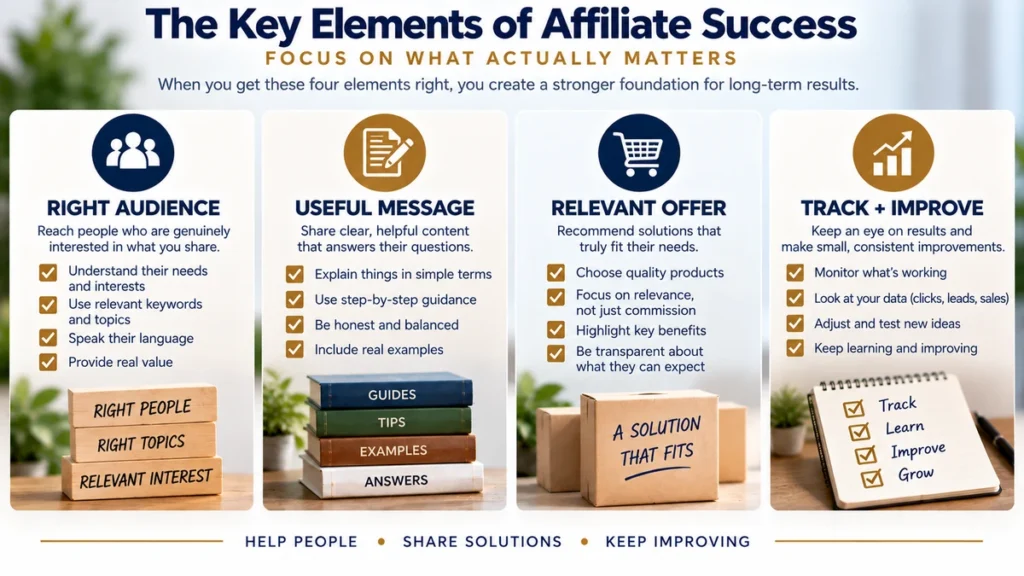
When all the terminology is removed, a practical beginner system can look something like this:
That is much less exciting than many online advertisements make affiliate marketing appear.
But it is also much more useful.
If I were starting from the beginning, I would rather understand this simple process and execute it consistently than spend months collecting disconnected tactics. That is essentially the approach I laid out in If I Had to Start Again With ClickBank Today, I Would Do This.
The real job is not posting links.
It is creating a useful connection between an audience, a problem, and a relevant solution — and then building a measurable process around that connection.
You need traffic because nobody can respond to content they never see.
You need useful messaging because traffic without relevance usually goes nowhere.
You need an appropriate offer because even excellent marketing cannot make every product suitable for every person.
And you need tracking because without data, it becomes difficult to tell whether you have a traffic problem, a messaging problem, an offer problem, or simply too little information to draw a conclusion.
If you have been wondering how affiliate marketing works, remember the basic sequence:
Reach the right person → provide useful information → introduce a relevant offer → track the referral → learn from the result.
The tools can change. Traffic sources can change. Individual affiliate programs can come and go.
But that underlying process remains remarkably consistent.
Once you understand the process, the next step is not to make it more complicated. It is to begin building each part deliberately.
If you are new to Partner to Wealth and want to see how I’m approaching that process, visit the Start Here page for the next step.
Subscribe to get the latest posts sent to your email.
If you found this guide helpful, please tap the Like button and share it with someone who could benefit. Every Like and Share helps more people discover Partner to Wealth.