
Learn 7 common reasons ClickBank affiliates struggle to gain traction, including weak targeting, poor follow-up, tool overload, and changing strategies too quickly.
ClickBank makes affiliate marketing look simple on the surface: choose an offer, get a tracking link, send traffic, and earn a commission when someone buys.
Technically, that is how the model works. In practice, though, many ClickBank affiliates never build enough momentum to know whether their strategy could have worked.
The problem usually is not one single mistake. It is a combination of weak positioning, inconsistent traffic, poor follow-up, and changing direction before enough useful data has been collected.
If you are new to affiliate marketing, understanding these problems early can save you a lot of wasted time and unnecessary resets.

One of the fastest ways to stay stuck is to keep starting over.
A beginner might try search ads for a few days, switch to social media, buy a solo ad, start a blog, abandon the blog, change offers, and then begin looking for another system.
Every new method creates another learning curve. Instead of getting better at one traffic source or funnel, the affiliate repeatedly returns to the beginning.
A better approach is to choose one primary traffic method, learn how it behaves, and give yourself enough time to gather useful information before making major changes.
This does not mean staying with something that is clearly broken forever. It means separating a real strategic problem from ordinary impatience.
If you are still learning the overall process, the Partner to Wealth Start Here page explains how traffic, funnels, email, and offers fit together.
An affiliate link by itself is not a marketing strategy.
Before promoting a ClickBank product, you should understand who is likely to want it, what problem they are trying to solve, and why they might choose that solution instead of doing nothing or choosing a competing product.
That understanding affects almost everything:
When affiliates skip this step, their traffic often becomes too broad. They may get clicks, but the visitors are not necessarily the people most likely to care about the offer.
Sometimes direct linking can make sense, depending on the traffic source and the offer. But beginners often rely on it because it is the fastest setup, not because it is the strongest customer experience.
A useful bridge page can give the visitor context before sending them to the vendor.
That page can explain:
The goal is not to create unnecessary friction. The goal is to make the transition from traffic source to offer feel logical rather than random.
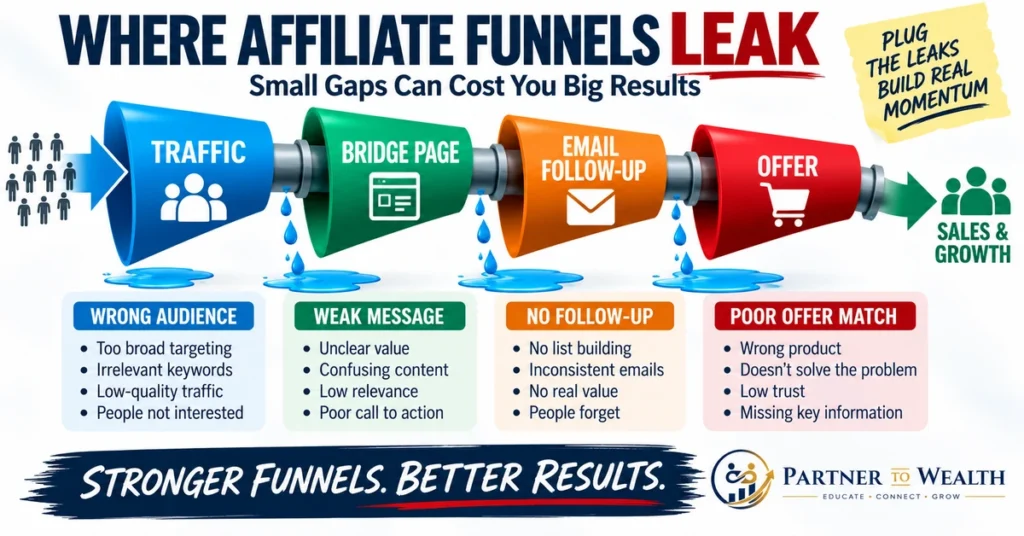
Not every visitor is ready to make a decision the first time they see an offer.
If your entire strategy depends on one click leading immediately to a sale, you lose the opportunity to continue the conversation with people who were interested but not ready.
This is one reason email marketing can be so valuable in affiliate marketing.
A simple opt-in funnel allows you to provide useful information, answer questions, share relevant resources, and bring subscribers back to an offer later when appropriate.
That does not mean emailing people endlessly with promotions. A strong follow-up sequence should provide value and help the subscriber understand the topic, not simply repeat the same sales link every day.
Our Affiliate Marketing Resources page includes tools currently used or evaluated by Partner to Wealth for email marketing, funnels, and related parts of the business.
Affiliate marketing becomes difficult when every click feels like a final verdict.
A campaign can produce a few clicks without a sale and still tell you almost nothing. Small amounts of data can be useful for catching obvious problems, but they are often not enough to make confident conclusions about an entire strategy.
Instead of asking only, “Did I make a sale?” it helps to look at the full path:
Those questions help you diagnose a funnel instead of treating every weak result as proof that affiliate marketing does not work.
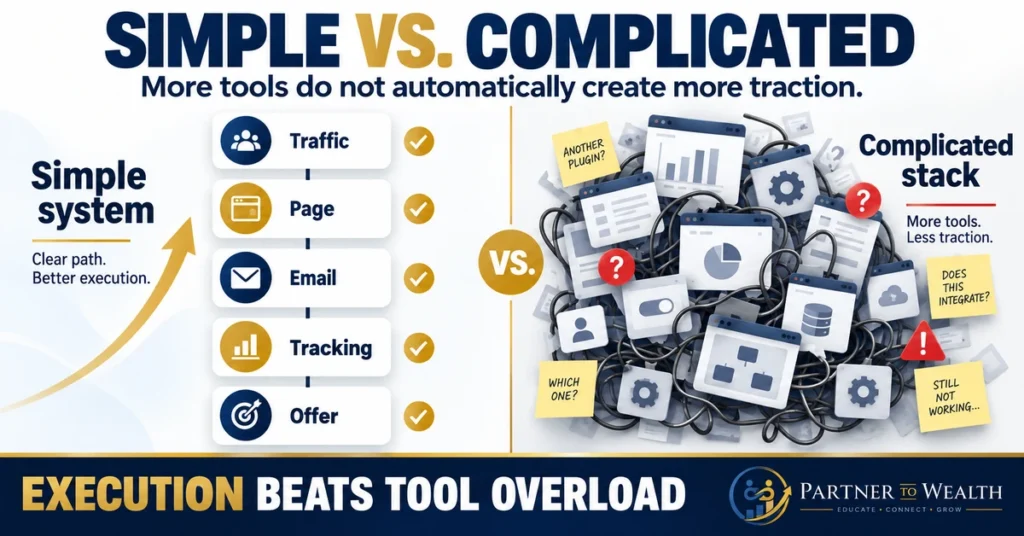
Affiliate marketers have access to an enormous number of tools: page builders, email platforms, trackers, AI tools, keyword platforms, plugins, automation systems, and advertising dashboards.
Many of those tools are genuinely useful. The problem starts when collecting tools becomes a substitute for doing the work.
A basic affiliate system may only need a few core pieces:
Adding more software should solve a specific problem. If it does not improve execution, measurement, or the visitor experience, it may simply create another distraction.
This may be the most important reason of all.
Affiliate marketing usually requires repetition.
You create content. You test traffic. You improve pages. You build follow-up. You learn which messages attract the right people. You remove weak ideas and keep improving the ones that show promise.
That process rarely produces perfect results immediately.
When someone quits after a handful of posts or a very small advertising test, they may stop before they have built enough visibility, skill, or data to improve intelligently.
Consistency does not guarantee success, but inconsistency makes meaningful improvement much harder.
Rather than constantly looking for another shortcut, I think a stronger approach is to build around a few repeatable fundamentals:
That foundation may look less exciting than constantly chasing new tactics, but it gives you something you can actually measure and improve.
One of the reasons I joined the ClickBank Profit Club free membership was to evaluate another structured source of ClickBank-focused training and see which ideas could fit into the systems I am already building.
If you are interested in ClickBank affiliate marketing and want to look at the program for yourself, you can explore the current membership below.
Affiliate disclosure: The link above is an affiliate link. Partner to Wealth may earn a commission from qualifying purchases or activity at no additional cost to you.
Most ClickBank affiliates probably do not need another hundred tactics. They need a clearer process and enough consistent execution to discover what actually works for them.
Choosing a relevant offer, understanding the audience, using an appropriate funnel, following up, tracking the important numbers, and staying with a strategy long enough to learn from it can create a much stronger foundation than repeatedly starting over.
Affiliate marketing still requires testing, patience, and judgment. But when the pieces are connected into a system, it becomes much easier to see what needs improvement and what deserves more attention.
Subscribe to get the latest posts sent to your email.
If you found this guide helpful, please tap the Like button and share it with someone who could benefit. Every Like and Share helps more people discover Partner to Wealth.