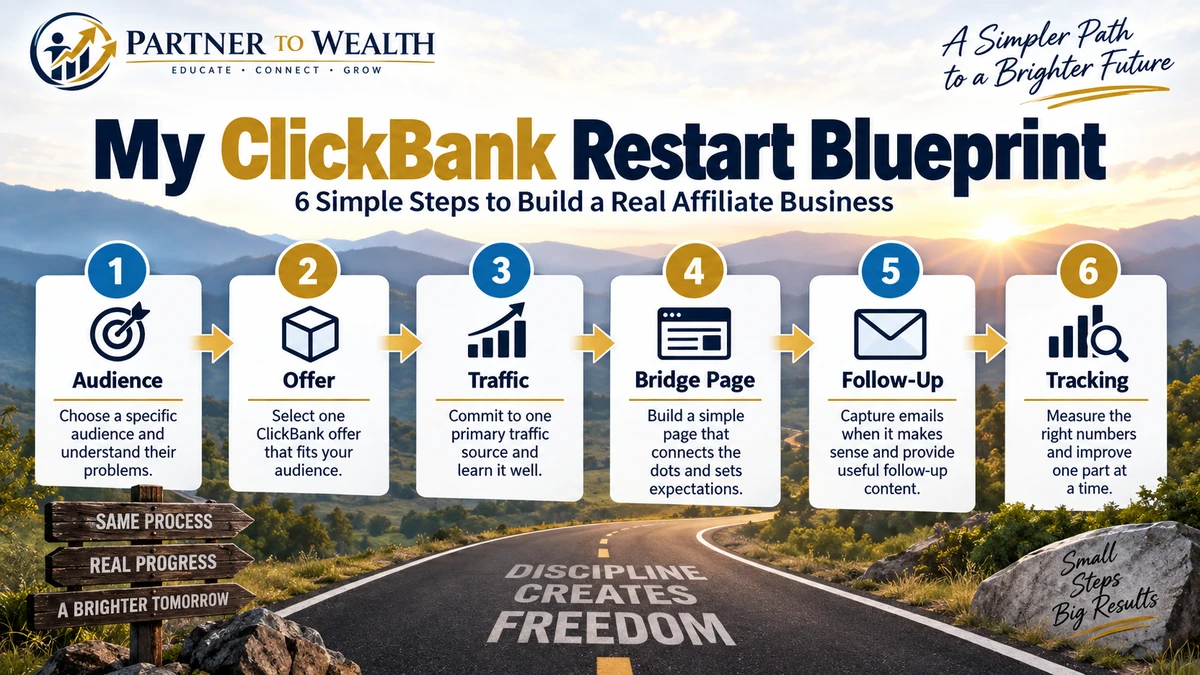
If I had to start again with ClickBank today, I would simplify everything. Here is the step-by-step affiliate marketing approach I would follow.
If I had to start ClickBank affiliate marketing again today, I would make the process much simpler than most beginners are tempted to make it.
I would not begin by collecting dozens of offers, buying a stack of software, testing five traffic sources, or trying to build a complicated funnel before I understood what each part was supposed to accomplish.
I would start with one audience, one offer, one primary traffic source, one simple funnel, and a way to measure what happens.
Then I would stay with that setup long enough to learn from it before adding more complexity.
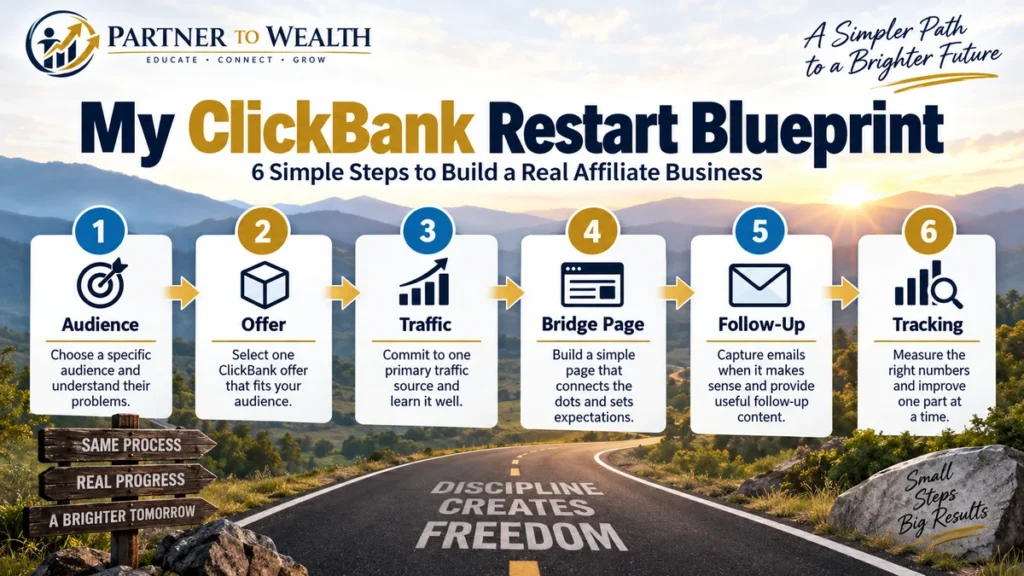
The first thing I would decide is who I am trying to reach.
That sounds obvious, but it is easy to do the opposite: browse ClickBank, find something with an attractive commission, grab the affiliate link, and then try to figure out who might buy it.
I would reverse that process.
I would choose a market where I can understand the audience, the problems they are trying to solve, and the language they use when looking for help.
That audience decision influences almost everything that comes afterward:
Starting with the audience gives the rest of the campaign somewhere to point.
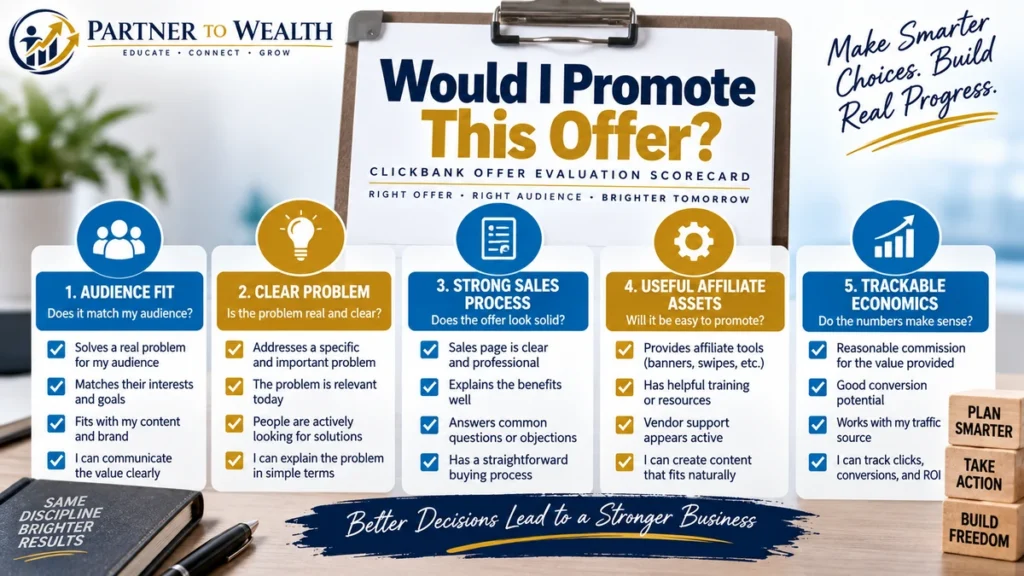
Once I understood the audience, I would look for one ClickBank offer that appears to fit that audience well.
I would not choose it based on commission size alone.
I would look at the sales page, the problem being addressed, the positioning, the customer journey, available affiliate resources, and whether I could create a logical reason for the right visitor to investigate the offer.
I would also use the information ClickBank provides to help evaluate offers rather than choosing randomly. The official ClickBank affiliate resources are a useful starting point for understanding how its marketplace and affiliate model work.
The goal would not be to find a magical product.
The goal would be to find an offer that makes sense for the audience and then learn enough about it to promote it intelligently.
This is where I would be especially disciplined.
I would choose one primary traffic source and learn it before adding another.
That might be search advertising, organic search, social content, email partnerships, or another source that fits the audience and offer.
What I would not do is bounce between several traffic methods every time a few clicks fail to produce the result I hoped for.
Each traffic source has its own learning curve. The targeting, creative, keywords, costs, policies, and visitor behavior can all be different.
If I constantly changed traffic sources, I would constantly reset that learning process.
This is one of the problems discussed in 7 Reasons Most ClickBank Affiliates Never Get Traction.
I would not build a complicated funnel just because I could.
I would ask what the visitor actually needs between the traffic source and the offer.
In some situations, a simple bridge page may be enough.
A useful bridge page can:
I would add more funnel steps only when they have a clear purpose.
Complexity should solve a problem, not create one.
If the campaign and traffic source made list building appropriate, I would start capturing email addresses early rather than depending entirely on one visit to the affiliate offer.
Most people do not make every decision the first time they encounter a product or idea.
An email list gives me another opportunity to provide useful information, answer questions, share relevant resources, and reconnect with people who showed genuine interest.
I would keep the follow-up focused and useful rather than turning every email into another version of “buy this now.”
The Partner to Wealth Resources page lists some of the tools currently being used for email marketing, funnels, and related parts of the business.
I would not wait until money had already been spent to decide what numbers matter.
Before launching a paid campaign, I would know what I need to watch.
The point is not to stare at dashboards all day.
The point is to know where the campaign is losing people so I can improve the correct part of the system.
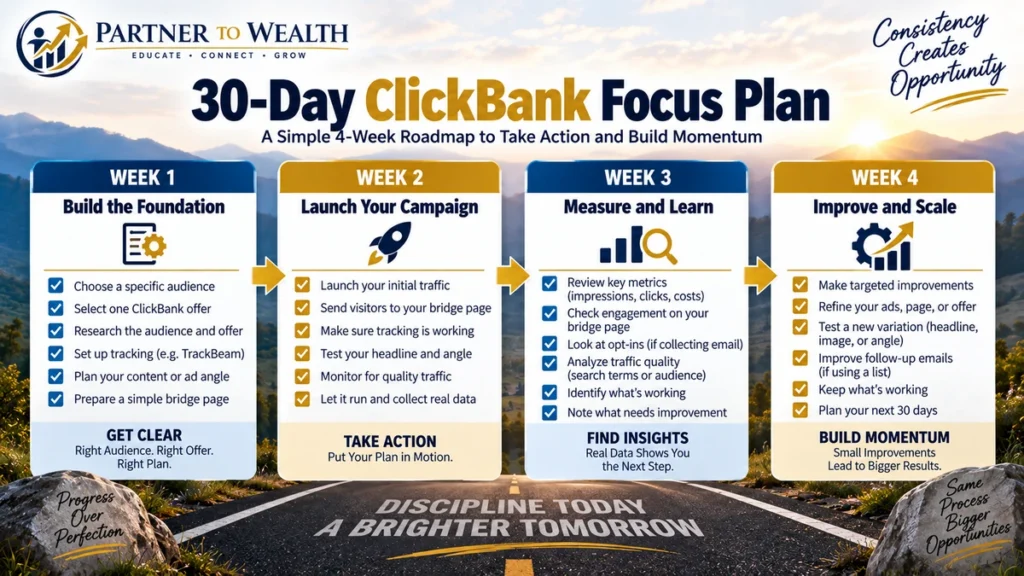
One of the easiest mistakes in affiliate marketing is reacting emotionally to small amounts of data.
If I were starting again, I would decide in advance what would justify a change.
For example:
That is very different from changing the entire strategy simply because a small test did not immediately produce a sale.
I would also keep a basic record of what I tested and what happened.
It does not need to be complicated.
Without a record, it is surprisingly easy to repeat old mistakes or forget why a campaign was changed in the first place.
A simple journal turns activity into accumulated knowledge.
If I were starting again, there are also several things I would deliberately avoid.
The objective would be to create fewer moving parts and understand each one better.
If I had to condense the entire approach into one sequence, it would look like this:
A focused ClickBank affiliate marketing plan is easier to measure and improve when each step has a clear purpose.
That may sound less exciting than constantly discovering new tactics, but it creates something far more useful: a system you can actually understand.
Structured training can still be valuable, especially when it helps clarify one of the parts of that system.
That is one reason I joined the ClickBank Profit Club free membership. I wanted another ClickBank-focused source of training that I could evaluate against what I am actually implementing.
If you want a clearer explanation of the membership first, read The ClickBank Profit Club Explained in Plain English.
If you would rather explore the membership directly, you can do that below.
Affiliate disclosure: The link above is an affiliate link. Partner to Wealth may earn a commission from qualifying purchases or activity at no additional cost to you.
If I had to start again with ClickBank today, I would focus much less on trying to do everything and much more on understanding a small number of connected pieces.
One audience. One offer. One primary source of traffic. A simple funnel. Useful follow-up. Clear tracking.
Then I would give myself enough time to learn from the system before deciding what deserves to be added, changed, or removed.
For anyone still learning the broader affiliate model, the Partner to Wealth Start Here page provides a simple overview of how the main pieces fit together.
Subscribe to get the latest posts sent to your email.
If you found this guide helpful, please tap the Like button and share it with someone who could benefit. Every Like and Share helps more people discover Partner to Wealth.