
Affiliate marketers should clearly disclose when they may earn commissions from recommended products. Learn where disclosures belong, what they should say, and common mistakes beginners should avoid.
Affiliate marketing involves recommending products or services and potentially earning a commission when someone purchases through your link.
That financial relationship matters.
Readers should be able to understand when a recommendation includes a financial connection between you and the company or retailer you are promoting.
In the United States, Federal Trade Commission guidance addresses these relationships through its rules and guidance concerning endorsements and advertising.
Understanding basic affiliate disclosure requirements helps you communicate that relationship clearly instead of leaving visitors to figure it out for themselves.
This guide explains what beginners should know before publishing affiliate content.
An affiliate disclosure is a statement that tells readers you may receive compensation when they purchase through certain links.
The purpose is transparency.
A visitor reading a product recommendation might evaluate that recommendation differently if they know the publisher could receive a commission.
That financial relationship is commonly called a material connection.
Material connections can include more than affiliate commissions. They may also include payments, free products, discounts, employment relationships, or other benefits connected to an endorsement.
For a typical affiliate website, however, the most common situation is simple:
You recommend a product, provide an affiliate link, and may receive a commission if the visitor completes a qualifying purchase.
That relationship should be disclosed clearly.
A disclosure gives visitors important context about your recommendation.
It does not mean that your recommendation is dishonest.
It simply tells readers that a commercial relationship exists.
The key principle is that the connection should be clear and conspicuous.
A visitor should not have to search through your website, open a legal page, or guess what an affiliate link means.
Transparency should be part of the content itself.

Placement matters.
A disclosure buried in a privacy policy, About page, footer, or terms page may not give readers enough notice when they are actually viewing the recommendation.
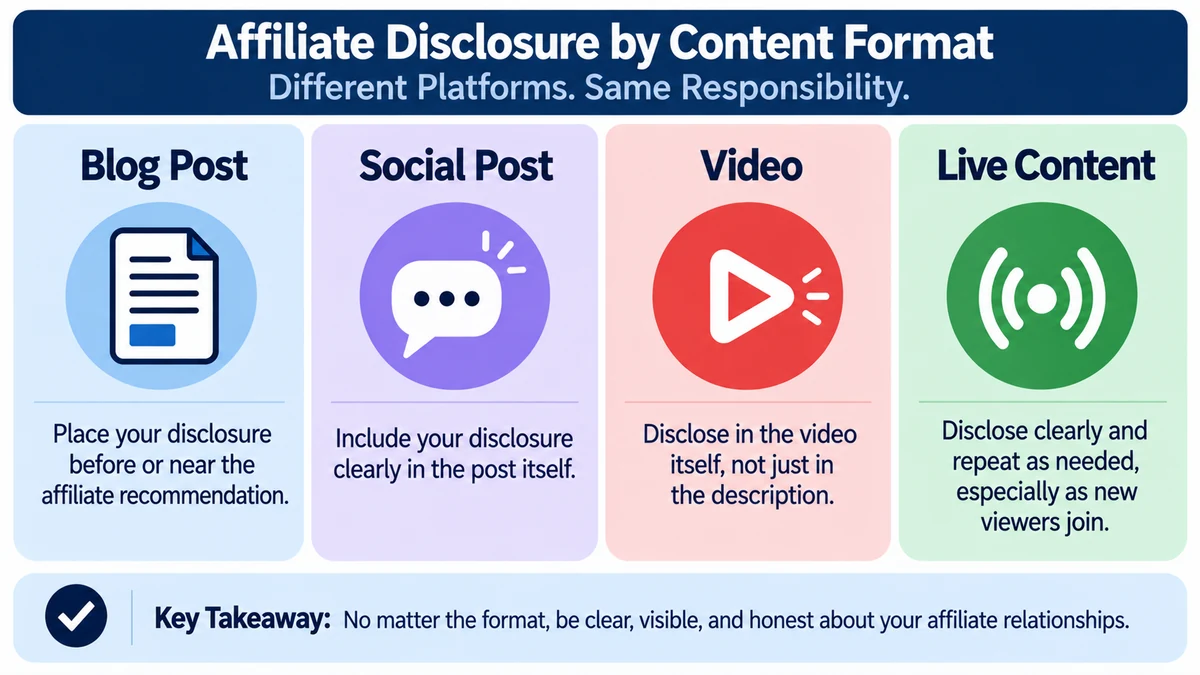
For blog content, the disclosure should generally appear where visitors can notice it before or near the affiliate recommendation or link.
The Federal Trade Commission explains that disclosures should be difficult to miss and presented with the endorsement itself. You can review the FTC’s guidance in its Endorsement Guides Q&A.
For example, a blog article containing affiliate links could include a short disclosure near the beginning of the post before readers encounter the first affiliate recommendation.
If an article is long and affiliate links appear much later, additional context near those links may also make the relationship clearer.
The goal is simple:
Do not make visitors hunt for the disclosure.
Complicated legal language is usually unnecessary.
The important point is to communicate the financial relationship in language an ordinary reader can understand.
A simple disclosure could say:
This post contains affiliate links. If you purchase through these links, I may earn a commission at no additional cost to you.
Another option is:
I may receive a commission when you purchase through links in this article.
The wording can vary, but the meaning should be obvious.
Readers should understand that you may financially benefit from purchases made through the links.
Not necessarily.
Someone unfamiliar with affiliate marketing may not know what the phrase affiliate link means.
They might understand that the link is special without understanding that the publisher can receive compensation.
That is why clearer wording such as:
“I may earn a commission from purchases made through links in this post”
is easier for beginners to understand.
Likewise, simply placing a Buy Now button beside a product does not explain the financial relationship.
The disclosure should communicate what the relationship actually is.
Yes. An honest opinion does not eliminate the financial connection.
You might genuinely like a product and still earn a commission when somebody purchases it.
The disclosure is not an accusation of bias.
It gives the reader information that could affect how they evaluate your recommendation.
Your content should still reflect your genuine views and should not make claims you cannot support.
Disclosure principles also apply when affiliate recommendations appear on social platforms.
A disclosure should be easy to notice with the endorsement itself.
It should not be hidden among a long collection of hashtags or placed somewhere users are unlikely to see it.
Terms such as Ad or Sponsored can communicate a promotional relationship in appropriate circumstances.
When affiliate commissions are involved, wording that directly explains the commission relationship can be even clearer.
The FTC’s Disclosures 101 guidance provides additional information about disclosures in social-media endorsements.
Platform-provided disclosure tools may also be useful, but they should not automatically be assumed to satisfy every disclosure need.
Video creates another placement consideration.
A disclosure hidden only in a video description may be missed by viewers.
When an endorsement appears in the video itself, disclosure within the video can make the relationship easier for viewers to understand.
For live content, viewers may join at different times, so disclosures may need to be repeated periodically.
The important principle remains the same:
The audience should have a reasonable opportunity to notice and understand the relationship.
Beginners sometimes create a disclosure but place or word it in a way that reduces its usefulness.
A site-wide disclosure page can provide additional information, but it should not replace a noticeable disclosure around affiliate content.
A reader may already have clicked before discovering the financial relationship.
Terms that do not clearly explain the commercial relationship can leave visitors confused.
Many readers do not know how affiliate links work.
Explain the relationship instead of expecting them to recognize industry terminology.
Having an affiliate disclosure page is useful, but readers should not need to visit another page to discover that a specific recommendation may generate a commission.
An affiliate disclosure handles transparency about your financial relationship.
It does not make unsupported advertising claims acceptable.
Affiliate marketers should still avoid misleading claims about:
The fact that a page includes an affiliate disclosure does not turn an inaccurate statement into an acceptable one.
Disclosure and truthful marketing are separate responsibilities.
FTC guidance is not the only thing to check.
Affiliate programs can also establish their own promotional requirements.
A merchant or affiliate network may specify:
That is another reason to review the affiliate program terms before promoting an offer.
A campaign can follow your general disclosure practices while still violating a particular program’s rules.
Affiliate disclosures explain your financial relationship with the merchant or advertiser.
Tracking tools serve a different purpose.
For example, affiliate tracking IDs can help separate activity from different links, placements, or traffic sources.
Likewise, affiliate cookie duration affects how attribution may work after someone clicks an affiliate link.
Neither tracking IDs nor cookie duration replaces the need for a clear disclosure.
Disclosure is only one part of responsible affiliate promotion.
You should also understand what visitors will see after they click.
Before sending traffic, consider evaluating the affiliate sales page to understand how the offer is presented, what claims are being made, and whether the page is appropriate for your audience.
Clear disclosure cannot compensate for promoting an offer you have not properly reviewed.
You do not need to reinvent your disclosure every time you publish.
A basic workflow can make the process easier.
Before publishing affiliate content:
That creates a repeatable process rather than treating disclosure as an afterthought.
Affiliate disclosures are fundamentally about transparency.
If you may receive compensation from a recommendation, readers should be able to understand that relationship without searching for the information.
Keep the disclosure noticeable.
Keep the wording simple.
Place it close to the recommendation.
And remember that disclosure does not replace the need for accurate claims, honest recommendations, and compliance with the individual affiliate program’s rules.
A short, understandable disclosure is far more useful than complicated wording hidden where visitors are unlikely to see it.
Subscribe to get the latest posts sent to your email.
If you found this guide helpful, please tap the Like button and share it with someone who could benefit. Every Like and Share helps more people discover Partner to Wealth.