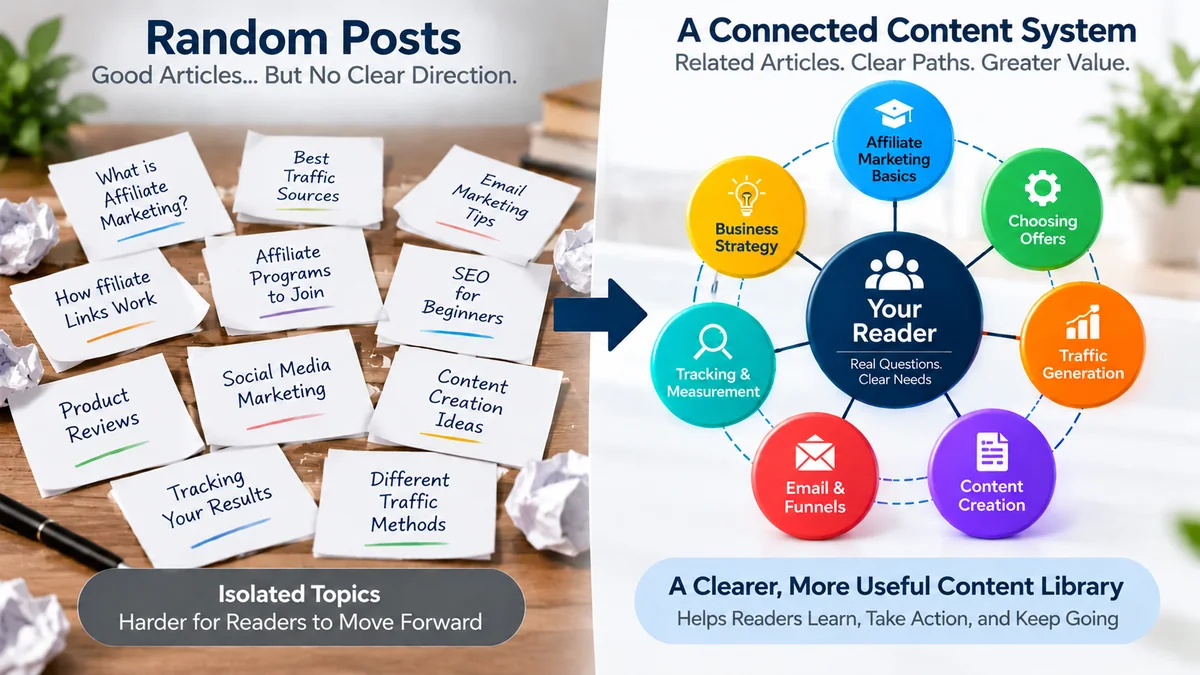
Learn how to build a connected affiliate marketing content strategy so each article has a clear purpose, supports related content, and helps readers move naturally from one useful topic to the next.
Publishing useful articles is important, but a collection of good articles does not automatically become a good content strategy.
A strong affiliate marketing content strategy gives each article a clear job and connects related topics so readers can continue learning without having to figure out where to go next.
Instead of choosing a new subject every time you sit down to write, you build a growing library around the questions, problems, and decisions your audience actually faces.
That makes content planning easier, reduces unnecessary duplication, and helps individual articles support one another rather than existing as isolated pages.
An affiliate marketing content strategy is a plan for deciding:
It is not simply an editorial calendar.
A calendar tells you when something will be published. A content strategy explains why that article deserves to exist and how it fits into the larger site.
That distinction becomes more important as your content library grows.
Keywords are useful research tools, but they should not define the entire purpose of your site.
Start with the audience you are trying to help.
Ask questions such as:
For a beginner affiliate marketing audience, someone might first need to understand how affiliate marketing works. Later, that same person might need help choosing an offer, understanding buyer intent, selecting a traffic method, creating useful content, or tracking results.
Those needs create the foundation for a content strategy.
Keyword data can then help you discover how people describe those needs in search.
If you have not worked through that process yet, our guide to keyword research for affiliate marketing explains how to move from a broad topic toward a focused search question.
Once you understand the audience, identify the broad areas your site needs to cover well.
These are sometimes called content pillars, topic areas, or subject clusters.
The terminology matters less than the purpose.
Each area should represent a meaningful part of the audience’s journey rather than a category created simply because a keyword tool suggested it.
For an affiliate marketing education site, broad areas might include:
You do not need to cover everything at once.
The goal is to establish a logical structure so new article ideas have somewhere to belong.
A useful way to reduce overlap is to decide what each article is primarily supposed to accomplish.
For example, one article might:
An article can naturally touch several related ideas, but its main purpose should still be clear.
Consider the difference between these subjects:
Those subjects may belong in the same broader content ecosystem without doing the same job.
Random publishing often creates a site with many unrelated entry points but little depth.
A more deliberate approach is to strengthen one important subject with related articles that answer different questions.
For example, a traffic cluster might eventually include:
Each article has a distinct purpose, but together they provide more complete coverage of the subject.
This does not mean every topic needs ten supporting articles.
Depth should come from real reader needs, not from manufacturing pages simply to make a cluster look larger.
Two article ideas can sound similar while serving different reader intentions.
Before deciding that one topic duplicates another, ask what the searcher wants to accomplish.
For example:
Those can potentially justify different pages because the reader’s need changes.
On the other hand, several keyword variations that all represent the same question may belong together on one strong page.
The goal is not one page per keyword. The goal is one useful resource per meaningful topic and intent.
Internal linking is one of the most important parts of a connected content strategy.
A good internal link helps a reader continue naturally into a related subject.
For example, someone learning how to create useful affiliate content may also benefit from understanding how that content fits into the rest of the site.
Our guide on how to write affiliate content that helps before it sells focuses on creating an individual article around the reader’s needs. The strategy in this article expands that idea across an entire content library.
Google’s link best practices recommend using descriptive, relevant anchor text and linking to other resources on your site when they genuinely help readers understand the subject.
That is a better reason to add a link than simply trying to reach a certain number of internal links.

The clickable words in an internal link should give the reader a reasonable idea of what they will find.
Generic phrases such as:
provide very little context by themselves.
A descriptive link such as:
learn how to test an affiliate campaign without changing everything at once
sets a clearer expectation.
That does not mean every link needs to contain an exact SEO keyword.
The anchor should fit the sentence naturally and accurately describe the destination.
More internal links are not automatically better.
A link should exist because the destination adds useful context, answers a likely next question, or helps the reader continue a process.
If you have to rewrite an entire paragraph simply to insert a link to an unrelated article, that is usually a sign that the link does not belong there.
A smaller number of genuinely useful connections is better than turning every paragraph into a navigation menu.
As a site grows, it becomes easier to forget what you have already published.
Before creating a new article, check:
This simple check can prevent several articles from competing to explain essentially the same thing.
It also keeps the content library easier for readers to navigate.
A content strategy should include older articles, not just new ones.
Sometimes the most useful next move is to update an existing page.
You might discover that an older article:
Google’s guidance on helpful, reliable, people-first content emphasizes creating substantial value for readers rather than producing content primarily to attract search visits.
That principle applies just as much to improving an existing article as it does to publishing a new one.
You do not have to publish articles in a perfect sequence, but some order can make your library easier to build.
A practical approach is:
This creates natural opportunities for internal links because later articles can reference the foundation that came before them.
One of the easiest ways to identify a useful supporting article is to ask:
What is the reader likely to wonder after finishing this page?
If someone finishes an article explaining affiliate traffic, the next question might be how to choose a traffic source.
If someone understands keyword research, the next question might be how those keyword ideas fit into a broader content plan.
If someone learns how to create an affiliate article, the next question might be how to measure whether the article is attracting the intended audience.
This approach keeps content expansion tied to genuine learning needs.
You do not need complicated software to organize the strategy.
A spreadsheet or simple document can work.
For every published or planned article, consider recording:
This gives you a quick way to see where your content is strong and where important gaps remain.
A keyword tool can show searches you have not targeted, but that does not automatically mean you have a content gap.
A real content gap exists when there is an important question, problem, decision, or stage of the audience journey that your current library does not adequately address.
That distinction matters.
If you publish every keyword variation a tool suggests, you can create many pages without making the site meaningfully more useful.
If you focus on real content gaps, each new article strengthens the overall resource.
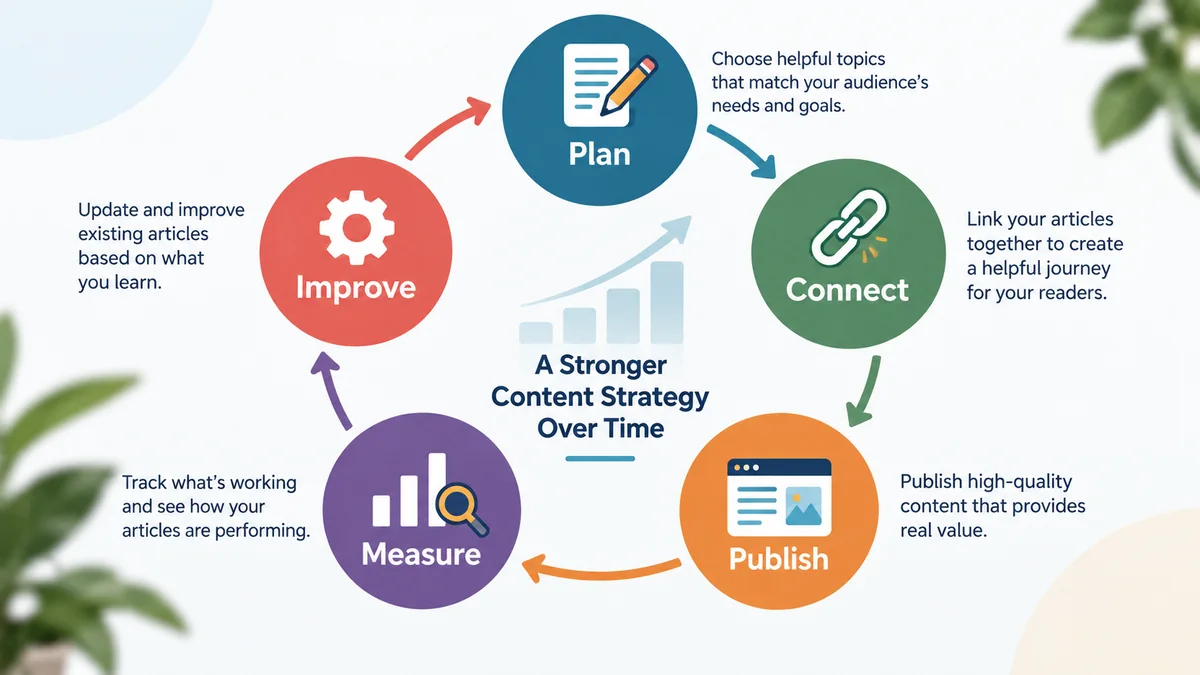
Strategy becomes much easier to follow when publishing has a repeatable process.
A basic workflow might include:
If you want a broader routine for organizing those activities, our weekly affiliate marketing workflow explains how to turn recurring tasks into a manageable system.
A content strategy should eventually be informed by real performance rather than assumptions alone.
Over time, look for signs such as:
The purpose is not to change articles every few days.
It is to learn from actual behavior and use that information when deciding what to improve or publish next.
The same controlled mindset is useful when evaluating campaigns. Our guide on testing an affiliate campaign without changing everything at once explains why making deliberate changes can make results easier to interpret.
Avoiding a few common mistakes can keep the site much more organized.
Creative ideas are useful, but every new subject should still fit the audience and the site’s purpose.
Minor keyword differences do not necessarily justify separate pages.
A link should help the reader, not exist simply to increase a link count.
New content often creates opportunities to improve and connect existing pages.
A large number of pages is not the same thing as a useful content library.
A focused site can be more coherent than one that publishes broadly across subjects its core audience does not need.
You can reduce the strategy to seven steps:
An affiliate marketing content strategy is not about creating the largest possible collection of articles.
It is about building a useful body of information in which each page has a purpose and related pages support one another.
Start with the reader. Organize the important subjects. Avoid unnecessary duplication. Connect relevant articles naturally. Review what you already have before automatically creating something new.
Over time, that approach turns individual posts into a more coherent resource—one that is easier for readers to explore and easier for you to continue building thoughtfully.
Subscribe to get the latest posts sent to your email.
If you found this guide helpful, please tap the Like button and share it with someone who could benefit. Every Like and Share helps more people discover Partner to Wealth.