Trying to master every traffic channel at once can make affiliate marketing harder to understand. Learn why focusing on one traffic source helps beginners measure, learn, and improve more effectively.
One of the easiest ways to make affiliate marketing harder than it needs to be is to try to get traffic from everywhere at once.
A beginner starts a blog, opens several social-media accounts, experiments with paid advertising, watches videos about YouTube, considers Pinterest, joins online communities, and starts thinking about email — all before learning whether any one of those channels actually works for them.
It can feel productive because there is always something to work on.
But activity and useful learning are not always the same thing.
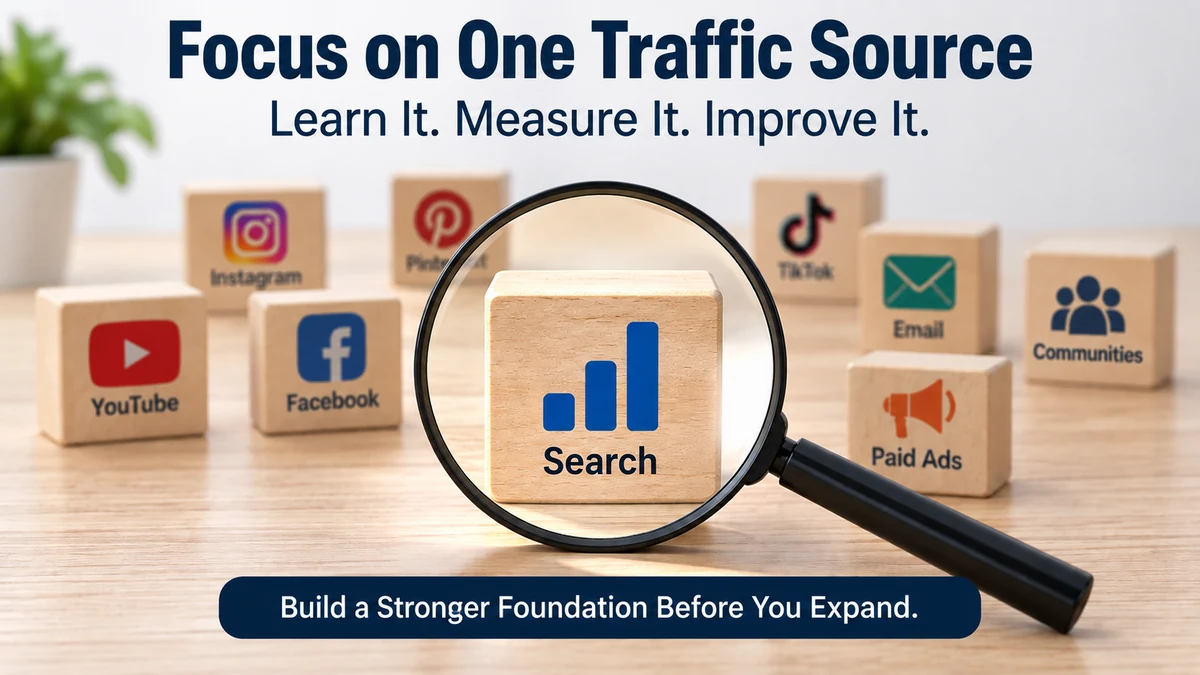
For most beginners, it is easier to develop a repeatable process when you focus on one traffic source, learn how that source behaves, collect useful data, and improve your approach before adding another channel.
That does not mean you should depend on one traffic source forever.
It means giving yourself enough focus to understand what you are doing before creating more moving parts.
There is no shortage of ways to attract visitors online.
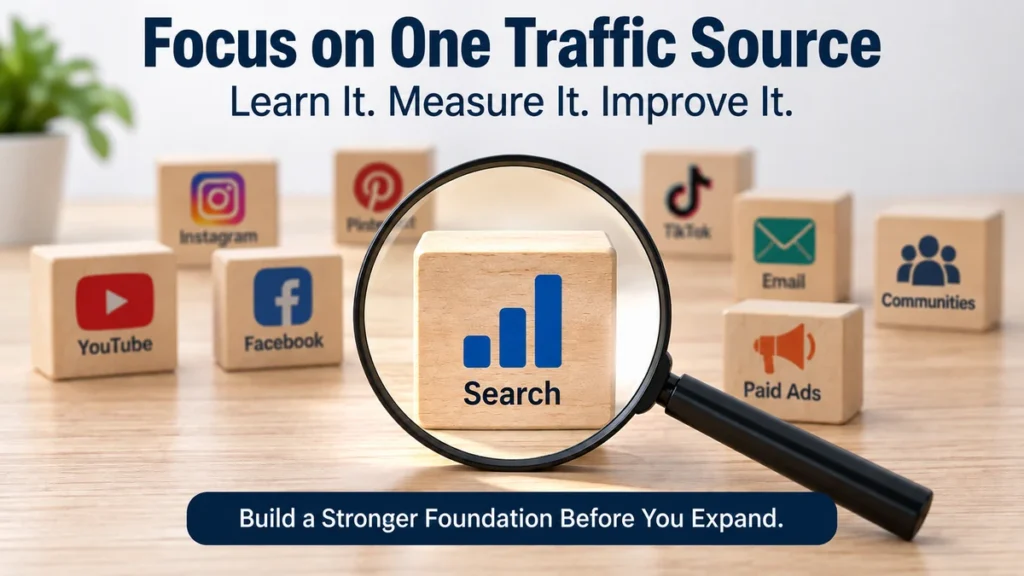
Depending on the business, traffic can come from:
None of these is automatically the best traffic source.
They have different audiences, costs, learning curves, targeting options, content requirements, platform rules, and measurement challenges.
Trying to understand several of them simultaneously can make it difficult to tell whether your results are improving because of something you changed or simply because the traffic mix changed.
If you are still learning the basic affiliate model itself, it helps to understand how affiliate marketing actually works before adding several different traffic systems on top of it.
Think of traffic testing as an experiment.
If you change five things at the same time and your results improve, which change caused the improvement?
You may not know.
The same problem appears when a beginner launches several traffic channels together.
You may be receiving visitors from search, social media, paid ads, and referrals, but each group can behave differently.
One source may bring curious readers.
Another may bring people actively searching for a solution.
Another may generate inexpensive clicks but very little meaningful engagement.
If everything is mixed together, it becomes easier to draw the wrong conclusion.
Working with one primary traffic source gives you a cleaner environment in which to learn what that particular audience responds to.
Every traffic channel has its own behavior.
Someone who searches Google for an answer is behaving differently from someone casually scrolling through a social feed.
A person who clicks a search advertisement may have different expectations from someone who discovers a recommendation inside an email newsletter.
When you stay with one traffic source long enough, you begin to understand things such as:
Those lessons are much harder to see if you continually switch channels.
This is one reason a repeatable system matters more than continually collecting tactics. I discuss that broader principle in Courses vs Systems: Why Systems Win.
Traffic volume by itself tells you very little.
One hundred people who have no interest in the problem you are addressing may be less useful than ten people who arrived because they were specifically looking for an answer.
That is why more traffic should not automatically be the goal.
A better question is:
Am I attracting the type of visitor this page and offer are designed to help?
Focusing on one traffic source makes that question easier to investigate because you have fewer variables competing for your attention.
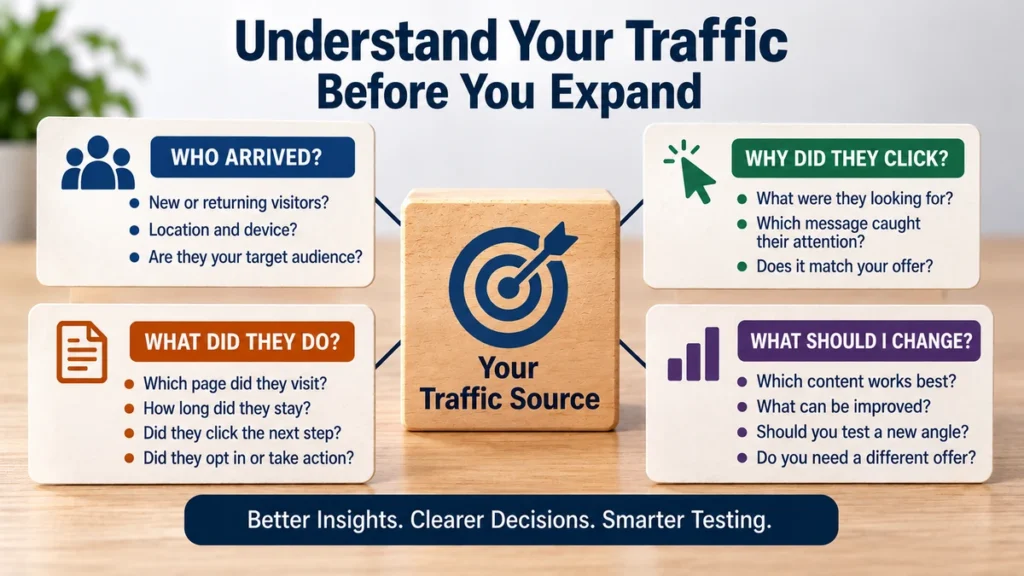
A traffic strategy becomes more useful when you can measure what happens after visitors arrive.
At a basic level, you may want to understand:
Tools such as Google Analytics can help separate acquisition sources instead of treating every visitor as part of one undifferentiated group. Google’s official Traffic acquisition report is designed to help you understand where website and app visitors come from and examine individual traffic sources.
The point is not to become obsessed with analytics.
The point is to make decisions from something more useful than a feeling.
When a campaign does not perform as expected, there are several possible reasons.
You could have:
If several traffic sources are running at once, diagnosing the problem becomes more complicated.
For example, poor overall engagement might appear to mean your page is weak when the real problem is one low-quality traffic source bringing the wrong visitors.
Or you may stop a promising campaign because traffic from an unrelated channel made the combined results look worse.
Keeping your early testing focused makes the signal easier to interpret.
This distinction is important.
Choosing one traffic source does not mean repeating one exact advertisement, keyword, post, or piece of content forever.
You can still test different ideas inside the same channel.
For example, if your primary source is paid search, you might test:
If your primary source is organic search, you might test different article topics, search intents, internal links, content formats, or calls to action.
The important thing is that you are learning inside one understandable environment rather than jumping between unrelated platforms every few days.
Beginners often fall into a predictable pattern.
They choose one traffic source.
They try it briefly.
The results are not immediately impressive.
Then they hear about another platform and switch.
A short time later, they switch again.
Eventually they have touched six traffic sources but have learned very little about any of them.
This is particularly risky when the decision to quit is based on a very small amount of information.
A traffic source can fail, of course.
But there is a difference between determining that something is not working and abandoning it before you have learned enough to evaluate it.
There is no universal number of days, clicks, posts, or visitors that works for every traffic source.
Paid traffic can generate measurable activity quickly, although enough conversion data may still take time to accumulate.
Organic search may require much longer before content begins receiving meaningful visibility.
Social content can sometimes generate immediate engagement but still require repeated publishing before useful patterns become obvious.
So instead of relying on an arbitrary deadline, ask whether you have collected enough information to make a reasonable decision.
You should eventually be able to explain:
If you cannot answer those questions yet, you may still be in the learning stage.
Focusing on one traffic source will not help much if the destination does not match what the visitor expected when they clicked.
The traffic source, message, page, and offer need to make sense together.
Sometimes that means sending visitors to a useful article. In other situations, an intermediate page can provide context before the final destination.
If you are unfamiliar with that approach, see What Is a Bridge Page and Why Use One?.
Diversification can eventually be useful.
Depending entirely on one platform can create risk because algorithms, advertising rules, competition, costs, and platform policies can change.
But diversification becomes more useful after you understand your basic acquisition and conversion process.
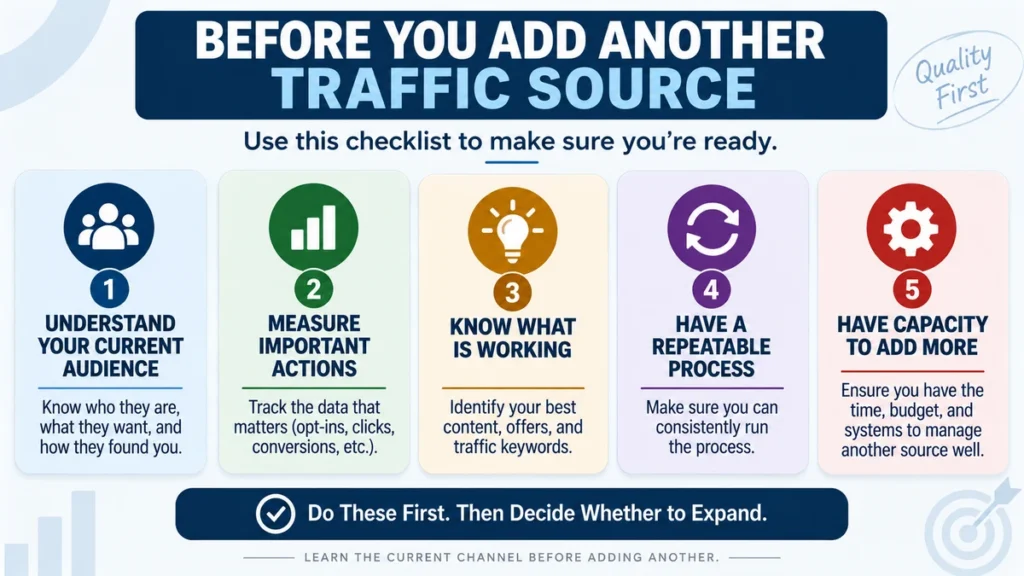
A reasonable time to consider another source is when:
At that point, a second source can become an expansion rather than another restart.
One advantage of building an owned website is that traffic sources can change while your core content and visitor pathways remain under your control.
Search traffic, paid traffic, email, social media, and referrals can eventually lead into the same useful content ecosystem.
That makes it easier to build around a central system instead of treating every platform as a separate business.
For an affiliate marketer, that system might eventually connect useful articles, email capture, bridge pages, product resources, and relevant offers.
You do not have to build every piece at once.
The goal is to make each new piece strengthen something you already understand rather than simply adding another tool or channel to manage.
If you are just getting started, a simple approach looks like this:
This is not the fastest-looking approach.
But it makes it much easier to know what you are actually learning.
Beginners do not need traffic from everywhere.
They need enough focused traffic to learn how their system behaves.
When you focus on one traffic source, you can learn the audience, measure behavior, identify weak points, and make changes with a better understanding of what those changes actually affected.
Later, you can diversify.
But adding another channel is much more useful when you are expanding a process you understand rather than escaping one you never gave yourself enough time to learn.
If you are still building your affiliate-marketing foundation, visit the Start Here page to continue through the core concepts in order.
Subscribe to get the latest posts sent to your email.
If you found this guide helpful, please tap the Like button and share it with someone who could benefit. Every Like and Share helps more people discover Partner to Wealth.