
One useful affiliate blog post can become a full week of social content. Learn how to repurpose lessons, tips, checklists, questions, visuals, and more without repeating the same message.
Publishing a useful affiliate blog post takes time.
You research the topic, organize the ideas, write the article, add images, optimize the page, and make sure the content actually helps the reader.
Then many marketers publish it once, share the link one time, and move on.
That leaves a lot of useful material sitting inside a single page.
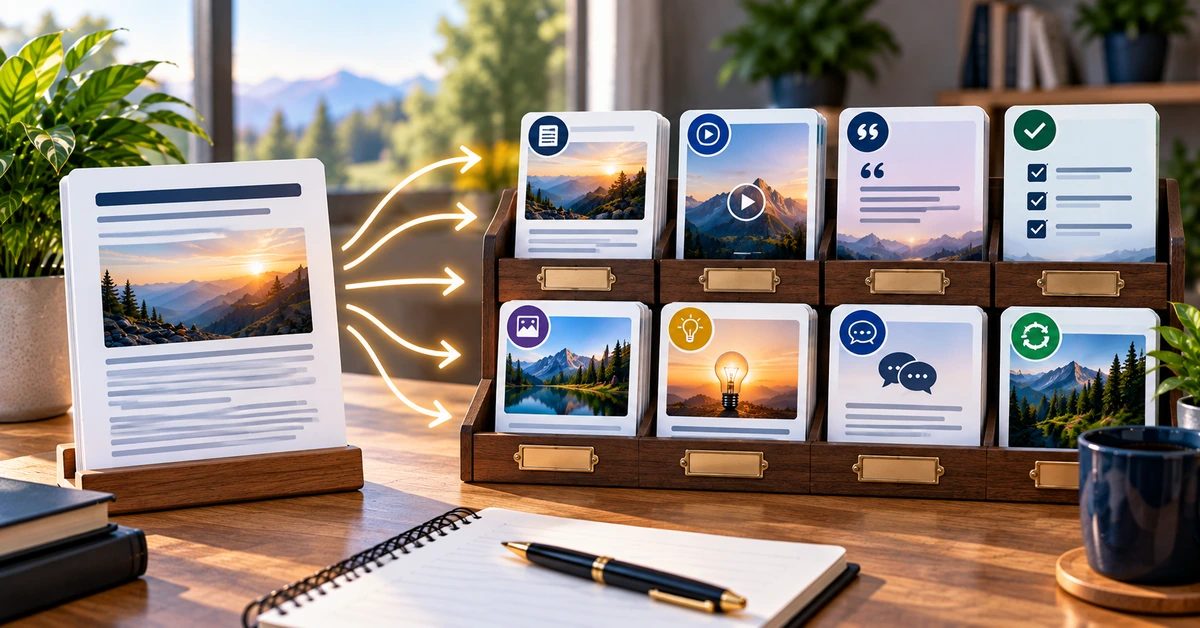
A better approach is to treat every strong article as a source of smaller ideas that can be adapted into social content throughout the week.
This does not mean copying the same promotional message seven times.
It means finding different useful ideas inside the article and presenting each one in a way that makes sense on the platform where you are sharing it.
Done well, one affiliate blog post can support a full week of social content without forcing you to invent seven unrelated topics from scratch.
The easiest way to make social media feel exhausting is to open a platform and ask yourself:
What should I post today?
That question forces you to start from zero every time.
Instead, start with something you have already created.
A well-developed affiliate article usually contains several separate pieces of useful information:
Each of those can become its own social post.
This works especially well when the article belongs to a larger content system rather than standing by itself. If you are still organizing your site that way, read How to Build an Affiliate Marketing Content Strategy That Connects Your Articles.
Repurposing does not mean posting the same paragraph everywhere.
If you copy the same caption onto Facebook, LinkedIn, Pinterest, and every other channel for seven straight days, your audience is not receiving seven useful pieces of content.
They are receiving the same message repeatedly.
True repurposing changes the angle.
For example, imagine your original article explains five mistakes beginners make when choosing an affiliate offer.
From that one article, you could create:
The source article stays the same.
The social content changes because each post has a different purpose.
Before creating anything, scan the finished article and pull out seven potential social angles.
You can usually find them quickly.
Look for:
You may find more than seven.
That is useful because not every idea belongs on every platform.
The following structure gives you a starting point without requiring seven completely new ideas.
Start with the central idea of the article.
Do not try to summarize the whole post.
Choose one useful point and explain it clearly enough that the social post provides value even if the reader never clicks the link.
Then, if appropriate, invite people to read the complete guide.
This approach is especially useful on LinkedIn and Facebook, where a short explanation can stand on its own before the article link appears.
A good Day 1 post might follow this structure:
The social post should create a reason to care about the article, not simply announce that you published something.
Choose one tip that can be understood without reading the rest of the article.
For example:
If the article is about tracking affiliate campaigns, your social post could explain why changing one variable at a time makes results easier to interpret.
If the article is about email marketing, the post could explain why a subscriber should know what happens after clicking the first link.
If the article is about traffic, you might focus on one way to evaluate whether visitors actually match the offer.
The goal is usefulness.
A reader should be able to take something away from the post even before visiting your site.
Lists inside blog posts are easy to repurpose.
If the article contains five questions, four mistakes, six steps, or three things to check, turn that section into a compact checklist.
For example:
That can work as a text post, a simple graphic, or the foundation for a Pinterest pin.
This is also where understanding intent matters. A social post should connect naturally with what the reader is trying to accomplish. The same principle is covered in How to Match Content to Buyer Intent in Affiliate Marketing.

Mistake-based posts work because they focus on a recognizable problem.
Choose one mistake from the article and explain:
Avoid turning the post into exaggerated fear-based copy.
You do not need headlines suggesting that one small mistake will destroy someone’s business.
Simply show the problem and the better alternative.
Useful educational content builds more trust than unnecessary drama.
Not every social post needs to be a miniature lesson.
Sometimes the article contains a natural discussion question.
For example:
The important part is that the question relates to the topic you actually cover.
Do not ask random engagement questions just because they might generate comments.
Relevant conversations can help you understand what your audience cares about, which can also lead to future article ideas.
Some ideas become stronger when the image carries much of the message.
Pinterest is an obvious example.
Instead of placing an entire article summary into the image, focus on one clear visual idea that makes the topic understandable at a glance.
The image could represent:
The caption and destination link can provide the context.
The same principle applies to other visual social channels: the image should support the idea rather than serve as decoration.
At the end of the week, return to the full article.
By this point, you have already shared several useful pieces of the topic.
Now you can frame the original article as the place where the complete explanation lives.
A simple recap post could say that throughout the week you covered several parts of a topic and that the full guide brings them together.
This gives the article another opportunity to earn traffic without repeating the exact Day 1 message.
Turning one article into seven pieces of social content does not mean publishing seven posts on four platforms every day.
That would quickly become difficult to manage.
A better approach is to decide which platform is the best home for each idea.
For example:
The goal is not maximum duplication.
The goal is useful distribution.
This is closely related to the principle in Why Beginners Should Focus on One Traffic Source at a Time. You learn more when you understand what each channel is actually doing instead of scattering attention everywhere without a plan.
One of the biggest mistakes in blog promotion is making every social post nothing more than:
New article! Click here to read it.
That gives the audience very little reason to stop scrolling.
Instead, let the social post contain a real idea.
You can still link to the full article.
But the post itself should teach, clarify, question, demonstrate, or summarize something useful.
This creates a healthier relationship between your website and social channels.
Your blog remains the home of the complete resource.
Your social channels distribute individual ideas from that resource to people who might benefit from them.
There is one area where shortening content requires extra care.
If the original material contains an affiliate recommendation, do not strip away important context simply because the social version is shorter.
If a post contains an affiliate relationship that should be disclosed, make the relationship clear where the recommendation appears. The FTC’s social media disclosure guidance explains how material relationships should be disclosed clearly and conspicuously.
The broader principles are covered in Affiliate Disclosure Requirements: What Beginners Need to Know Before Promoting Products.
Repurposing should make content easier to consume.
It should not make the relationship between you, the reader, and the offer less clear.
The fastest time to repurpose an article is immediately after you finish it.
You already know:
If you wait three months, you may have to reread the entire article before remembering which pieces are worth sharing.
A simple workflow is:
This can become part of the larger routine described in How to Build a Simple Weekly Affiliate Marketing Workflow.
Once you have dozens or hundreds of published articles, your content library becomes a major asset.
You no longer need every social post to come from something published that morning.
An older evergreen article may still contain an excellent:
That means your social calendar can eventually include both new content and strategic reuse of older material.
The key is keeping track of what has already been shared.
You do not need a complicated system.
For each article, you can simply record:
That prevents accidental repetition while making future planning easier.
Repurposed social content can also help you learn which parts of an article attract attention.
One idea may generate conversation.
Another may earn more clicks.
A visual checklist may perform better than the broad article announcement.
A question may reveal that readers are confused about a topic you only covered briefly.
Those responses can influence future content.
You might discover:
That turns social distribution into more than promotion.
It becomes another source of information about what your audience finds useful.
You do not need seven unrelated ideas every week to stay active on social media.
You need useful source material and a repeatable way to break it into smaller pieces.
A strong affiliate blog post can give you:
That is a week of useful social content from one piece of work you have already completed.
The important word is useful.
Do not repurpose content merely to fill a calendar.
Use each social post to make one idea clearer, easier to apply, or easier to discover.
Then let the full article do what it was designed to do: give interested readers the deeper explanation when they are ready for it.
Subscribe to get the latest posts sent to your email.
If you found this guide helpful, please tap the Like button and share it with someone who could benefit. Every Like and Share helps more people discover Partner to Wealth.