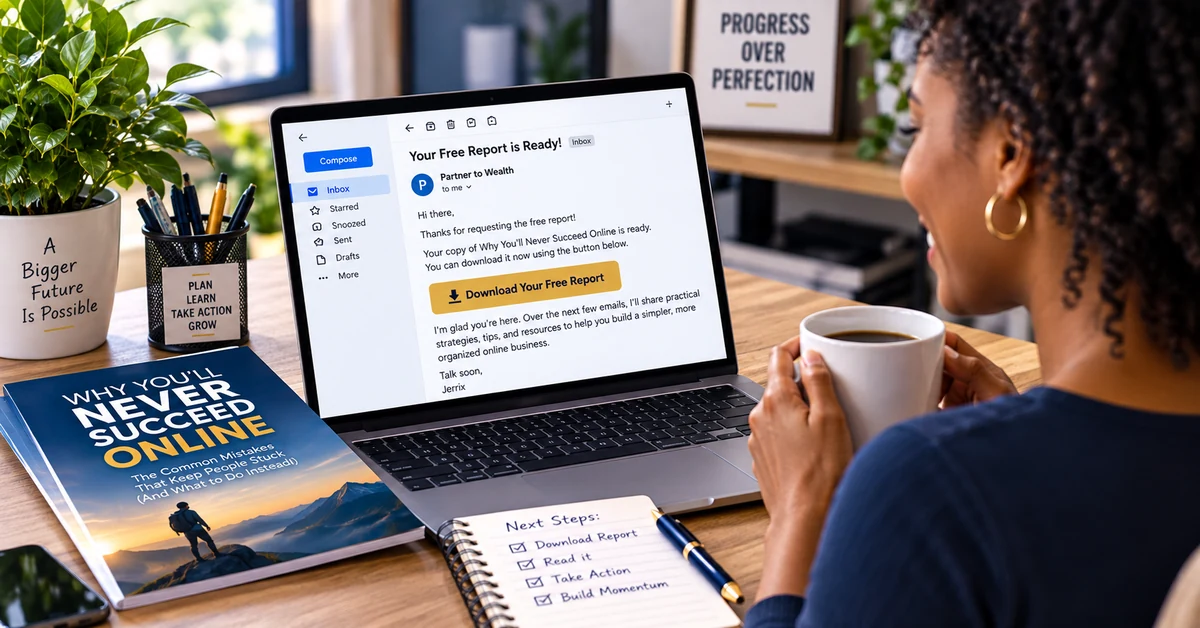
Learn what to include in the first email after someone downloads your free report, from delivering the resource and setting expectations to choosing one clear next step and testing the full subscriber experience.
When someone requests your free report, the first email has a simple job: deliver what you promised and make the next step clear.
This is not the time to squeeze your entire business story, five affiliate links, three social profiles, and a sales pitch into one message. The subscriber just trusted you with their email address because they expected something specific. Your first email should respect that expectation.
A useful welcome email confirms the signup, gives the subscriber immediate access to the resource, briefly explains what they can expect from you, and points them toward one logical next action.
If you get those basics right, you create continuity between the page that earned the signup and the emails that follow.
Think about what happened immediately before the subscriber entered their email address.
They were reading a blog post, landing page, resource page, advertisement, or social post. Something on that page offered them a reason to subscribe. They accepted that offer because they expected a specific resource or benefit.
Your first email should feel like the next step in the same experience.
If the signup page promised a free report, the email should deliver the report.
If it promised a checklist, send the checklist.
If it promised a template, provide the template.
Do not suddenly switch subjects simply because the subscriber is now inside your email system.
This is the same principle behind matching a blog post to the right lead magnet. The article, signup offer, delivery email, and follow-up should feel connected rather than like unrelated pieces of marketing.
A strong first message does not need to be long. It needs to cover the right things in the right order.
For most simple lead-magnet funnels, I would include five elements:
AWeber’s current welcome email guidance recommends delivering the promised lead magnet right away, setting expectations, and keeping the introduction brief rather than burying the resource under a long company story.
That structure works because it starts with the subscriber’s reason for being there instead of immediately asking them to do something for you.
Open by reminding the subscriber why they are receiving the message.
That does not require a complicated introduction. Something as simple as this works:
Thanks for requesting the Beginner Affiliate Marketing Report. Your copy is ready below.
That sentence performs two useful jobs.
First, it confirms that the email is connected to an action the subscriber took.
Second, it immediately names the resource they were expecting.
This is particularly useful because people do not always open an email the moment it arrives. They may see it hours later, after several other messages have entered their inbox. A short reminder gives the message context.
If the email exists primarily to deliver a resource, do not make the subscriber hunt for the link.
Put the access link or button near the beginning of the message.
For example:
Your report is ready:
Download the Free Report
The example link above is only illustrative. In your actual delivery email, use the real download or access URL associated with the resource.
AWeber’s lead magnet guide recommends using an automated welcome email to provide access to the resource and begin the subscriber relationship.
You can repeat the resource link later in the email if that helps usability, but the subscriber should not need to read several paragraphs before finding what was promised.
Once the subscriber has the resource, give them a little context about who is sending the email.
This can be extremely brief:
I’m Jerrix from Partner to Wealth. I share practical information about affiliate marketing, traffic, funnels, email, tools, and building a more organized online business.
The purpose is not to tell your entire story.
It is simply to help the subscriber connect the email address in their inbox with the website or resource they just interacted with.
You can share more background later if it supports the relationship. The delivery email should remain centered on the subscriber’s immediate need.

One of the easiest ways to create confusion is to collect an email address for one resource and then begin sending unrelated messages without explanation.
Tell the subscriber what kind of communication they can expect.
For example:
Over the next several emails, I’ll share practical lessons on building a simpler affiliate marketing system, including traffic, email follow-up, funnels, and choosing relevant offers.
If you have a predictable frequency, you can mention that too. Do not promise a schedule you do not intend to maintain.
The goal is to reduce surprise.
A subscriber who understands why future messages are arriving is in a much better position to decide whether those messages remain useful.
The first email can contain another action, but it does not need five competing calls to action.
After delivering the resource, choose the next step that best supports the subscriber.
That might be:
For a brand-new subscriber, a low-friction educational action usually makes more sense than immediately presenting several unrelated offers.
If the next step is another article, make sure it continues the same subject. Partner to Wealth’s guide on why affiliate marketers should build an email list from day one explains the larger role that email follow-up can play after the first website visit.
The following is an example structure, not a mandatory script. Change the wording to fit your audience, resource, and normal voice.
Subject: Your free report is ready
Hi [First Name],
Thanks for requesting [Resource Name].
You can access it here:
I’m [Name] from [Website or Business]. I share practical information about [main subjects you cover].
Over the next few emails, I’ll send you additional information related to [topic of the resource], including practical steps you can use as you continue.
For now, start with the report. If you have a question after reading it, feel free to reply.
Talk soon,
[Name]
The point of this structure is not clever copywriting.
It is clarity.
The subscriber knows what they requested, where to find it, who sent the email, and what may happen next.
Your subject line should help the subscriber recognize the message.
If they requested a free report, useful subject-line directions include:
These examples are intentionally straightforward.
The subscriber already took an action. You do not need to manufacture curiosity about whether the promised resource exists.
AWeber similarly recommends direct welcome-email subject lines that make it obvious that the subscriber’s requested resource or welcome information is inside the message.
A common mistake is trying to use the delivery email for every marketing objective at once.
The message starts by delivering a report, then promotes three products, asks for a social follow, links to six blog posts, introduces a paid course, requests a reply, and ends with another offer.
Technically, all of those things can fit inside one email.
That does not mean they should.
Every additional action competes with the reason the subscriber opened the message.
Start with the purpose of the email:
Deliver → orient → set expectations → give one useful next step.
You have future emails available for the rest.
The first email should not carry the entire relationship.
After the subscriber has received the resource, the next email can help them use it.
For example, Email 2 might:
AWeber’s current lead-magnet guidance recommends following the initial delivery message with useful related information rather than treating the download as a one-time transaction.
This is where an autoresponder becomes valuable. Instead of asking the first email to accomplish everything, you can build a logical sequence where each message has one job.
Partner to Wealth’s simple affiliate marketing funnel guide describes the larger flow of useful content, email follow-up, and relevant offers working together.
The subscriber joined because of a particular interest.
If your first email delivers a beginner report and the next message immediately becomes an aggressive pitch for an unrelated product, the experience becomes disconnected.
A promotion can belong in the sequence when it genuinely supports the subject being discussed.
But the transition should make sense.
For example:
Free report about building an affiliate foundation → lesson about choosing tools → article explaining the core tech stack → relevant tool recommendation.
That progression gives the recommendation context.
Compare that with:
Free beginner report → immediate unrelated high-ticket offer.
The second path may technically contain an affiliate link, but it does little to build continuity or trust.
One useful option is to invite the subscriber to reply with a simple question.
You could ask:
What’s the part of affiliate marketing you’re finding most confusing right now?
Do not ask a complicated survey question that requires a ten-minute response.
A short question can help you learn what subscribers are actually struggling with, and genuine replies can turn an automated sequence into a real conversation.
If you invite replies, make sure the reply address is monitored. Asking people to respond to an inbox nobody checks creates the opposite experience from the one you intended.
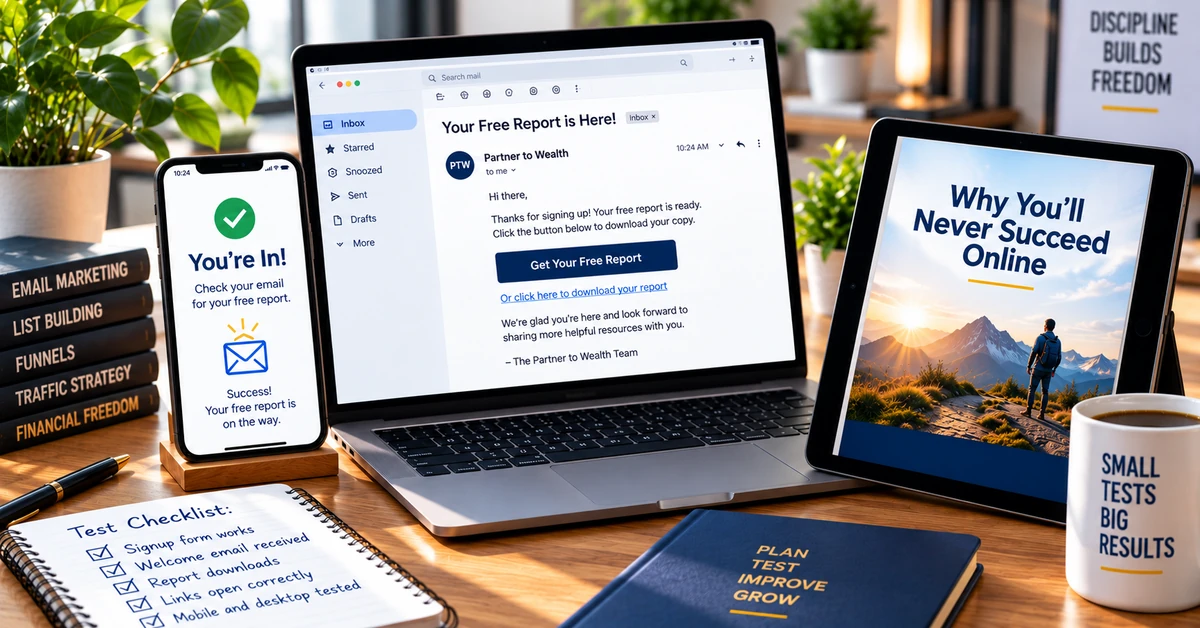
Before relying on the automation, subscribe to the funnel yourself using a test address.
Check the experience from beginning to end:
Testing the sequence as a subscriber can reveal problems that are easy to miss while looking only at the email editor.
A broken download link in a beautifully written email is still a broken subscriber experience.
Email marketing also comes with responsibilities.
In the United States, when an email has a commercial primary purpose, the Federal Trade Commission’s CAN-SPAM compliance guidance includes requirements such as accurate sender information, non-deceptive subject lines, a valid physical postal address, and a working way for recipients to opt out of future commercial messages.
Your email platform can help provide some of the technical pieces, but using a platform does not eliminate your responsibility to send appropriate messages.
Keep your sender information accurate, describe the message honestly, and make unsubscribing straightforward.
Before activating a new lead-magnet sequence, review the first message with this checklist:
The first email after someone downloads your free report does not need to be spectacular.
It needs to be reliable.
Deliver what you promised.
Remind the subscriber why they are hearing from you.
Briefly explain what comes next.
Give them one useful action.
Then let the follow-up sequence continue the relationship one message at a time.
A good first email makes the subscriber think, “Yes, this is exactly what I signed up for.”
If you’re building your affiliate-marketing foundation and want to see the type of free resource Partner to Wealth uses to begin that relationship, you can request the free Why You’ll Never Succeed Online report here.
Subscribe to get the latest posts sent to your email.
If you found this guide helpful, please tap the Like button and share it with someone who could benefit. Every Like and Share helps more people discover Partner to Wealth.