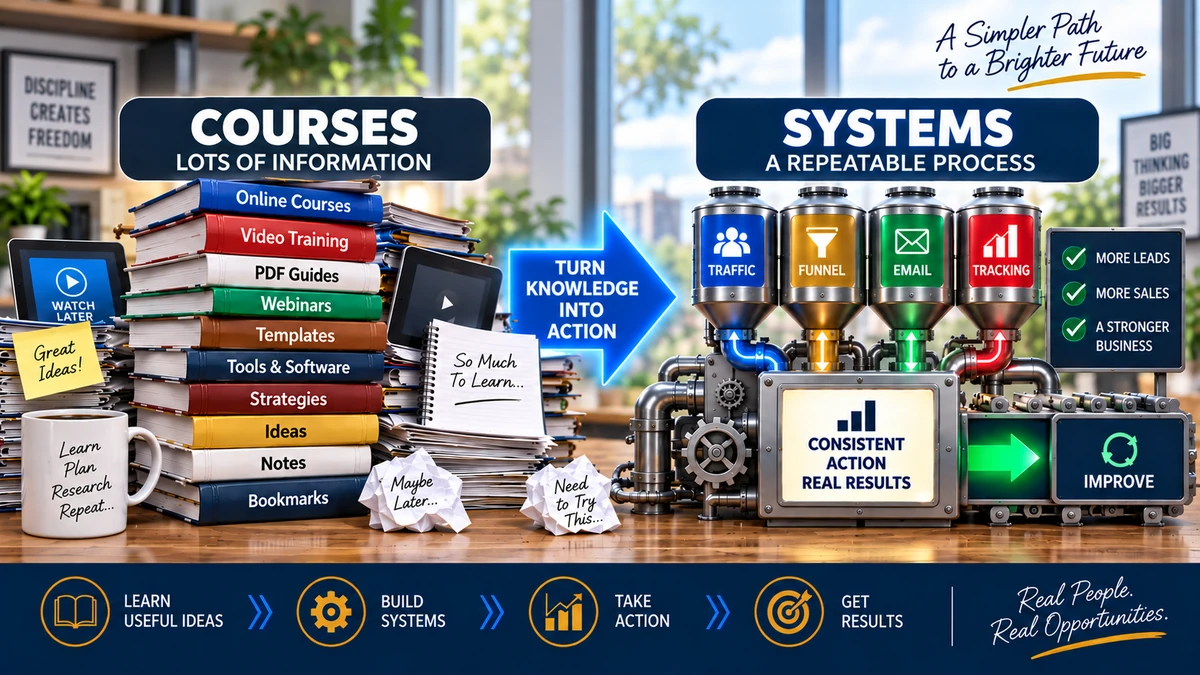
Courses can teach useful strategies, but systems turn those lessons into repeatable action. Learn why affiliate marketing systems matter more than collecting more information.
Affiliate marketing systems are what turn lessons, tools, and ideas into repeatable action.
A course can teach you something valuable. A video can explain a strategy. A checklist can show you what to do next. But none of those things automatically become part of your business simply because you consumed them.
The difference is implementation.
That is why I have become increasingly interested in building systems instead of simply collecting more information. I still use training, but I want every useful lesson to eventually answer a practical question: Where does this fit in the business I am actually building?
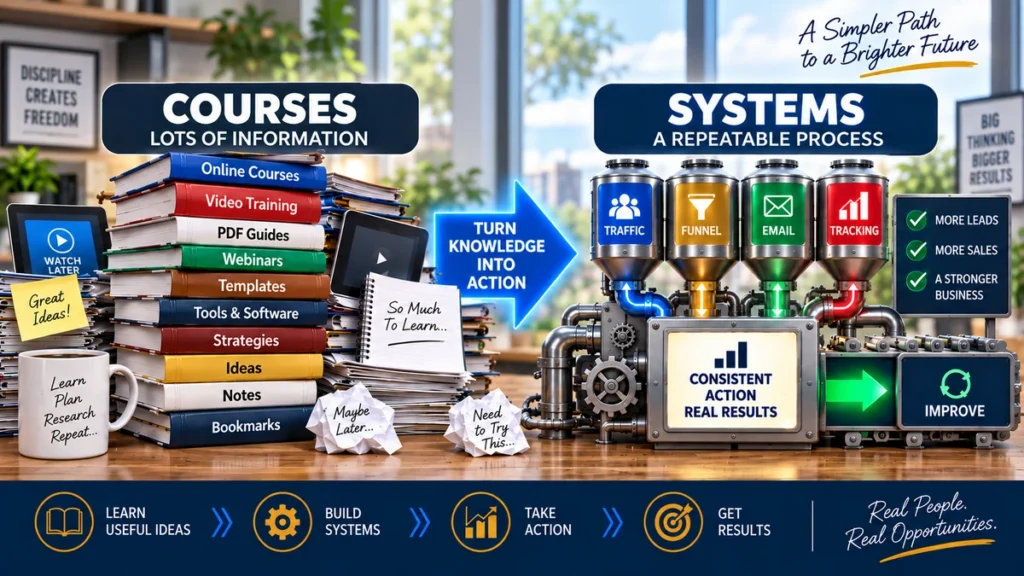
There is nothing wrong with taking courses.
Good training can shorten the learning curve, introduce ideas you would not have discovered on your own, and help you avoid obvious mistakes.
The problem starts when learning becomes disconnected from execution.
You can finish a course on traffic and still have no traffic system. You can watch ten lessons about email marketing and still have no follow-up sequence. You can study landing pages for weeks and still have no page receiving real visitors.
Knowledge becomes operational only when it changes what you consistently do.
Online business makes it extremely easy to become a collector.
You can collect:
Each item may be useful on its own. The problem is that a larger collection does not automatically create a stronger business.
Sometimes the collection itself becomes another form of procrastination. There is always another lesson to watch before launching, another tool to investigate before building, or another strategy to study before committing to the current one.
Eventually, the amount of information can make the next action less clear instead of more clear.
When I talk about affiliate marketing systems, I am not talking about complicated automation or an expensive software stack.
A system can be very simple.
It is a repeatable process that tells you what should happen, in what order, and how you will know whether it is working.
For example, a basic affiliate system might look like this:
That sequence is far more useful to me than having twenty disconnected tactics with no clear order.
I explained a similar approach in If I Had to Start Again With ClickBank Today, I Would Do This.
One reason systems are powerful is that they reduce unnecessary decision-making.
Without a system, every day can begin with the same questions:
A system gives those decisions boundaries.
If your current rule is to test one traffic source before adding another, you do not need to debate three new traffic methods every morning.
If your funnel already has a defined purpose, you do not rebuild it every time you discover another page-building technique.
That does not mean systems should never change. It means changes happen for a reason rather than because something new caught your attention.
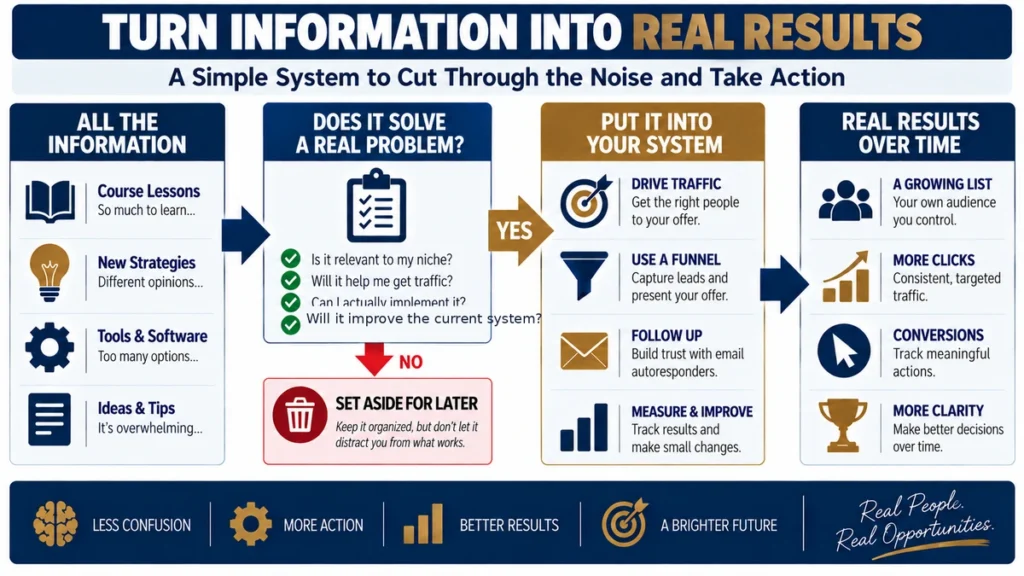
Once you have a system, it becomes much easier to decide whether another course, lesson, or resource deserves your time.
Instead of asking, “Is this training good?” I can ask more useful questions:
Those questions turn education into evaluation.
ClickBank itself maintains an Affiliate Resource Center covering areas such as getting started, traffic, affiliate websites, marketplace use, and promotion. Resources like these can be useful, but the important step is deciding which information belongs in the process you are actually executing.
A repeatable process also makes measurement easier.
If you change your offer, traffic source, landing page, email sequence, targeting, and headline at the same time, it becomes difficult to understand why the outcome changed.
A system encourages more controlled improvement.
You can identify where people are dropping out, change one meaningful part, and then compare what happens next.
That turns tracking from a collection of numbers into a decision-making tool.
Our Partner to Wealth Resources page includes several of the platforms currently being used for funnels, email, and other parts of that operating system.
Motivation is useful, but it is unreliable.
There will be days when learning something new feels exciting and days when checking links, reviewing campaign data, writing follow-up emails, or improving an old page feels less exciting.
A system gives the work continuity even when the individual task is not particularly interesting.
You know what comes next because the process already exists.
That matters because many of the activities that strengthen an affiliate business are repetitive by nature:
The repetition is not necessarily a flaw. Often, repetition is the system working.
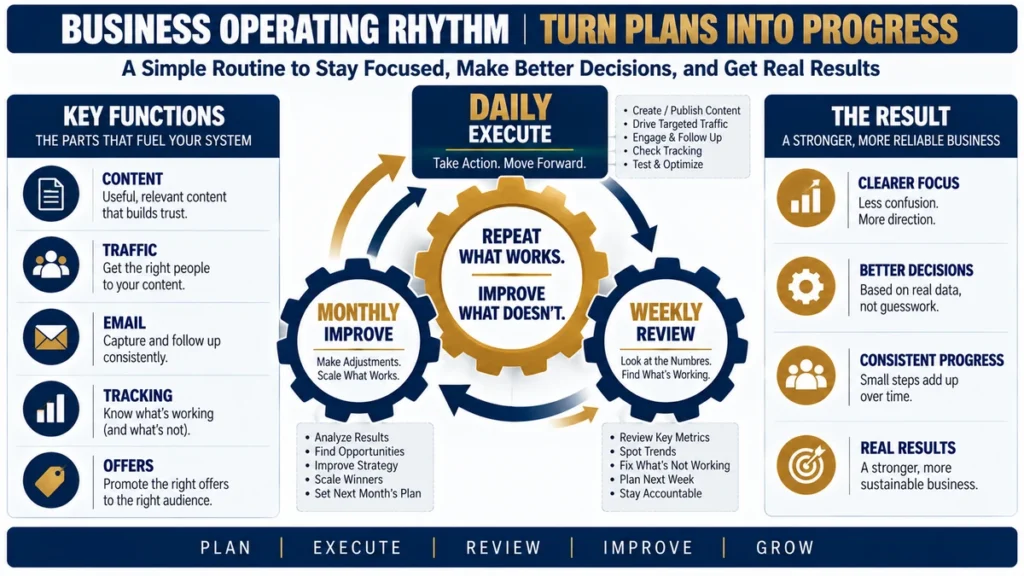
This is why I do not actually see courses and systems as enemies.
The best outcome is when useful training becomes part of a working system.
You might learn a better method for evaluating offers and add that method to your campaign checklist.
You might learn a better way to structure email follow-up and update your autoresponder process.
You might discover a tracking practice that gives you better visibility into your traffic and make it part of every future campaign setup.
At that point, the course has done its job. The information has moved from something you watched into something the business now does.
Before adding another training program, I would ask myself five questions:
That last question matters.
Every new course competes for time and attention with the systems you are already trying to build.
I joined the ClickBank Profit Club free membership because it is relevant to a part of the business I am already working on.
My objective is not to replace everything I am doing with another program. It is to evaluate the training, implement useful ideas where they fit, and ignore anything that does not improve the current system.
If you want a straightforward overview first, read The ClickBank Profit Club Explained in Plain English.
If you want to investigate the membership for yourself, you can use the link below.
Affiliate disclosure: The link above is an affiliate link. Partner to Wealth may earn a commission from qualifying purchases or activity at no additional cost to you.
Courses can teach you what is possible. Systems determine what actually gets repeated.
I would rather have a small number of useful ideas working together than a huge library of strategies that never leave the notebook.
The goal is not to stop learning. The goal is to make learning serve execution.
When a useful lesson becomes part of a repeatable process, it stops being information you consumed and starts becoming an asset the business can use again and again.
Subscribe to get the latest posts sent to your email.
If you found this guide helpful, please tap the Like button and share it with someone who could benefit. Every Like and Share helps more people discover Partner to Wealth.